
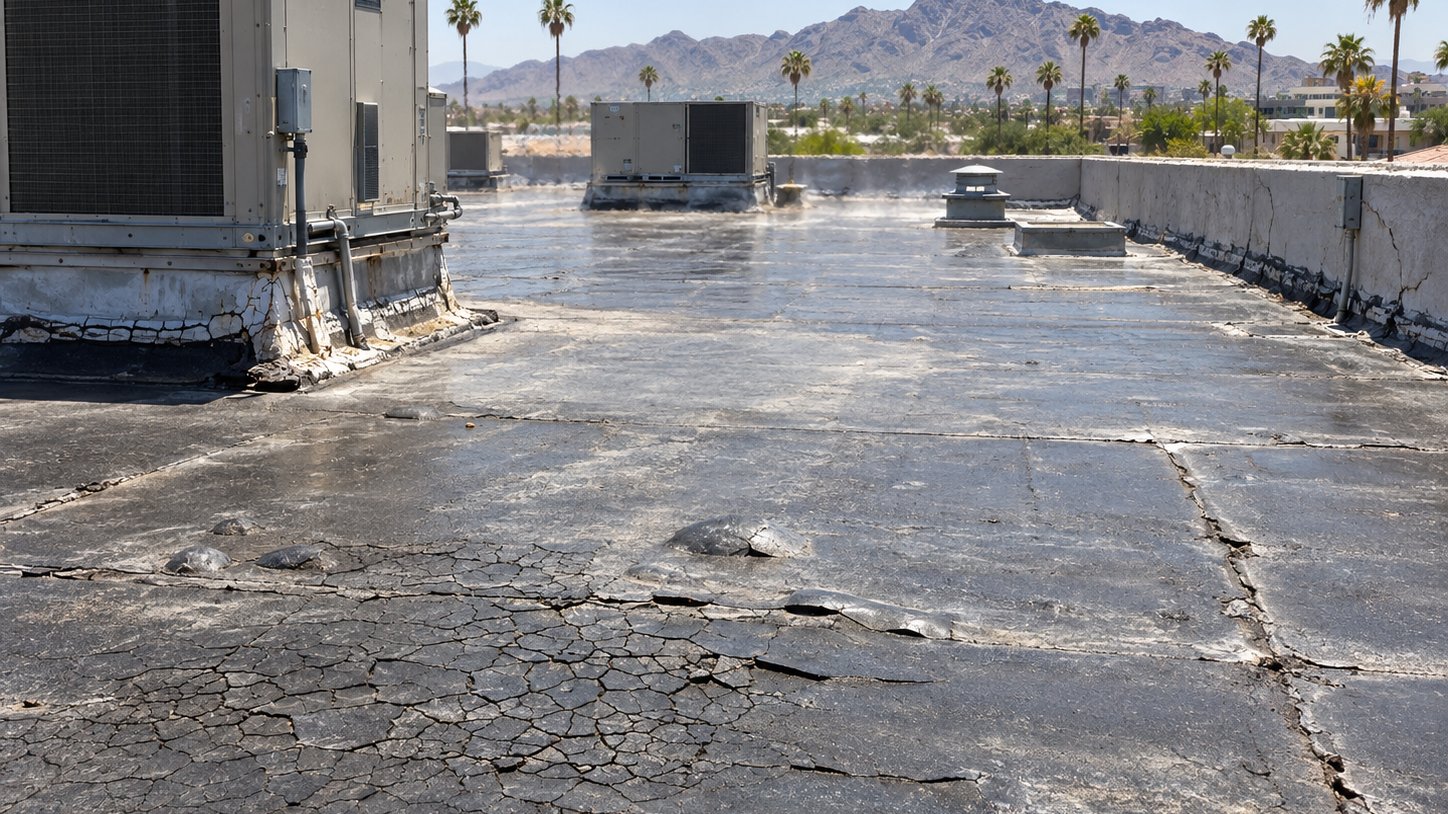
When I walk a commercial roof in October, I'm not mainly looking for storm damage. I'm looking at what five months of desert sun did to it. Heat rarely causes a leak by itself. What it does is make the roof brittle, pull seams apart, dry out sealants, and wear down coatings. Then the next rain gets in.
The short version: Arizona heat damages commercial roofs in five ways: UV breakdown, daily expansion and contraction, drying out and turning brittle, blistering, and failure of sealants at penetrations. All five can be slowed down. None of them fix themselves.
Phoenix heat is getting worse, and roofs feel it first
These numbers explain why a roof that lasts 20 years in the Midwest may get 12 to 15 here. In 2024 Phoenix had 113 days in a row at or above 100°F. The previous record, set in 1993, was 76 days (AZCIR). The same year had 70 days at or above 110°F, compared with a normal of about 21, and it was the hottest year on record in Phoenix (KJZZ).
The roof surface gets far hotter than the air. According to Lawrence Berkeley National Laboratory's cool roof guidelines, dark roofs in full sun can exceed 150°F. At night in the desert, the same surface can cool off by 60 to 90 degrees. That swing happens every day, all summer long.
NRCA research on solar heating and thermal movement found that membrane temperature depends mostly on surface color and reflectivity. That's why white and reflective roofs hold up better here, and why a roof whose coating has worn through starts aging faster.
5 ways extreme heat damages commercial roofs in Arizona
1. UV breakdown of the top surface
UV light breaks down the top layer of every roofing material. On foam roofs, you see it as chalking and thin spots in the coating. On TPO it shows up as surface crazing, and on built-up and modified bitumen roofs the granules come loose. The coating is the part that takes the UV. Once it wears through, the sun starts damaging the foam or membrane underneath, and that damage costs several times more to fix.
2. Expansion and contraction every day
Roofing materials expand in the afternoon and shrink overnight. Do that 150 or more times a season and the stress collects where the roof changes direction or material: seams, perimeter edge metal, parapet walls, and the corners of HVAC curbs. That's where most of the split seams and pulled flashings we find in the fall are.
3. Drying out and turning brittle
Asphalt roofs (built-up and modified bitumen) and some older single-ply membranes contain oils and plasticizers that keep them flexible. Constant heat bakes those out. The material shrinks, then cracks into an alligator-skin pattern like the one in the photo above. Once a roof is brittle, you can't make it flexible again. A coating may buy some time, but only if the roof is still watertight underneath.
4. Blistering from trapped moisture
When moisture or air is trapped between layers, heat turns it to vapor that expands and pushes the layers apart. On a 160°F roof surface, that pressure builds every afternoon. Small blisters grow, split open, and let water into the insulation. A blister isn't cosmetic. It tells you there's moisture inside the roof, which is why we recommend a moisture scan before anyone quotes a recoat.
5. Sealant failure at penetrations
Caulk, pitch pans, and mastic are usually the first things to fail in Phoenix heat. They shrink, pull away, and crack, most often around HVAC curbs, plumbing vents, conduit, and satellite mounts. Most commercial roofs in the metro have a dozen or more penetrations. In my experience, more leak calls start at penetrations than anywhere else on the roof.
How heat damage shows up on each roof system
Every system handles heat differently. This table shows what we usually find on each type during fall inspections across Phoenix, Chandler, Mesa, and Scottsdale.
Why heat damage and monsoon season go together
Heat does its damage from May through September. Monsoon season officially runs June 15 through September 30, with the heaviest storms usually in July and August, right as the roof is at its weakest. A seam that opened in June, or caulk that pulled away from a curb in July, is exactly where wind-driven rain gets in during an August storm.
That's why so many Phoenix leak calls come after the first big storm of the year. The storm usually didn't cause the damage. It found damage the heat had already done. It's also why October is the best month to inspect: summer is over, the damage is visible, and you have time to fix it before winter rain and next year's heat.
What heat-related repairs cost when you catch them early vs late
Heat damage gets more expensive the longer it waits. These are typical 2026 Phoenix metro price ranges from a licensed contractor:
How to protect your commercial roof from Arizona heat
- Inspect twice a year. Once in spring before the heat, and once in October after monsoon season. Ask for mil-thickness readings, seam probing, and photos of every penetration.
- Keep the surface reflective. Recoat foam and coated roofs before the coating wears through, not after. White, reflective surfaces run far cooler. ENERGY STAR-labeled roof products have to meet EPA standards for solar reflectance and how well they hold up.
- Reseal penetrations every year. HVAC curbs, vents, and conduit should get fresh sealant or proper flashing each fall. It's the cheapest leak prevention you can buy.
- Keep drains and scuppers clear. Water that sits on a heat-damaged roof finds every crack. Clear the drains before and after monsoon season.
- Scan for moisture before any recoat. Blisters and soft spots mean water may be trapped inside. Coating over it traps the problem and can void the warranty.
- Choose a system built for heat when you replace. Reflective TPO, foam with silicone, or a coated system are all good choices here. The U.S. Department of Energy says a white roof on a commercial building can save up to $0.20 per sq ft each year in energy costs, and a cool roof can cut a single-story building's air-conditioning use by up to 15% in hot climates.
Watch out: Be skeptical of any contractor who says a coating will "restore" a brittle, cracked, or wet roof. A coating protects a roof that's still sound. It can't bring back a roof the heat has already ruined.
Frequently asked questions
How hot does a commercial roof get in Phoenix?
Dark roof surfaces in full sun can go above 150°F, while white reflective roofs run much cooler. On a 115°F day, the difference is large enough to change how fast the roof ages.
Does heat damage from Arizona summers void a roof warranty?
Normal weathering usually isn't covered, but it doesn't void the warranty either. Skipping required maintenance, like resealing penetrations and clearing drains, can void it. Keep inspection records.
Which commercial roof holds up best in Arizona heat?
Reflective systems. Spray foam with a well-kept silicone or acrylic coating and white TPO both do well here. Dark asphalt roofs age fastest unless they're coated.
When is the best time to inspect for heat damage?
October. The summer's damage is visible, monsoon season is over, and you have months to make repairs before next summer.
Related reading
- What Chalky Foam Roofs Actually Mean (And When to Worry): how to read UV wear on a foam roof
- HVAC Curbs and Commercial Roof Leaks: The Silent Killer: where heat-dried sealant turns into leaks
- When to Replace vs Recoat: A 5-Minute Decision Guide: the 6-point test once heat damage is found
- End of Summer Roof Inspection: What Phoenix Commercial Buildings Need: the full post-monsoon checklist