
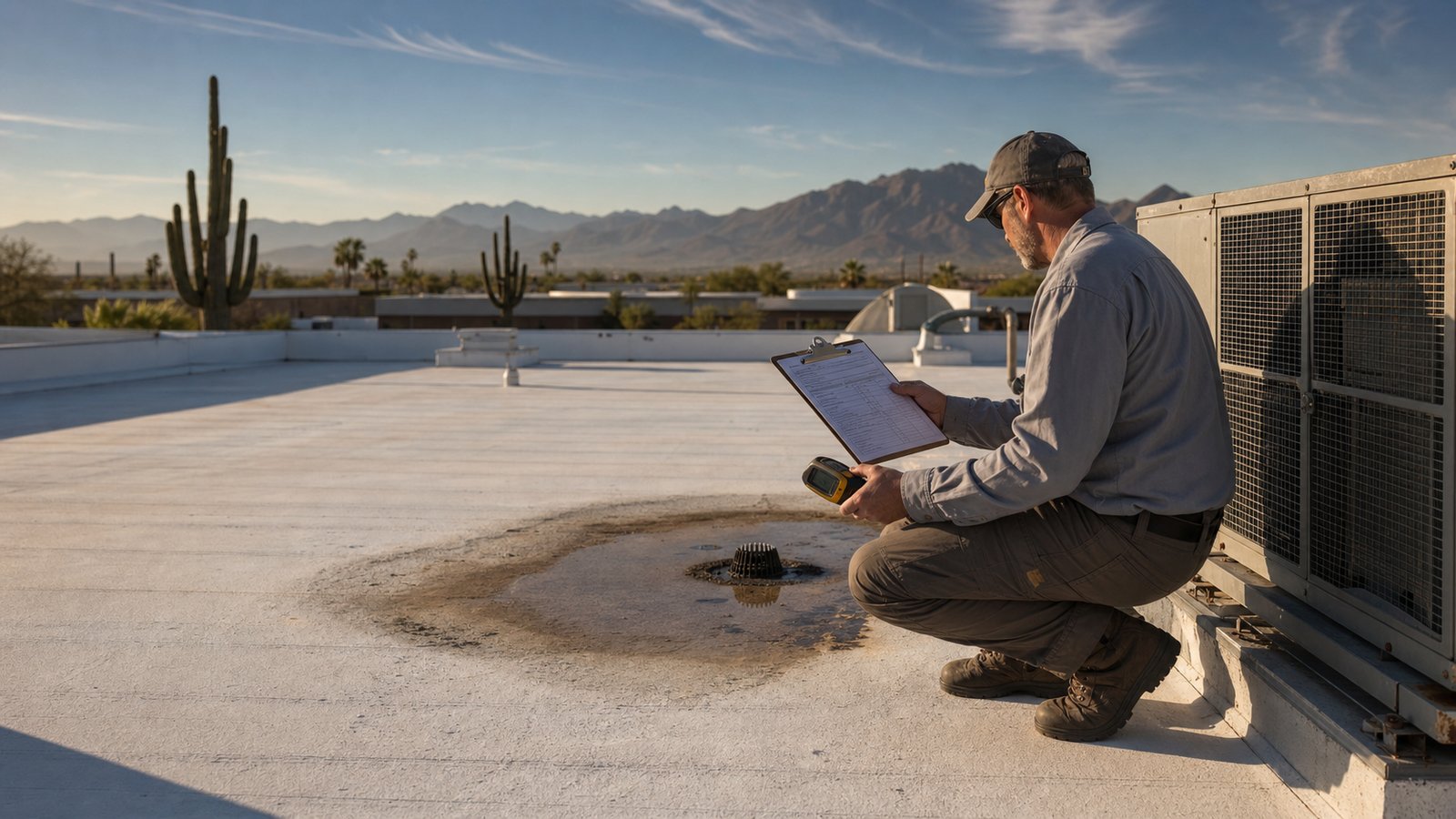
I get more inspection calls between September 15 and October 31 than any other 45-day window of the year. Half of them come from property managers who noticed something during monsoon — a tenant leak, a stain, a dislodged parapet cap after a haboob — and half come from owners who just want a clean bill of health before the fiscal-year reserve fund review. Both are the right instinct. The end-of-summer commercial roof inspection is the single highest-value inspection Phoenix commercial buildings can get, and getting it wrong or delaying it into December costs owners and property managers real money in denied claims and voided warranties.
If you only remember one thing: the National Weather Service officially closes Phoenix monsoon season on September 30. Insurance adjusters accept a written condition report dated within 30 to 60 days of the storm event as proof of storm-related damage. Wait until December to inspect, and the same damage becomes "wear and tear" — excluded from nearly every commercial policy in the state.
Why September and October beat every other inspection window
Three things line up in the 45 days after monsoon season closes and never line up again the rest of the year.
Storm-cause defensibility. Monsoon 2026 delivered 60-70 mph gusts, hail across multiple East Valley municipalities, and 2-inch-per-hour rainfall bursts. Every commercial roof in the metro took a beating. In September and early October, the damage is documented easiest and covered fastest because the storms are still in recent memory — for the adjuster, the news cycle, and the National Weather Service archive. By December, you're asking a claim adjuster to accept a chain of causation that stretches back four to five months.
Roof access is safe. July and August roofs in Phoenix hit 160-180°F surface temperatures. TPO membranes go soft, silicone coatings tack, foam gets pliable underfoot. Walking a roof in those conditions is unsafe and destructive — every footprint on soft TPO is a permanent record. September afternoons come down to the 90s and October drops into the 80s, which is the first stretch of the year where a proper walk-through with a mil gauge and moisture scanner doesn't damage the roof itself.
Fiscal-year timing. Most Arizona property management companies run October-through-September fiscal years. An inspection report dated September 20 becomes a line item in the next year's reserve fund conversation. Waiting until January means the number goes into the following fiscal year — a full 12 months of exposure later.
What a real end-of-summer inspection includes
The end-of-summer roof inspection is not a walkaround. It's a diagnostic. Here's the field sequence I run on every commercial roof over 10,000 square feet in Phoenix, Chandler, Mesa, Tempe, Gilbert, Scottsdale, Glendale, and Peoria between September 15 and October 31.
- History review, before I climb. Every tenant leak report from July and August. Every National Weather Service Phoenix alert for wind, hail, or rainfall over the building's ZIP. The roof age, last recoat date, and any active manufacturer warranty. Ten minutes of paperwork saves an hour of misdiagnosis on the roof.
- Mil-thickness readings in six-plus locations. Mapped on a roof diagram. On any coated or membrane roof over 5 years old, mil thickness tells you exactly how much service life is left. Six readings is a floor; twelve is standard on 20,000+ square foot roofs.
- Infrared moisture scan on roofs over 8 years old. Visual inspections miss wet insulation. Wet insulation kills recoats. The International Institute of Building Enclosure Consultants (IIBEC) considers infrared thermography a standard of care on any low-slope commercial roof approaching mid-service life.
- Photo documentation of every HVAC curb, drain, seam, penetration, and parapet. Timestamped. Referenced to the roof diagram so the adjuster (and the next owner) can locate every finding.
- Ponding-water tracing at drains. Where slope has settled, water pools. Where it pools for 48+ hours, the coating or membrane fails first. The National Roofing Contractors Association (NRCA) flags 48 hours as the operative threshold for ponding-water damage.
- Hail-strike and wind-lift documentation. Every roof coating and every membrane manufacturer has hail damage criteria. Get the strikes photographed and mapped now; miss them and they disappear under UV chalking over the next year.
- A written condition report within 5 business days. With the AZ ROC license number and inspection date. Verbal summaries don't win claims.
Honest end-of-summer inspection costs in Phoenix
The Phoenix commercial roofing market is transparent about inspection pricing if you know what to ask. Here's what I actually see contractors charging across the metro in fall 2026, along with what each service produces.
Free visual with mil readings
- Phoenix cost
- $0
- What you should get
- 6+ mil readings, photo log, short written summary, estimate for any recommended work.
Standalone infrared moisture scan
- Phoenix cost
- $200-$600
- What you should get
- Wet-area map on a roof diagram, thermographic images referenced to zones, moisture-content ratings by area.
Paid full condition assessment
- Phoenix cost
- $350-$1,200
- What you should get
- Everything above + a written 5-10 page report with recommendation, dollar range, and signed AZ ROC license number.
Post-storm insurance-adjuster package
- Phoenix cost
- $500-$1,800
- What you should get
- Full condition assessment + adjuster-ready photo log + narrative report tying findings to specific NWS storm events.
Drone aerial inspection (add-on)
- Phoenix cost
- $150-$400
- What you should get
- High-resolution overhead imagery of the entire roof plane, useful on multi-building portfolios and hard-to-access roofs.
The $400/$50,000 rule. The most expensive Phoenix commercial roofing mistake we see every fall is a property owner recoating a roof that has hidden wet insulation. The recoat traps moisture, delaminates within 18-24 months, and requires a full tear-off. A $400 infrared moisture scan before the recoat prevents that $50,000+ tear-off. If your last inspection didn't include a moisture scan and the roof is over 8 years old, the number-one thing to book this fall is that scan.
The end-of-summer damage patterns we actually see in Phoenix
Every fall inspection I run in the East Valley finds a variation of the same six issues, in roughly the same rank order. If your property manager is telling you the roof is fine after a Phoenix monsoon and none of these were checked, they didn't inspect it.
- HVAC curb sealant cracking (~40% of fall findings). Mechanical vibration all summer combined with 60-70 mph monsoon gusts opens hairline cracks in butyl and urethane sealant. The leak may not show up until the next storm, but the failure started in July.
- Roof-drain restrictions. Monsoon debris plus haboob dust plugs internal drains. A drain that flowed fine in June is 40% blocked by October. Ponding around blocked drains destroys coatings and membranes within 12-18 months.
- Parapet coping lift and sealant joint separation. 60+ mph gusts lift metal coping enough to open sealant joints. The lift may reseat visually, but the joint is now a monsoon-water entry point until the next recoat.
- Foam topcoat erosion. UV plus hail plus mechanical foot traffic during HVAC service calls. Thin spots concentrate around rooftop units and along HVAC-technician walk paths.
- Ponding-water expansion. Where slope has settled by a fraction of an inch, water pools longer. Small ponds in June become larger ponds in September as monsoon rain accelerates crickets and drain-body degradation.
- Skylight gasket UV failure. The gasket around the polycarbonate dome dries out over the summer. The first cold-front rain in October is when the drips start. Inspect gaskets in September before the cold-front rains reveal them.
How the fall inspection interacts with your warranty and insurance
The end-of-summer inspection is not a nice-to-have compliance item. It's the piece of paper that determines whether two other very expensive documents work when you need them.
Manufacturer warranties. GAF, Versico, and most NDL manufacturers require documented annual or semi-annual inspections by a certified contractor to keep the warranty in force. Miss the inspection, and even a legitimate manufacturing defect claim can be denied. Every fall we find at least a handful of Phoenix commercial roofs where the manufacturer NDL is void because the last documented inspection was 3+ years ago. Reinstating a voided warranty costs $500-$2,500 in inspection and remediation fees — if the manufacturer will reinstate at all.
Insurance policies. The Arizona Department of Insurance and Financial Institutions confirms that Arizona commercial property policies typically require notification of storm damage in a reasonable time frame — most carriers set that at 30-60 days from the storm event. A September or October inspection report, timestamped and signed, is what makes the notification meaningful. Wait until December and the adjuster's opening move is to argue pre-existing wear and tear, which is excluded from nearly every commercial policy.
The 30-60 day rule is the difference between a paid claim and a denied claim. Every claim adjuster in Arizona has a rejection template that starts with "no evidence of damage was documented within a reasonable time frame following the storm event." The September inspection is your defense against that letter.
For a deeper walkthrough of the exact documentation adjusters look for, our full guide is at Commercial Roof Insurance Claim Documentation: A Phoenix 2026 Guide.
How to prep your building before the inspector arrives
Ninety minutes of prep in the property management office cuts an hour off the inspection itself and dramatically improves the quality of the written report.
- Pull every tenant leak complaint from July and August. Even the ones that never turned into a call to the property management office. Suite numbers, dates, ceiling grid locations if known.
- Print NWS Phoenix alerts for wind (50+ mph), hail, and heavy rainfall (1"+ per hour) over the building's ZIP code between June 15 and September 30. The NOAA Storm Prediction Center storm reports is the canonical source.
- Pull the roof file. Original installation date, last recoat date, active manufacturer warranty certificate, any prior inspection reports.
- Roof access setup. Ladder, hatch key, HVAC unit locations, any tenant-notification requirements. Fall inspection days need to start early — 7 AM before the roof heats up.
- List of prior known issues. Repairs done, patches applied, coating touch-ups. The inspector needs to know what's original versus repaired.
What to do with the inspection report once you have it
The report is the deliverable that keeps producing value long after the inspection day. Five specific uses that Phoenix property managers should extract from every fall inspection.
- Reserve fund calibration. The recoat-or-replace recommendation with dollar range becomes the fiscal-year 2027 reserve-fund line. Do this in October, not January.
- Warranty defense file. A copy goes to the manufacturer to keep NDL coverage active. Another copy goes into the building's operations file with the warranty certificate.
- Insurance pre-storm proof. If any monsoon-2026 damage becomes a claim later, the September report is Exhibit A. Send it to the carrier as an FYI even if you're not filing yet.
- Second-bid document. When you get a competing recoat or repair estimate, the fall report is what a second contractor bids against. Prevents the "you need everything replaced" upsell.
- Tenant transparency. A one-page summary sent to major tenants after monsoon builds trust and reduces the number of "is the roof going to hold?" calls all winter.
Red flags in fall inspection quotes
Storm chasers and unlicensed operators surge into the Phoenix metro through September and October. Vet them the same way you vet an emergency contractor.
- Same-day estimate with the inspection. A real inspection needs 5 business days to produce a proper report. Same-day is a sales call, not an inspection.
- No mil-thickness gauge on the truck. Ask what tools they'll bring. If mil gauge and moisture scanner aren't on the list, walk away.
- No AZ ROC license number. Verify it in real time at roc.az.gov. Commercial roof work requires CR-42.
- "Storm damage guaranteed" pitch. No legitimate contractor can promise the adjuster will pay before the inspection. That's the number-one sign you're dealing with a storm chaser.
- Cash-only or heavily discounted "today only" pricing. Reputable Phoenix contractors don't need same-day close pressure to book fall inspections.
Frequently asked questions
When should Phoenix commercial buildings schedule an end-of-summer roof inspection?
Book between September 15 and October 31. The National Weather Service closes monsoon on September 30, and adjusters accept written condition reports dated within 30-60 days of the storm event as proof of storm-related damage. December inspections lose that timeline argument.
What is included in a proper end-of-summer commercial roof inspection?
Mil-thickness readings in six or more locations mapped on a diagram, infrared moisture scan on roofs over 8 years old, photo documentation of every HVAC curb, drain, seam, penetration, and parapet, ponding-water tracing, hail and wind-lift documentation, and a written condition report within 5 business days with a monitor/repair/recoat/replace recommendation and a dollar range.
How much does an end-of-summer commercial roof inspection cost in Phoenix?
$0 for a legitimate free visual with mil readings, $200-$600 for a standalone infrared moisture scan, $350-$1,200 for a full paid condition assessment, and $500-$1,800 for a post-storm insurance-adjuster package. A $400 moisture scan can prevent a $50,000+ tear-off caused by coating over hidden wet insulation.
Does insurance require an end-of-summer inspection to file a monsoon damage claim?
Most Arizona commercial property policies do not require it, but every adjuster expects one. Practically, you need a written inspection report dated within 30-60 days of the storm event. Wait longer and the adjuster's opening move is to argue the damage was pre-existing wear and tear — which is excluded from coverage under nearly every commercial policy in Arizona.
What are the most common end-of-summer roof problems on Phoenix commercial buildings?
HVAC curb sealant cracking (~40% of fall findings), roof-drain restrictions from monsoon debris and haboob dust, parapet coping lift, foam topcoat erosion around HVAC service paths, ponding-water expansion where slope has settled, and skylight gasket UV failure. All six are documented by a proper inspection and respected by insurance adjusters.
What should be in the written report after an end-of-summer inspection?
Mil-thickness readings mapped on a roof diagram, moisture scan results with a wet-area map, timestamped photos of every defect referenced by zone, an overall condition rating with roof age and last recoat date, a monitor/repair/recoat/replace recommendation with a dollar range, and the AZ ROC license number of the inspecting contractor with a signature and inspection date.
Related reading
- Commercial Roof Inspections: What Property Managers Should Demand — the 9-point field checklist for what a real inspection produces
- Commercial Roof Insurance Claim Documentation: A Phoenix 2026 Guide — the full evidentiary playbook once damage is documented
- Phoenix Monsoon Season Roof Prep: HOA & Property Manager Checklist — the pre-season companion to this post-season inspection
- Commercial Roofing Warranties: Manufacturer vs Contractor — how the fall inspection keeps both types of warranty in force