
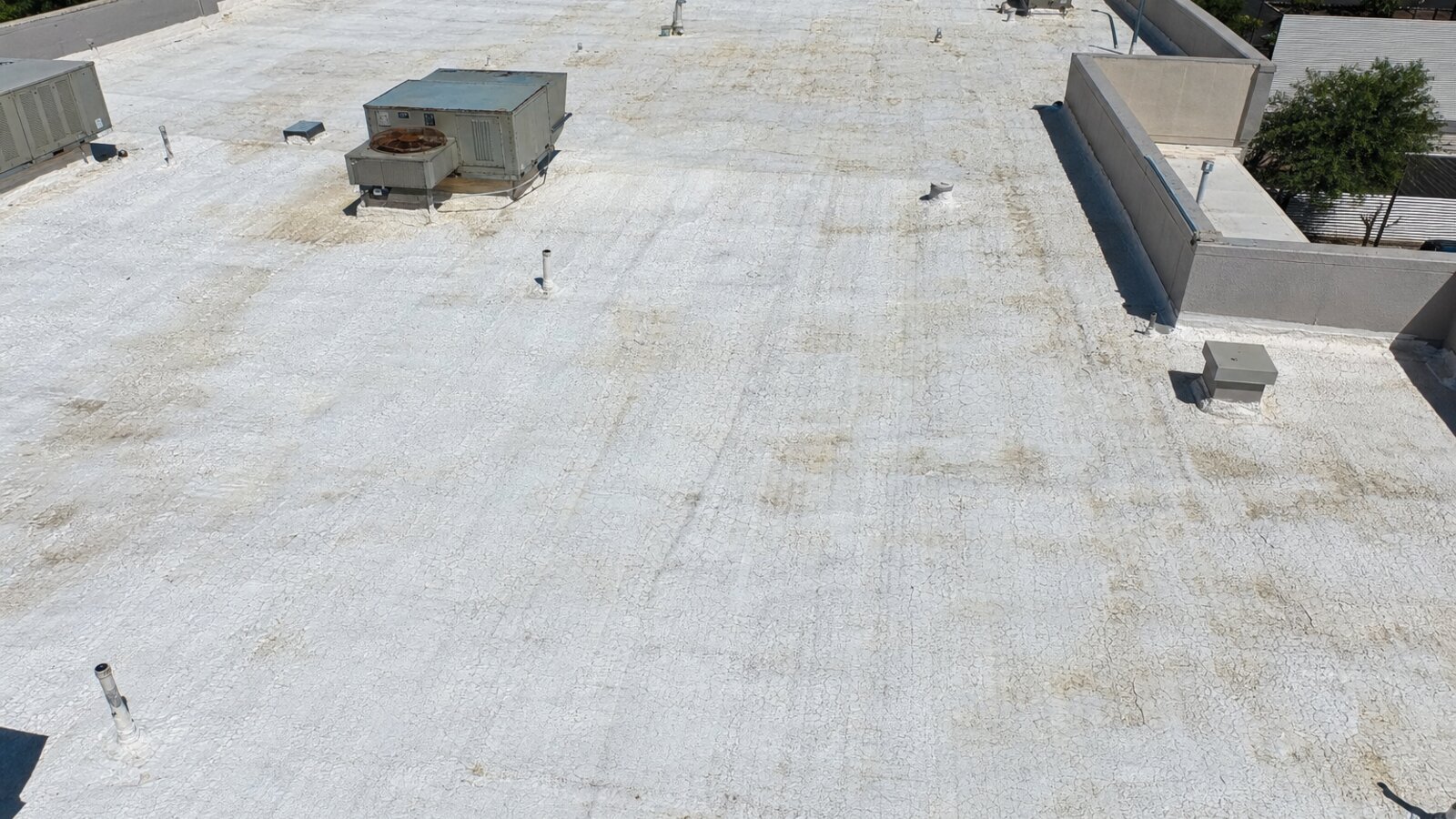
First — what a chalky foam roof actually is. Spray polyurethane foam (SPF) roofing has two layers that matter: the closed-cell foam itself, which is tan or amber when new and does most of the insulation and waterproofing, and an elastomeric topcoat on top of it (usually acrylic or silicone, sometimes polyurethane) that reflects UV, protects the foam from sunlight, and gives the roof its white color. Foam is fantastic underneath but it is not UV-stable on its own. The topcoat is what makes the whole system last in Phoenix.
The one-sentence answer: chalking is the elastomeric topcoat breaking down under Phoenix UV. It is normal aging up to a point and it is a 60-to-180-day warning past that point. The rub test below tells you which side of the line you are on.
Why every Phoenix foam roof eventually goes chalky
Phoenix sits under some of the highest annual UV loads in the continental United States. According to NOAA Phoenix climate records, we average around 300 days of measurable sunshine and summer surface temperatures on a white commercial roof commonly hit 150–170°F. Elastomeric coatings are engineered to slowly sacrifice their binder to UV so the pigment underneath keeps reflecting. The visible byproduct is a fine white powder — that's chalking. Every acrylic and even most silicones will chalk to some degree. It's not a defect. It's the coating doing its job.
The problem is not that chalking happens. The problem is that once chalking accelerates, the topcoat is thinning fast, and thin topcoat is a countdown to exposed foam. Once the foam itself is UV-exposed, it starts to crumble, and at that point you're no longer looking at a recoat — you're looking at cutting out damaged foam, respraying, and coating. That's roughly 3–4x the cost of catching it at the chalky stage.
The 5-minute rub test: chalking severity, decoded
You do not need a coating inspector to sort a chalky foam roof into "watch it" versus "recoat now." Take a clean piece of dark cloth or a black nitrile glove up onto the roof, press it firmly against the coating, and drag it about six inches. What comes off tells you where you are on the aging curve.
Light dust, barely visible
- What it means
- Normal UV aging, coating is still doing its job.
- Action window
- 3–5 years to next recoat.
Clear white smear on cloth
- What it means
- Topcoat thinning, mils dropping toward minimum.
- Action window
- 12–24 months — schedule recoat.
Heavy chalk with hairline cracks
- What it means
- Coating is failing, moisture path opening.
- Action window
- 60–180 days — recoat before monsoon or next summer.
Tan/yellow foam visible under smear
- What it means
- Topcoat is effectively gone, foam itself is UV-exposed.
- Action window
- Immediate inspection — may need foam repair.
Pro tip: the corners and south-facing slopes of a Phoenix commercial roof age fastest — that's where you rub-test. If those spots are still light-dust category, the rest of the roof is fine. If those spots are already showing foam, don't waste time testing anywhere else — call for an inspection.
Chalking + these three signs means don't wait
Chalking alone is a soft warning. Chalking combined with any of these three visible signs means you're already leaking or about to be. This is where the honest-contractor math changes fast.
- Yellowing across large areas. Uniform yellow tint on the coating is UV degradation of the resin. It always precedes cracking by 6–18 months.
- Hairline surface cracking. Also called "alligatoring" or "crazing." Once cracks open in the topcoat, monsoon rain drives water directly to the foam substrate.
- Any interior ceiling stain. One stain plus a chalky roof is not a coincidence. That's a roof in the "already leaking" category — chalking just tells you why.
For the fuller list of foam-roof warning signs, see our companion post on foam roof replacement warning signs — chalking is only one of seven signals we grade on.
What a chalky foam roof recoat actually costs in Phoenix
Numbers that come out of our own bids across the metro this year, on roofs where the foam substrate is still sound and only the topcoat needs to be restored. A silicone recoat costs more up front but adds 15–20 years vs. 10–15 for acrylic, per IIBEC coating durability studies and manufacturer data from GAF liquid-applied roof coatings.
- Acrylic elastomeric recoat, 2 coats: $2.00–$3.75 per sq ft — best value if you're planning to sell or refinance within 10 years
- Silicone recoat, 2 coats: $3.25–$5.50 per sq ft — best value if you're holding the property long-term
- Full foam replacement (foam + coating): $9.00–$14.00 per sq ft — what you pay if chalking went ignored past the point of foam damage
A 10,000 sq ft roof recoated at the right moment costs $22,000–$55,000. The same roof replaced because chalking was ignored costs $90,000–$140,000. That is the entire reason we push property managers to rub-test annually. See our detailed breakdown in The True Cost of Commercial Roof Replacement in Arizona.
Frequently asked questions about chalky foam roofs
Is a chalky foam roof bad?
Light chalking on a Phoenix foam roof is normal UV wear on the elastomeric topcoat — it is not a failure. It becomes a problem when the chalking is heavy enough that the mil thickness of the topcoat drops below the manufacturer minimum, when the underlying foam starts to show through, or when hairline cracking, blistering, or yellowing appear alongside it. Chalking is the roof telling you the clock is ticking on the topcoat, not that the roof is failing today.
How do I test whether my chalky foam roof needs a recoat?
Do the rub test above. Then combine the result with a mil-thickness gauge reading — anything under 15 mils of remaining coating on a Phoenix roof warrants a professional inspection within 60 days, per NRCA technical guidance for coated SPF systems. Most reputable Phoenix commercial roofers will do a mil-gauge inspection as part of a free evaluation.
Does a chalky foam roof still keep water out?
Yes — until it doesn't. The elastomeric topcoat is what makes a foam roof waterproof. Foam itself is closed-cell and sheds water well when intact, but once the topcoat oxidizes down to nothing, UV starts degrading the foam itself, and that is when leaks appear at HVAC penetrations, parapet transitions, and drain surrounds. A chalky roof is watertight today but on a countdown, and in Phoenix that countdown accelerates every summer.
Can I just pressure wash the chalking off?
You can — and any reputable contractor will, before any recoat — but pressure washing is preparation, not a solution. Chalking is the coating itself breaking down, so removing the chalk doesn't add mil thickness back to the topcoat. Use low pressure (under 1,500 psi) and a fan tip to avoid damaging the foam substrate. If a contractor tells you a wash-and-seal in a single visit will restore a heavily chalking roof, that's a red flag — you need real recoat mils applied, not a rinse.
How often should a Phoenix foam roof be recoated?
In the Phoenix UV environment, plan on a foam roof recoat every 10–15 years for acrylic elastomeric systems and every 15–20 years for silicone, per DOE cool-roof performance data. The exact interval depends on original mil thickness, sun exposure, and whether the roof gets an annual inspection and small-repair cycle. A well-maintained Phoenix foam roof can run 40+ years across two or three recoats. A neglected one can be past saving in 15. See our detailed guide to how long foam roofs really last in Phoenix.
Related reading
- How Long Should a Foam Roof Really Last in Phoenix? — the full aging curve and what actually determines Phoenix foam-roof lifespan
- Foam Roof Replacement Warning Signs — the seven signals I grade on when deciding recoat vs. replace
- Silicone Roof Coating: How It Extends Your Commercial Roof 10–20 Years — the coating we recommend most for long-hold Phoenix commercial properties
- The True Cost of Commercial Roof Replacement in Arizona (2026) — recoat vs. replacement math by roof system