
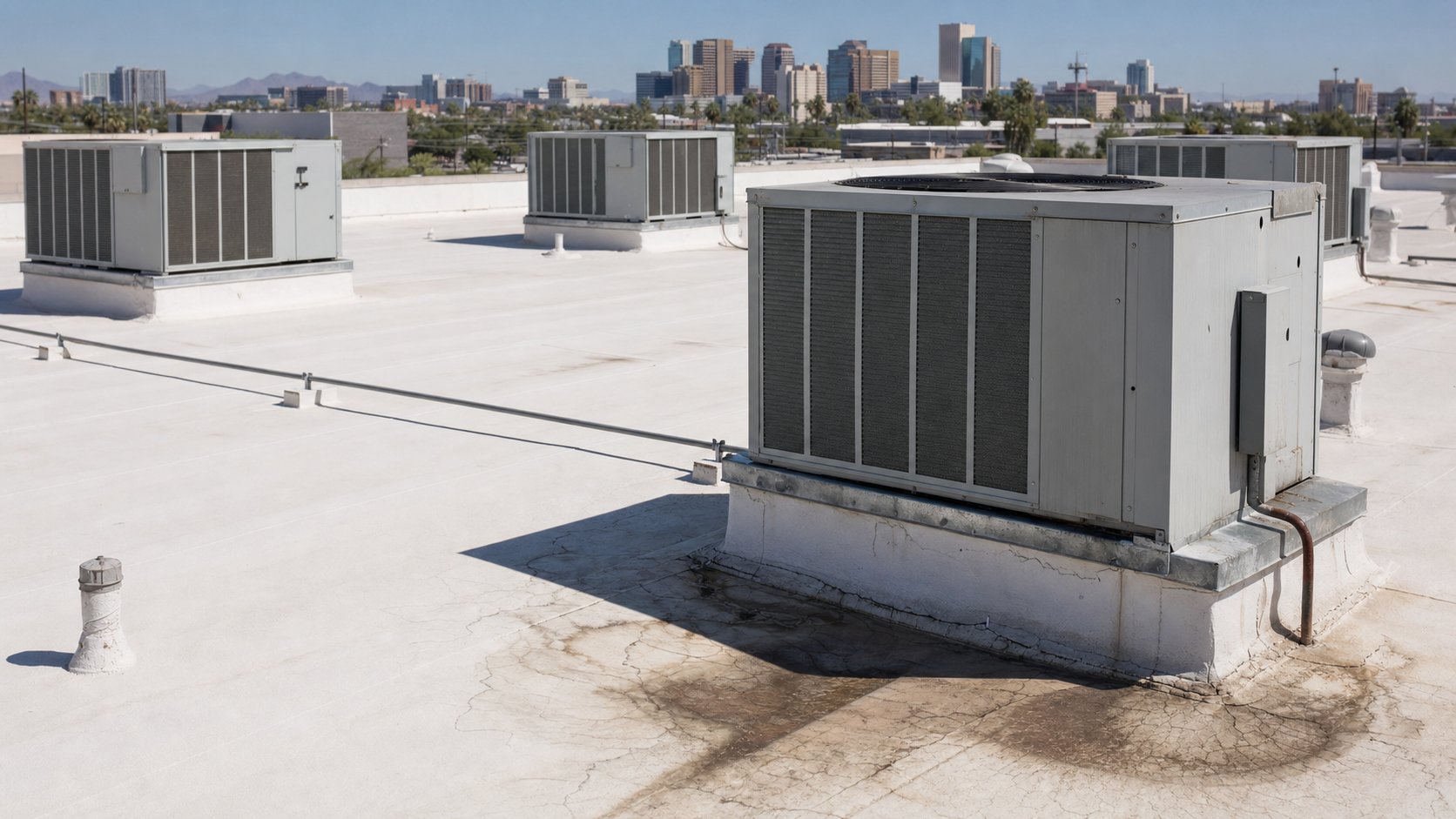
The HVAC curb roof leak in Phoenix is the most common commercial roofing failure I diagnose — more than blistered coatings, parapet cracks, or TPO seam failures. And it's the most missed. The roofer walks the field. The HVAC tech services the unit on top of the curb. Nobody inspects the eight-inch metal box in between.
The one-line answer: Walk your HVAC curbs twice a year (April and October), look for cracked sealant at the corners and screws backing out, and address anything you find before the next monsoon. Ignore it and you'll pay for interior damage 5 to 10 times the cost of the curb fix you skipped.
A curb is the raised metal box between the rooftop HVAC unit and the roof. The membrane wraps up its outside; counter-flashing on top seals against the unit. Per NRCA and IIBEC, minimum curb flashing height is 8 inches. Every Phoenix curb I see set at 4 or 6 inches leaks in 5 years or less — monsoon rain drives sideways at 40 to 60 mph and climbs anything shorter.
The 4 ways an HVAC curb roof leak starts in Phoenix
- Sealant failure at the counter-flashing. Polyurethane and butyl sealants fail in 3 to 5 years under Phoenix UV. Corner cracks open, wind-driven monsoon rain goes straight in.
- HVAC tech traffic damage. Techs step on the corner flashing every service call. Over 20+ visits, the base flashing tears — usually a small L-shape on the south or west side.
- Fasteners backing out. Phoenix rooftops swing 90 F daily. Curb metal and deck expand at different rates; screws walk out. Raised heads are direct water paths.
- Original curb set wrong. Curbs set at 4-6 inches instead of 8, or counter-flashing never installed. These leak from day one.
The 90-second HVAC curb field test
Property managers can walk their own curbs in under 5 minutes per unit. Bring gloves, a phone camera, and a spotter.
- Check the counter-flashing joint. Any crack, gap, or missing sealant is a red flag.
- Inspect every screw head. Anything raised more than 1/16 inch is backing out.
- Check the base flashing wrap. Any tear, blister, or unbonded lift is a leak in progress.
- Measure curb height. Anything under 8 inches is a design defect.
- Photograph everything with a date stamp for warranty and insurance claims.
What a real HVAC curb reflash costs in Phoenix
Phoenix metro 2026 for a licensed roofer with compatible membrane, primer, and approved sealant. Handyman "caulk-and-pray" prices are lower and worthless.
The economics that get missed: A skipped $1,200 reflash becomes a $10,000-$25,000 interior claim after two monsoons — and most commercial insurance policies exclude "long-term water damage" from neglected maintenance.
Frequently asked questions
How much does it cost to fix an HVAC curb leak in Phoenix?
$650 to $1,800 for a proper reflash. Add $800 to $2,500 if the deck is wet. Sealant chase: $150 to $350 (fails in 12-24 months). New curb-set during HVAC replacement: $1,200 to $2,800.
How do I know if a leak is coming from an HVAC curb?
If the ceiling stain is within 6 feet of a rooftop unit, the curb is the first suspect. Water tracks 3-15 feet along the deck before dropping. Hose-test each curb side for 15 minutes to confirm.
Should the HVAC company or the roofer handle a curb leak?
The roofer. HVAC service contracts exclude curb flashing, and a tech caulking a leak usually voids the roof warranty. If the unit has to be lifted, schedule the roofer to reflash the same day.
How often should HVAC curbs be inspected?
Twice a year — April (before monsoon) and October (after). Walk every curb, vent, and gas penetration. Full inspection runs $0-$1,200 in the Phoenix metro.
Related reading
- Emergency Commercial Roof Leak? Here's What to Do First — the 6-step response when you're already looking at water on the floor
- Commercial Roof Inspections: What Property Managers Should Demand — the 9-point field checklist that catches HVAC curb failures before the ceiling leaks
- Silicone vs Acrylic vs Polyurethane: The Honest Coatings Comparison — which coating actually holds up around HVAC penetrations in Phoenix
- Foam Roof Replacement Warning Signs — how HVAC curb leaks accelerate full-system foam roof failure