
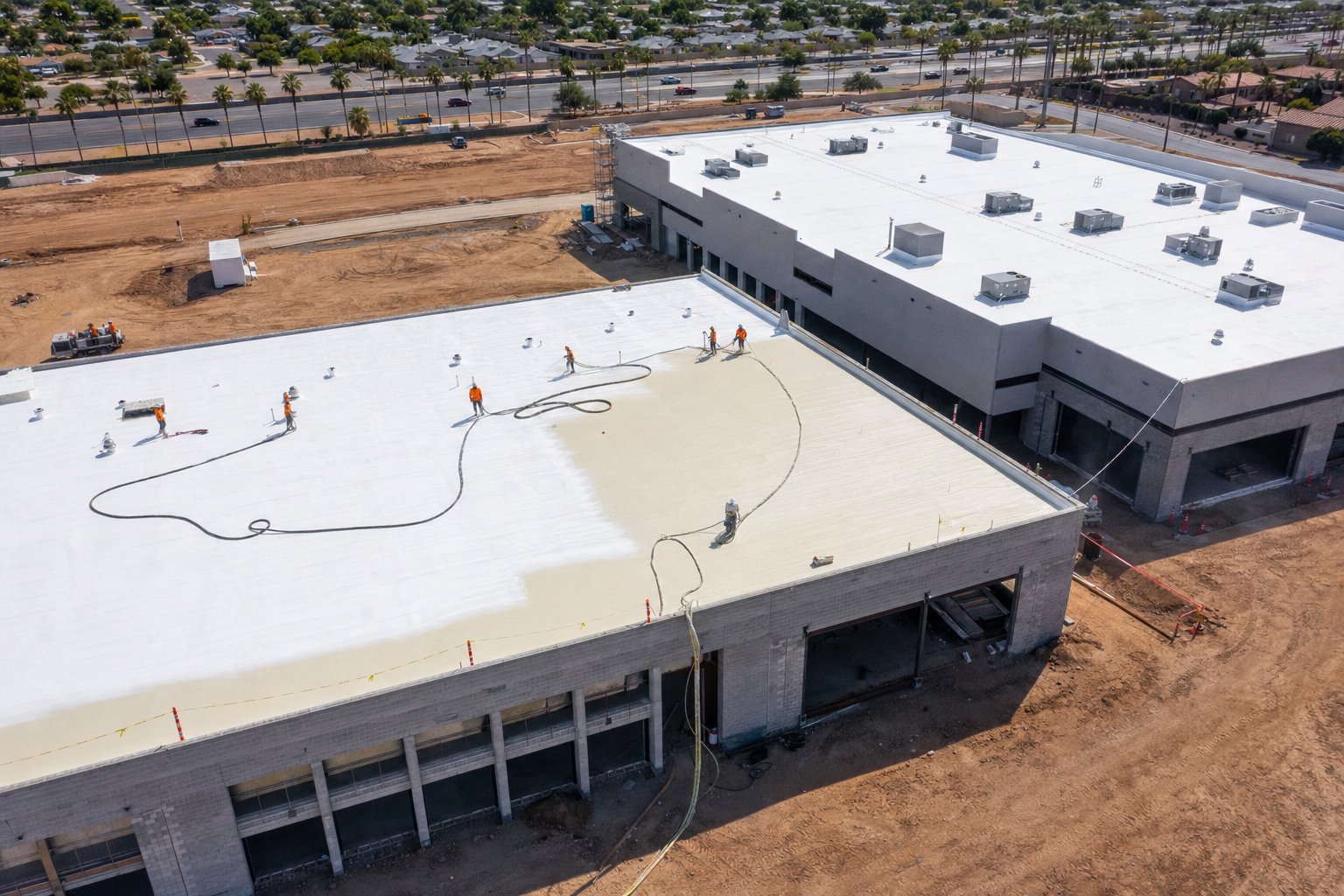
New Construction Commercial Roofing in Phoenix
New construction roofing is fundamentally different from restoration work. The GC is watching the schedule. The developer is watching the budget. The owner is expecting a manufacturer NDL warranty. And every day the roof isn't done, framing dries out, electrical waits, and interior finishes push. Being on time and doing it right the first time is the whole job. We install foam, TPO, and modified bitumen systems on new commercial buildings across the Phoenix metro with GC-friendly scheduling and clean handoff to the owner.
The RealityWhy new construction roofing needs a specialist
Most restoration roofers can't run new construction. It's a different rhythm — different specifications, different scheduling constraints, different documentation. Manufacturer NDL warranty enrollment requires certified installers, exact spec adherence, and detailed submittals. Miss a step and the developer loses their warranty. If your roofer isn't set up for new construction, the whole schedule slips.
GC-friendly scheduling
New construction runs on a critical-path schedule. Framing, decking, roofing, electrical, mechanical, interior — every trade waits for the previous one. We show up on the day the deck is ready, not two days later. And we finish inside the window so the next trade isn't sitting.
Manufacturer NDL warranty enrollment
GAF, Versico, and Carlisle NDL warranties (No Dollar Limit, 20-30 year) require certified installer status, exact specification adherence, and detailed manufacturer submittals. We handle every step — pre-job submittals, in-progress inspections, and warranty enrollment paperwork.
Detail coordination with MEP & framing
New construction roofs need coordination with mechanical (rooftop units, curbs), electrical (conduit penetrations, lightning protection), plumbing (vent stacks, drains), and framing (parapet blocking, insulation clips). Miss a curb layout and the RTU has to sit until the roofer comes back.
Clean handoff documentation
Owners buying a new commercial building expect a warranty binder — manufacturer NDL warranty, installer workmanship warranty, closeout submittals, and O&M documentation. Everything needed for their maintenance program and future recoat planning.
Meeting spec & passing inspection
Every new construction roof has to pass building department inspection (IBC/IECC) AND manufacturer inspection for warranty enrollment. Both happen on the same day. We coordinate every submittal, sample, and detail so nothing gets flagged.
Owner & tenant-improvement transitions
New construction rolls into TI work — every tenant makes MEP changes that require roof penetrations. We stay on the callout list for the first 12-24 months to handle new penetrations without voiding the manufacturer warranty.
Real WorkFeatured project
Here's what our new construction work actually looks like. This is Aster at Mountain Vista in Mesa — 11 buildings of new apartment construction, all built with fresh foam roofs installed on the developer's schedule and matched-spec across every building.
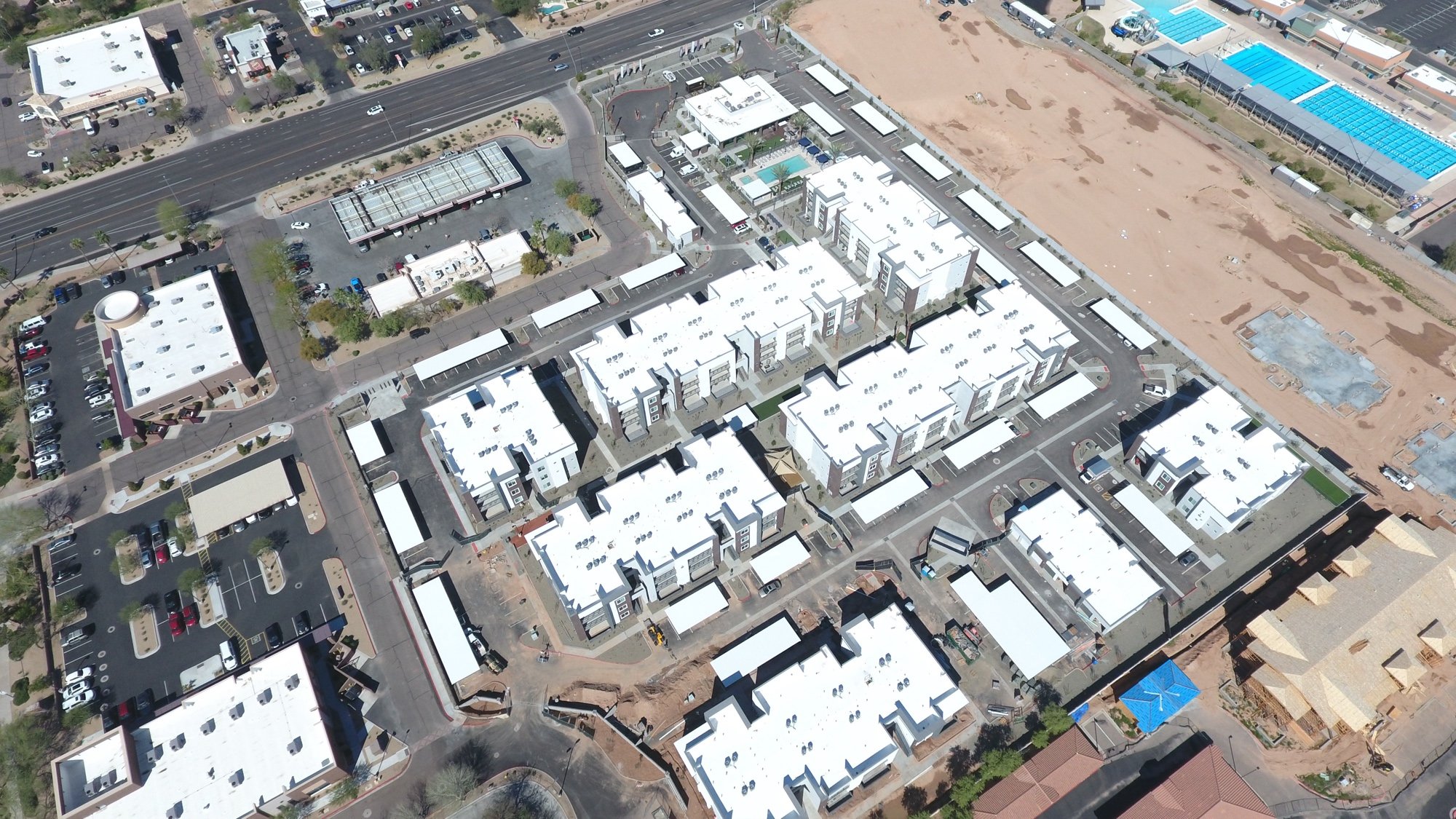
11-Building New Construction Apartment Community — Aster Mountain Vista
Aster at Mountain Vista is an 11-building new-construction apartment community in Mesa. We installed matched-spec spray polyurethane foam roofs on every building on the developer's critical-path schedule. Same system, same warranty, same aging curve across the entire community — with a manufacturer-backed warranty enrolled for every building before turnover.
Read the full case study →
Roof SystemsWhat we install & restore
New construction commercial roofs default to one of three systems: spray polyurethane foam (SPF) for owner-occupied buildings that want thermal performance and low maintenance, TPO single-ply for spec developments and multi-tenant properties, or modified bitumen for buildings with heavy foot traffic or specialized requirements.
| System | Best Use | Typical Warranty |
|---|---|---|
| ARMORCOAT AC100 Elastomeric | Restoration of aging foam & single-ply roofs | 10 yr No Leak |
| TRC 980 & Mule-Hide Silicone (96%+ solids) | Restoration with ponding water tolerance | 10-20 yr |
| Spray Polyurethane Foam (SPF) | New install or full re-foam — high R-value, monolithic | 10-15 yr |
| TPO Single-Ply (60-mil min) | Tear-off and replacement with reflective single-ply | 15-25 yr (manufacturer) |
| Bitumen & Targeted Repair | Short-term patching while planning restoration | Project-specific |
Our ProcessHow a project actually runs
New construction projects live and die on schedule and documentation. Here's how we run a new construction roof from pre-construction to warranty binder:
- Pre-construction submittals & coordination. Roofing scope aligned to the GC's critical-path schedule. Manufacturer submittals (system spec, samples, shop drawings). Detail coordination with framing, MEP, and structural. Curb layouts locked before deck goes down.
- Deck & parapet inspection. Pre-installation deck inspection — moisture, adhesion, fastener pattern verified. Parapet blocking checked for termination detail. Any issues corrected before roofing starts, not discovered during install.
- System installation to manufacturer spec. Insulation, base coat, top coat, or membrane installed per manufacturer specification for NDL warranty enrollment. Certified installers on every day of the job. Progress photos and installer QC checklist documented daily.
- Manufacturer in-progress inspection. GAF, Versico, or Carlisle field inspector on-site during install to verify NDL warranty compliance. Any findings addressed on the same day. Warranty enrollment paperwork initiated before punch list.
- Building department & final inspections. IBC/IECC building department inspection coordinated with manufacturer final inspection. Both passed on the same day. Any punch-list items handled before turnover.
- Warranty binder & owner handoff. Manufacturer NDL warranty enrolled, installer workmanship warranty issued, closeout submittals compiled, O&M documentation delivered. Owner walk-through with maintenance recommendations and first-year callout support.
FAQsCommon questions
Do you handle GC-driven new construction schedules?
Yes. We build our schedule around the GC's critical path — showing up the day the deck is ready and finishing inside the window so the next trade isn't waiting. Weekly schedule updates and daily on-site coordination with the site super.
Which manufacturer NDL warranties do you install?
GAF (Diamond Pledge and Golden Pledge NDL), Versico (VersiWeld, VersiFlex NDL), Carlisle (Sure-Weld NDL), and ARMORCOAT (10-year no-leak on foam). Certified installer status verified with each manufacturer before job start.
Can you coordinate with MEP subcontractors on curbs and penetrations?
Yes — this is required for new construction. We coordinate rooftop unit curbs with the mechanical contractor before deck goes down, so the curb pattern is locked. Penetrations for vent stacks, plumbing, and electrical planned in advance. Post-install penetration additions handled without voiding warranty.
How much does a new construction commercial roof cost in Phoenix?
Depends on system and square footage. Foam SPF for a new build typically runs $6-$10 per sq ft installed with all insulation. TPO with insulation typically runs $8-$14 per sq ft installed with NDL warranty. Full pricing after design review and material spec.
What documentation do you provide at owner handoff?
Complete warranty binder — manufacturer NDL warranty certificate, installer workmanship warranty, system specification and shop drawings, installation progress photos, manufacturer inspection reports, closeout submittals, O&M documentation, and first-year callout contact list. Everything the owner's maintenance team needs.
Which cities do you serve for new construction roofing?
The full Phoenix metro — Phoenix, Scottsdale, Mesa, Tempe, Chandler, Gilbert, Glendale, Peoria, Surprise, Goodyear, Ahwatukee, and Paradise Valley. Also Prescott and northern Arizona for select GC clients.