Industrial & Warehouse Roofing in Phoenix, Arizona
We roof industrial and warehouse facilities across the Phoenix metro — distribution centers, manufacturing plants, cold storage, and logistics hubs. Large flat roofs carry heavier mechanical loads, more service traffic, and bigger ponding zones than any other commercial building type, and they can't go offline. We spec for those realities and schedule around your freight, your shifts, and your climate-controlled inventory.
What We RoofIndustrial & warehouse building types we work on
Industrial isn't one thing. A high-bay distribution center is a different roofing problem from a manufacturing plant full of process equipment, and both are different from a temperature-controlled cold storage facility where the membrane is also part of the thermal envelope. We work across the full range of Phoenix-area industrial and warehouse properties:
Distribution & fulfillment centers
High-bay distribution and fulfillment buildings with massive roof footprints, rooftop HVAC arrays, and shipping bays that have to stay open. We sequence the roof so freight keeps moving.
Manufacturing plants
Manufacturing facilities with heavy process equipment, exhaust penetrations, and continuous shifts. Detailing around dozens of curbs and stacks is where these jobs are won or lost.
Cold storage & refrigerated warehouses
Temperature-controlled facilities where the roof is part of the thermal envelope. Reflective, high-R systems matter here — and the membrane can never be left open over climate-controlled product.
Logistics & transload hubs
Logistics, cross-dock, and transload buildings near the freeway and rail corridors. Around-the-clock dock activity means night and weekend roofing windows are usually the only option.
Light industrial & flex space
Multi-tenant light industrial and flex buildings with mixed warehouse and office use. We coordinate with multiple tenants and protect occupied office areas during the work.
Self-storage & bulk warehouse
Self-storage and bulk warehouse buildings with long roof spans and chronic ponding. Silicone restoration is frequently the most cost-effective path on these aging, sound-deck roofs.
The RealityWhy industrial roofs need different specs
A standard commercial roofing spec doesn't survive on an industrial building. The loads are heavier, the traffic is constant, the ponding zones are larger, and the operation can't simply close while you fix the roof. We adjust the system, the detailing, and the schedule to the realities of an industrial facility — not the other way around.
Foot traffic from HVAC service
Industrial roofs see constant foot traffic — HVAC techs, refrigeration crews, equipment service. We spec walkway pads on service routes and higher-mil membrane in traffic zones so the roof survives the people who use it.
Heavy mechanical loads
Rooftop units, exhaust fans, process equipment, and conduit racks concentrate weight and create dozens of penetrations. Reinforced detailing at heavy curbs and proper load support are non-negotiable on industrial decks.
Large ponding zones
The sheer footprint of a warehouse roof means water collects over big, flat areas that drain slowly. We map ponding, correct deep zones with tapered crickets or added drains, and favor systems — like silicone — that tolerate standing water.
Business-continuity scheduling
24/7 operations, freight schedules, and climate-controlled inventory all constrain when work can happen. We build a phased schedule that protects continuity — zone-by-zone sequencing, night and weekend windows, and no open deck over active operations.
Roof SystemsSystems we install for industrial & warehouse roofs
The right system depends on roof age, deck condition, ponding, mechanical load, and budget cycle. For large flat industrial roofs in the Phoenix metro, these are the systems we recommend and install most — and our free inspection determines which one fits your building.
| System | Best Use for Industrial | Typical Warranty |
|---|---|---|
| Spray Polyurethane Foam (SPF) | Seamless, self-flashing coverage over irregular industrial roofs; high R-value for cold storage and conditioned space | 20–30 yr (recoatable) |
| TPO Single-Ply (60–80 mil) | Large-footprint replacements and high-traffic distribution roofs; 80-mil in heavy service zones | 15–25 yr (manufacturer) |
| Silicone Restoration (Roof X-Tender 985) | Aging but structurally sound industrial roofs with chronic ponding — restore for 40–60% of replacement cost | 10–20 yr |
| Targeted Repair & Maintenance | Stop-gap repair to last through one budget year while planning a phased restoration or replacement | Project-specific |
Silicone restoration with TRI-BUILT Roof X-Tender 985 Super Silicone is frequently the smartest call on warehouse roofs: it's the only commercial coating that handles ponding water indefinitely, it adds no tear-off waste, and it can often be booked as maintenance rather than a capitalized replacement. For the full restoration-versus-replacement breakdown, see our silicone roof coating guide.
Business ContinuityWhy minimum disruption matters — and how we deliver it
For an industrial or warehouse operation, a roof project that stops the business is more expensive than the roof itself. Freight that can't ship, product that can't stay cold, and shifts that can't run all cost far more than the roofing line item. That's why minimum-disruption scheduling is built into every industrial job we run.
- 24/7 operations stay running. We sequence the roof zone-by-zone so production lines, picking operations, and shipping bays keep working while we move across the building. No full-facility shutdown.
- Freight schedules protected. We coordinate around inbound and outbound dock activity — staging materials and crew access so trucks keep flowing and dock doors stay usable through the project.
- Climate-controlled inventory safeguarded. Cold storage and temperature-sensitive product is never exposed. With silicone and foam restoration there's no tear-off and no open deck overnight, so the thermal envelope stays intact.
- Night and weekend windows. When daytime work isn't possible, we work nights and weekends to fit your operating schedule. Crews start before sunrise in summer to beat both the heat and the day shift.
- Daily progress and clean staging. Daily progress photos to your facility manager, contained staging areas, and end-of-shift cleanup so the site stays safe and operational throughout.
Built for operations managers, not just owners
The person who has to live with a roof project isn't usually the one who signs the contract — it's the plant or facility manager keeping freight moving and product cold. Every Vanguard industrial project is scoped, scheduled, and documented so that person can keep the operation running while the roof gets done. We've roofed Phoenix-metro warehouses around active 24/7 logistics for decades.
Where We WorkIndustrial corridors and cities we serve
Most of the Phoenix metro's industrial and warehouse inventory clusters in a handful of corridors, and we roof across all of them. Whether your facility is in the West Valley logistics belt or the East Valley industrial parks, we're a short drive away.
- Phoenix — citywide industrial and warehouse roofing, from the Sky Harbor corridor to South Mountain industrial parks
- Glendale industrial corridor — the Loop 101 / Glendale logistics belt with its large distribution footprints
- Tolleson — the heart of the West Valley distribution and cold-storage cluster
- Goodyear logistics — fast-growing fulfillment, e-commerce, and freight facilities along I-10
- Mesa light industrial — East Valley manufacturing, flex space, and light industrial buildings
Don't see your city? We serve the entire Phoenix metro for industrial and warehouse roofing, including Chandler, Tempe, Gilbert, Peoria, and Scottsdale.
FAQsCommon questions from facility & operations managers
Can you roof our warehouse without shutting down operations?
Yes. Most of our industrial roofing work is staged around your operations, not the other way around. We work night and weekend windows, sequence the roof zone-by-zone so freight and shipping bays stay open, and coordinate around climate-controlled inventory so cold storage and temperature-sensitive product is never exposed. Silicone and foam restorations are especially low-disruption because there's no tear-off and no open deck overnight.
What roofing systems work best for industrial and warehouse buildings in Phoenix?
For large flat industrial roofs in Phoenix, the three systems we recommend most are spray polyurethane foam (seamless, self-flashing, high R-value), TPO single-ply at 60–80 mil for high-traffic and large-footprint replacements, and silicone restoration with TRI-BUILT Roof X-Tender 985 when the existing roof is sound enough to coat. The right choice depends on roof age, deck condition, ponding, mechanical load, and budget cycle — which is exactly what our free inspection determines.
Why do industrial roofs need different specs than other commercial roofs?
Industrial and warehouse roofs carry heavier mechanical loads, see constant foot traffic from HVAC and equipment service, and have large ponding zones because of their sheer footprint. They also can't go offline easily — 24/7 operations, freight schedules, and climate-controlled inventory all constrain when and how the work happens. We spec walkway pads on service routes, higher-mil membranes in traffic zones, reinforced detailing at heavy curbs, and a phased schedule that protects business continuity.
Real WorkFeatured industrial projects
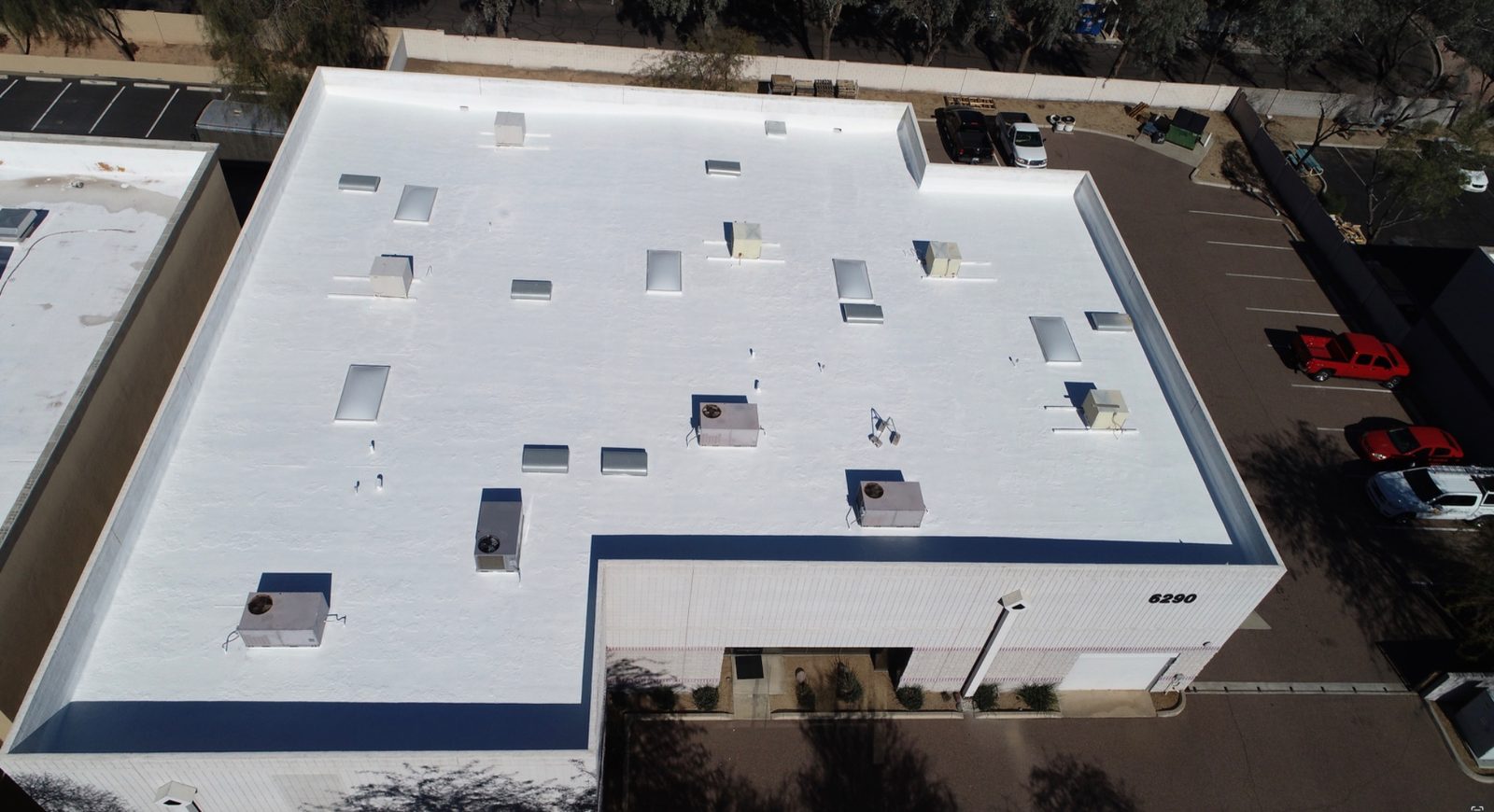
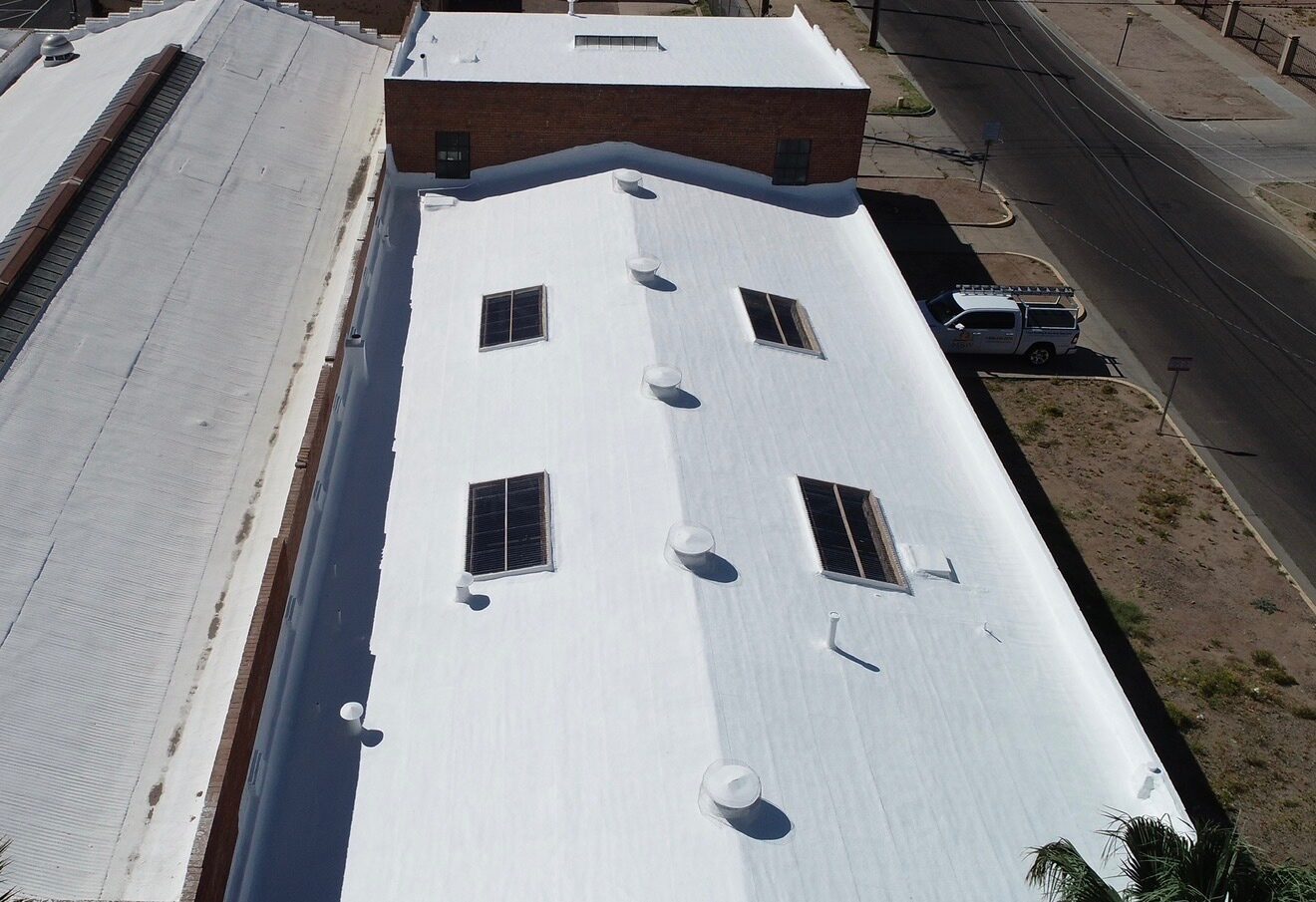
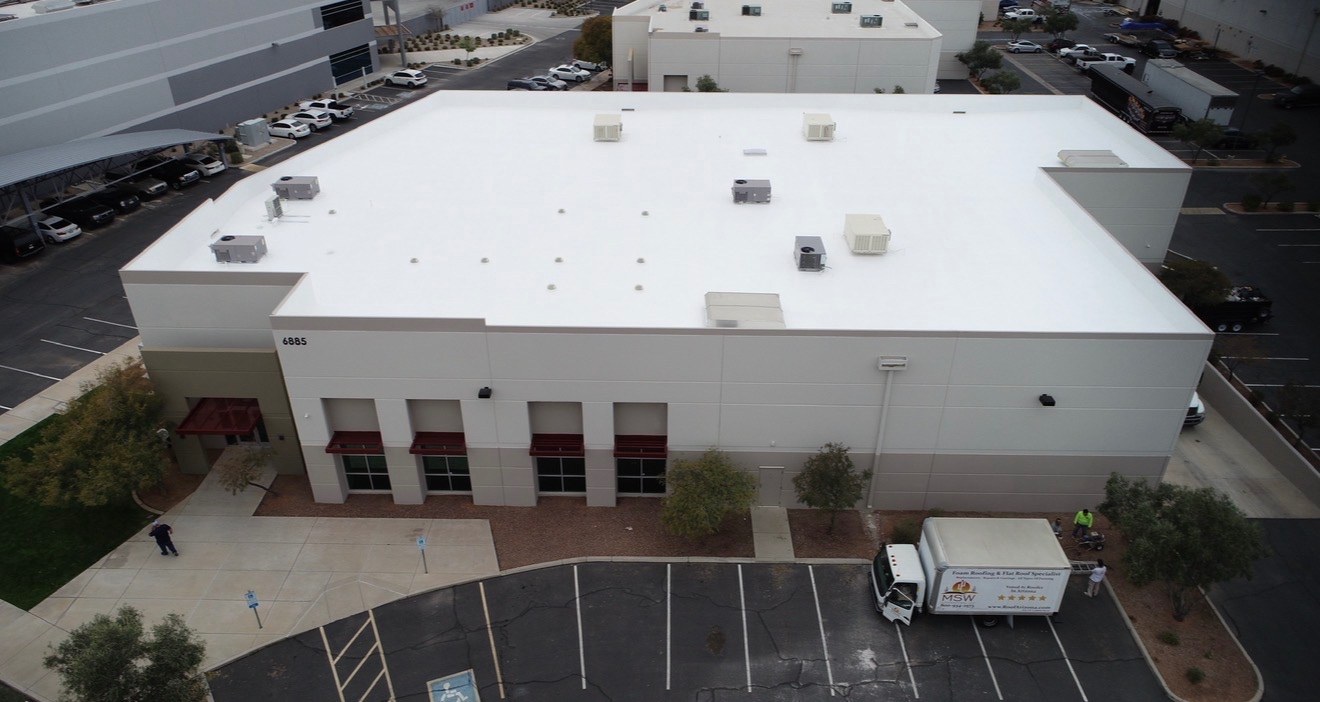
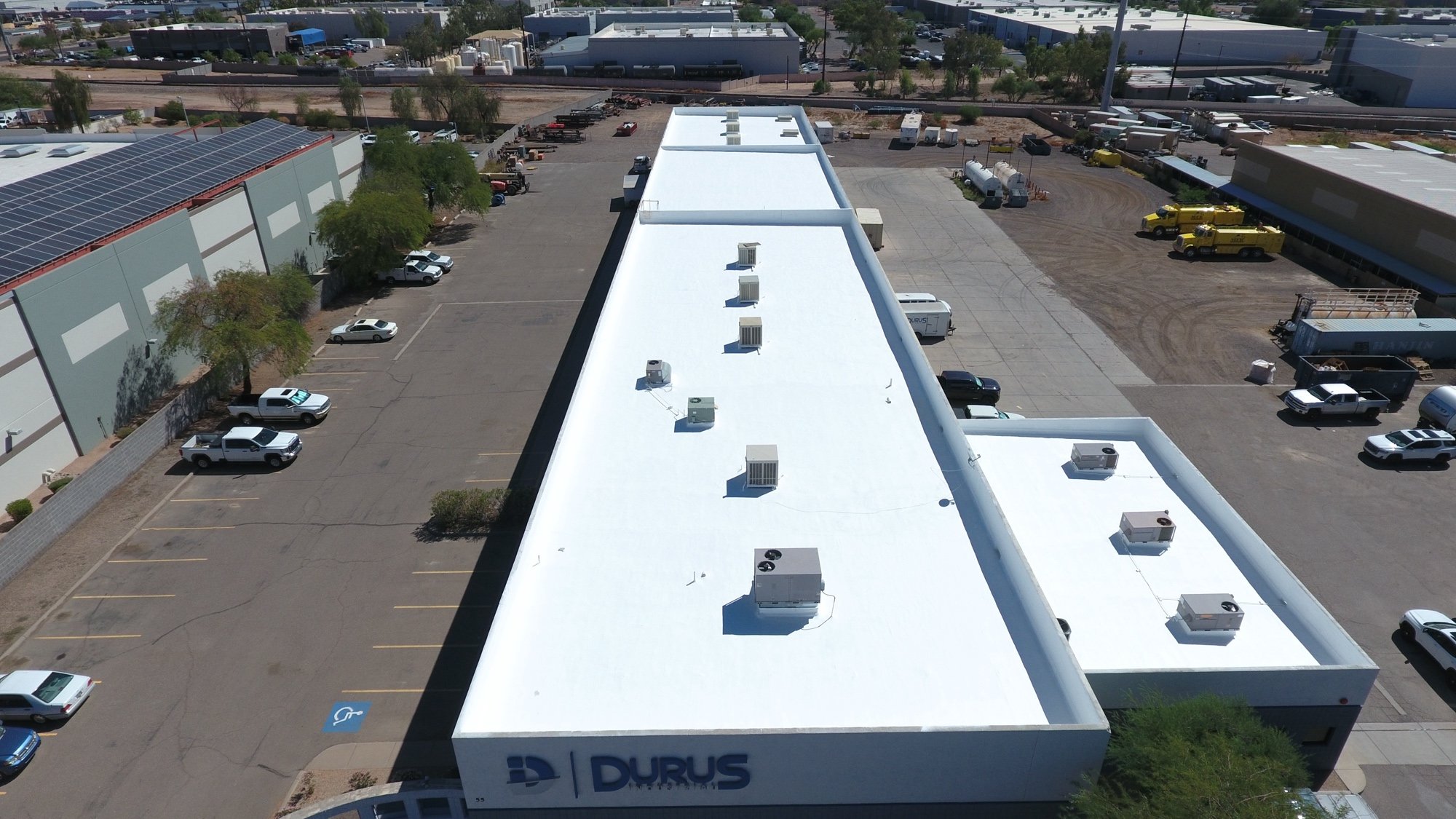
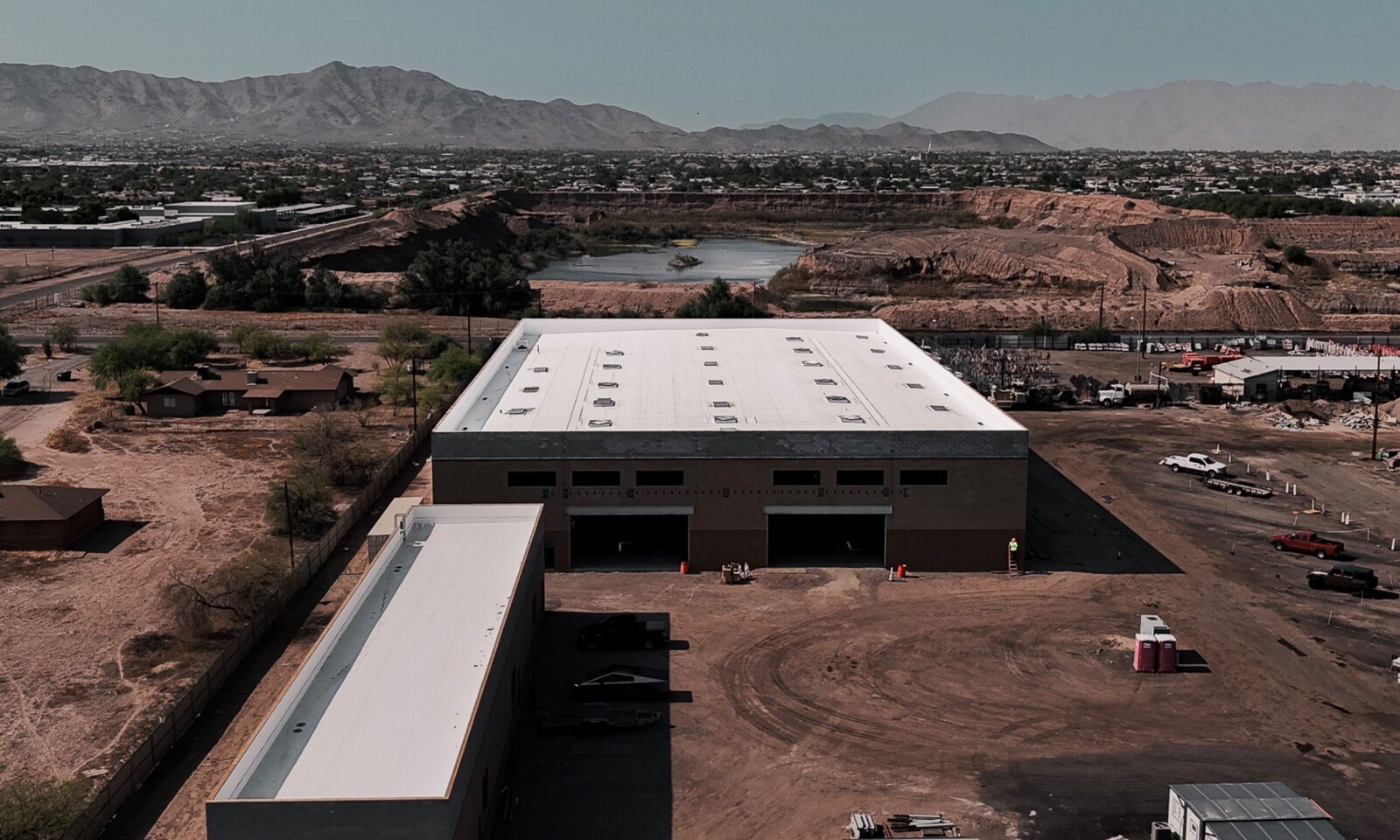
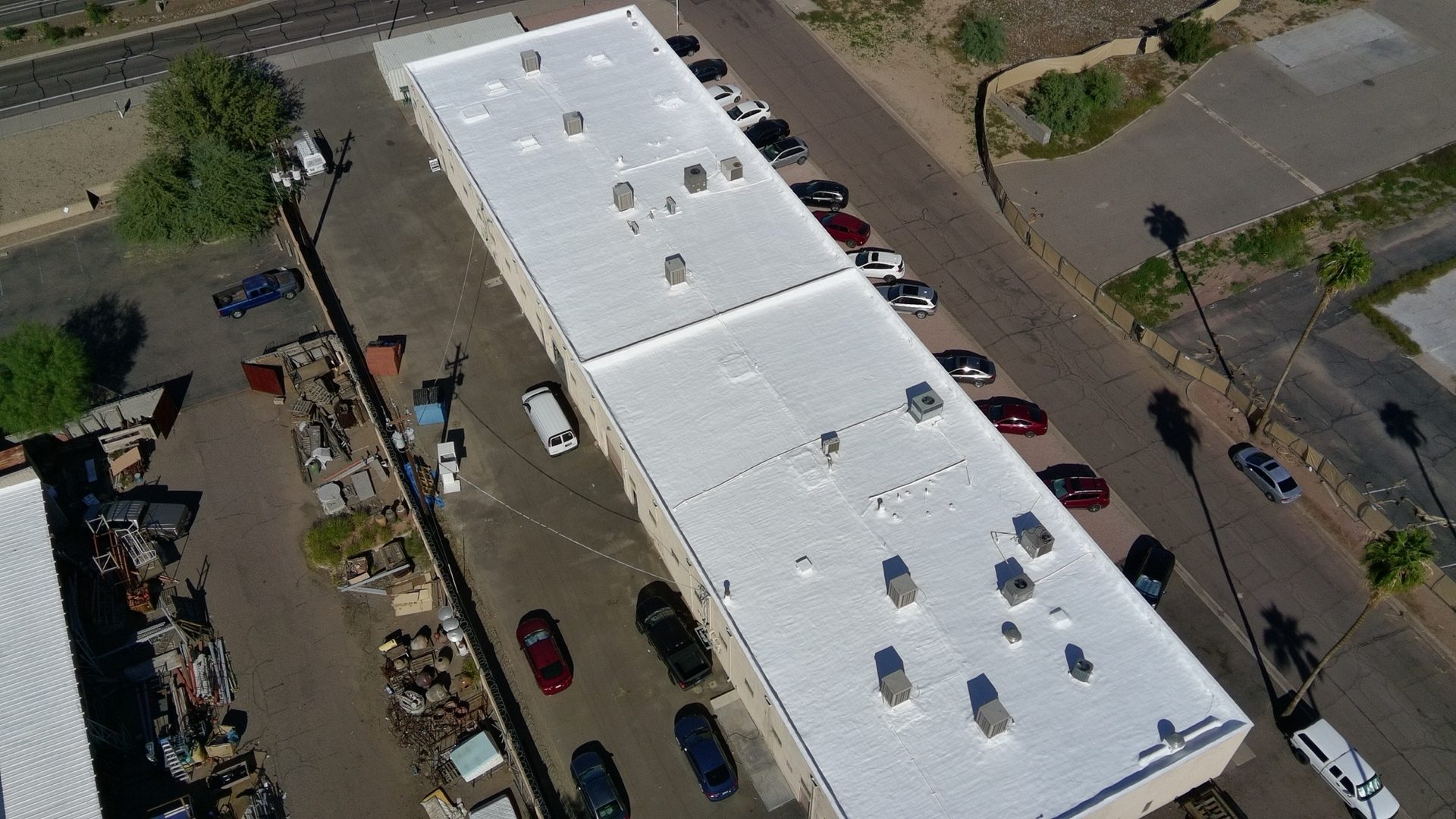
Here are six recent Phoenix-metro industrial and warehouse jobs that show the full range of what we do: a repair-heavy foam restoration on a Chandler industrial building, a new foam roof with custom skylights, an aging-foam recoat, a full tear-off and new foam system, a bare-deck TPO installation, and a from-scratch new foam roof on new industrial construction.