
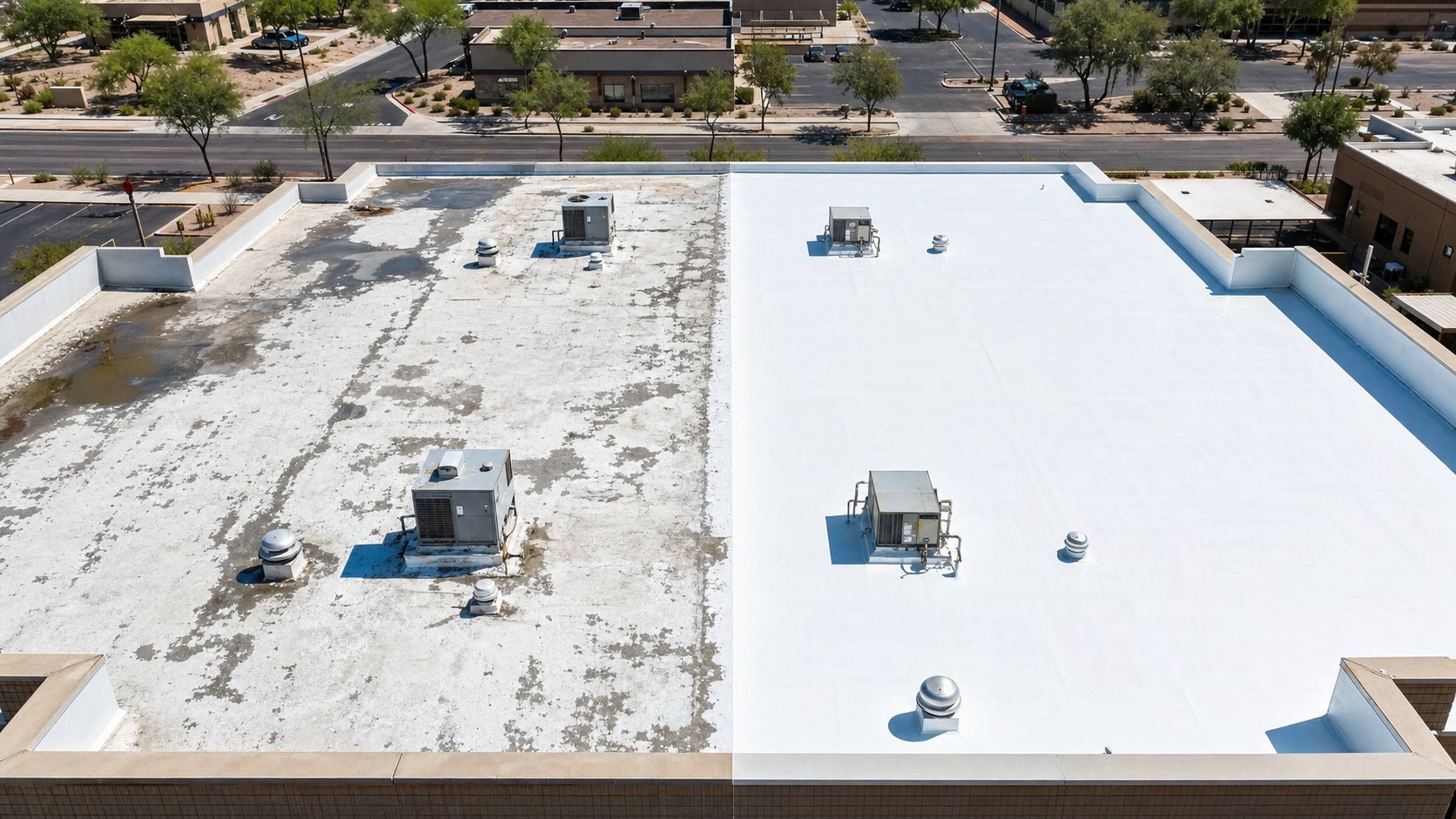
Every week a Phoenix property manager sends me a bid from a coating company promising to "restore" a roof for a third of what a replacement would cost. Sometimes it's the right call. Most times it's not. I use a 6-point test in the field that takes about 5 minutes.
The one-line answer: A recoat only makes sense when the substrate is dry, structurally sound, and less than 5% failed. Anything else, you're pouring good money over a bad roof.
The 6-point replace vs recoat test for Phoenix commercial roofs
Run each point. If the roof fails any two, stop pricing a recoat — you are looking at a full replacement.
- Substrate is dry. An IIBEC-recommended infrared or nuclear moisture scan shows no wet insulation. Coating over wet insulation rots the deck and voids every warranty.
- Less than 5% of the field has active failure. Blisters, delamination, seam splits, and open flashings under 5% can be cut and patched during coating prep. More than that and you are patching a quilt.
- Seams and flashings are intact. TPO and PVC seams pass a probe test with no lifted edges; foam base flashings and terminations are sound. Bad seams don't get better under a coating.
- Ponding clears within 48 hours. Per NRCA, chronic ponding kills every coating except ponding-approved silicone. Fix the slope before you coat.
- The deck itself is sound. No corroded metal, spalling concrete, or rotted wood. A coating can't rescue a failed structural deck.
- The roof is 3+ years from its warranty end. Coating a 25-year-old roof buys 3-5 more years, not 15. No manufacturer will NDL-warranty a coating on a substrate already past its rated life.
What replace vs recoat actually costs on a Phoenix commercial roof
Phoenix metro 2026 pricing for a 20,000 sq ft commercial roof from a licensed contractor with manufacturer NDL warranty. Handyman "roll-and-run" coating jobs are cheaper and worthless.
The trap: A recoat that fails the 6-point test still buys you 2-3 years, not 10-15. That means you pay $60,000 for a recoat, then $220,000 for the replacement you should have done in the first place — $280,000 total instead of $220,000.
4 red flags in a Phoenix recoat pitch
- No moisture scan. No infrared camera, no core sample — they don't know if the substrate is dry. Walk away.
- No mil thickness spec. A real bid lists dry mils per coat and total dry film thickness (20-30 for silicone). "Silicone coating" alone tells you nothing.
- Contractor warranty instead of manufacturer NDL. A 5-year contractor warranty is worth what the contractor is worth. A 10-15 year NDL from GAF, Versico, or ARMORCOAT is backed by a public company.
- Same-day pressure. Commercial roof decisions take 2-4 weeks. Anyone pushing a same-day signature on a $50,000+ project is running a scam.
Frequently asked questions
Replace vs recoat commercial roof Phoenix — how do I decide?
Run the 6-point test. Fail any two — wet insulation, more than 5% field failure, bad seams, chronic ponding, failed deck, or already past warranty age — and it's a replacement, not a recoat.
Recoat vs replacement cost on a 20,000 sq ft Phoenix roof?
$50,000-$95,000 for a silicone recoat vs $180,000-$330,000 for a tear-off replacement. Recoat only pencils out when the substrate passes the test.
Can you recoat a roof that already has ponding water?
Only with ponding-approved silicone, and only after fixing the drainage. Acrylic fails under ponding within 12 months.
Related reading
- Silicone vs Acrylic vs Polyurethane: The Honest Coatings Comparison — which coating actually holds up in Phoenix once you've decided to recoat
- Foam Roof Replacement Warning Signs — the specific failure patterns on Phoenix foam roofs that push a recoat into a full replacement
- Commercial Roof Replacement Cost Arizona — the full 2026 pricing breakdown by roof system when a replacement is the right call
- Commercial Roof Inspections: What Property Managers Should Demand — the 9-point inspection scope that catches the failures before you're forced to choose