
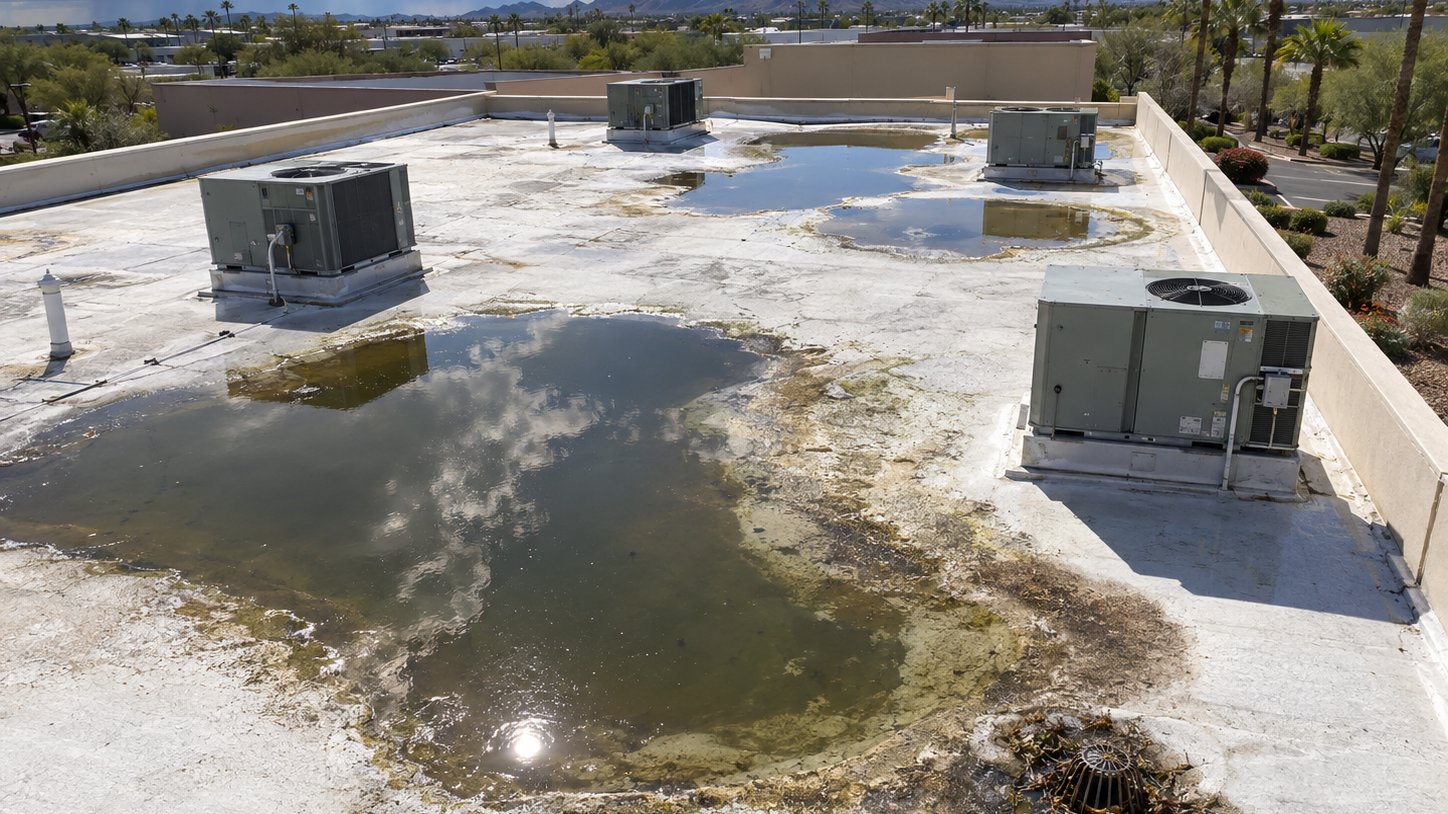
Every October I get the same question from property managers: "There's water sitting on the roof again. Is that a problem?" Sometimes it isn't. Often it is. And with ponding water on commercial roofs, the damage you can't see is usually worse than the puddle you can.
The short version: If water is still on the roof 48 hours after rain, that's ponding, and it's a drainage problem, not a coating problem. It shortens the life of most roof systems, often voids coating warranties, and adds about 5.2 lb per sq ft for every inch of depth. Fix the drainage first, then repair or coat.
What counts as ponding water on a commercial roof?
The National Roofing Contractors Association defines ponding as water that collects in low areas and remains more than 48 hours after precipitation under conditions that allow drying (NRCA glossary). NRCA also says short-term ponding is unavoidable and acceptable, but ponding beyond 48 hours can damage the roof assembly (NRCA, "Still Water Runs Deep").
In Phoenix, "conditions that allow drying" are about as good as they get. So if water is still sitting on your roof two days after a storm, the roof has a real low spot or a drainage failure. Our sun isn't the problem.
Building codes require low-slope membrane roofs to be designed with at least 1/4 inch of slope per foot (2%) for drainage (International Building Code, Chapter 15). Plenty of older Phoenix buildings were built flatter than that, or have lost slope over the years.
Why Phoenix commercial roofs pond
Most of the rain here comes in a short window. The City of Phoenix lists monsoon season as June 15 to September 30, with storms peaking from mid-July to mid-August (City of Phoenix). That rain comes hard and fast, often with dust and debris. These are the causes I see most:
- Clogged drains and scuppers. Monsoon dust, leaves, and debris from HVAC service visits build up at drains. It's the cheapest cause to fix and the most common.
- Deck deflection. Older steel and wood decks sag between supports over time, especially under heavy rooftop units.
- Crushed insulation. Foot traffic around HVAC units and heavy equipment compress the insulation, which leaves dips that hold water.
- Foam or roof-overs installed flat. A foam roof sprayed at an even thickness over a flat deck takes on the deck's low spots.
- Equipment added later. New units, curbs, or solar racks can block the original drainage paths.
What ponding water does to a commercial roof in Phoenix
It breaks down coatings faster
Acrylic coatings aren't built to sit underwater. Standing water softens them, and in our heat that cycle of wet and dry wears them out quickly. That's why most acrylic warranties exclude ponding areas. Some silicone coatings are rated for ponding water, and that's a big part of why silicone is the default coating here (see my coatings comparison).
It adds real weight
Water weighs about 62.4 lb per cubic foot, which works out to roughly 5.2 lb per sq ft for every inch of depth. A 20-by-50 foot pond two inches deep weighs about 10,400 lb. On a deck that's already sagging, more weight means more sag, and more sag holds more water. That cycle is why ponding should go to an engineer if the deck is visibly deflecting.
It finds every weak spot
A small pinhole or open seam that would shed water in a quick storm keeps leaking for days under standing water. Wet insulation under a pond also loses insulating value and can stay wet long after the surface looks dry.
It makes the roof hotter
When a pond dries, it leaves a dirt ring, and in shaded spots you can get algae. Both darken a white roof and cut its reflectivity, so those areas run hotter and age faster in summer.
How each roof system handles ponding
How to fix ponding water (and what it costs)
The fix depends on the cause. These are typical Phoenix-metro ranges. Every roof is different, so get a written scope.
Watch out: Coating over a ponding area without fixing the slope is the most common ripoff I see in recoat bids. The coating looks great for a season, then fails in the same low spots, and the warranty usually excludes them. Ask any bidder exactly how they'll handle the ponding. If the answer is "we'll coat it," keep shopping. My replace vs recoat guide covers the full test.
4 questions to ask any roofer about ponding
Ponding water on commercial roofs is where bids differ the most. Before you sign, ask every contractor these four questions and get the answers in writing:
- "Where are the ponding areas, and how big are they?" A serious bid marks them on a roof plan or photo. If the bid doesn't mention ponding, the roofer didn't look.
- "What's causing it?" Clogged drains, deck sag, and crushed insulation each need a different fix. "The roof is old" isn't a cause.
- "How will you fix the drainage, and is that in the price?" Look for specific line items: drain work, foam build-up, crickets, or tapered insulation.
- "Does the warranty cover the ponding areas?" Ask for the manufacturer's exclusion language. If those areas are excluded, the warranty protects less than you think.
How to check your roof for ponding
- Wait 48 hours after a storm. Go up yourself if it's safe, or send maintenance staff or a drone. Water still sitting there after 48 hours is ponding.
- Photograph and measure. Take wide shots and close-ups, and measure the rough size and depth of each pond. Date-stamp every photo.
- Check every drain and scupper. Look for debris, a clogged strainer, or a drain that sits higher than the roof around it.
- Look at the deck from below. From inside the building, check for sagging joists or deck between supports under the ponding area.
- Get a slope and moisture survey. A roofer can map the low spots and scan for wet insulation before you pay for a coating or repairs.
Frequently asked questions
How much ponding water on a commercial roof is acceptable?
According to NRCA, short-term ponding is acceptable. Water still on the roof more than 48 hours after rain is ponding, and that's a problem worth fixing.
Does ponding water void a roof warranty?
Often. Many coating warranties, especially acrylic, exclude ponding areas. Some membrane and silicone warranties allow limited ponding. Read the exclusions before you buy.
Can you just coat over ponding water?
You can, but it rarely lasts. Even a silicone coating that's rated for ponding doesn't fix the drainage. Fix the slope or the drains first, then coat.
Is ponding water a structural risk?
It can be. Each inch of water adds about 5.2 lb per sq ft. If the deck is visibly sagging under the ponding, have a structural engineer look at it.
Related reading
- How Long Does a Commercial Roof Last in Arizona? All 6 Systems: how drainage affects lifespan
- Silicone vs Acrylic vs Polyurethane: The Honest Coatings Comparison: which coatings handle ponding
- When to Replace vs Recoat: A 5-Minute Decision Guide: why ponding changes the answer
- Monsoon Season Roof Prep Checklist: drain clearing before next summer