
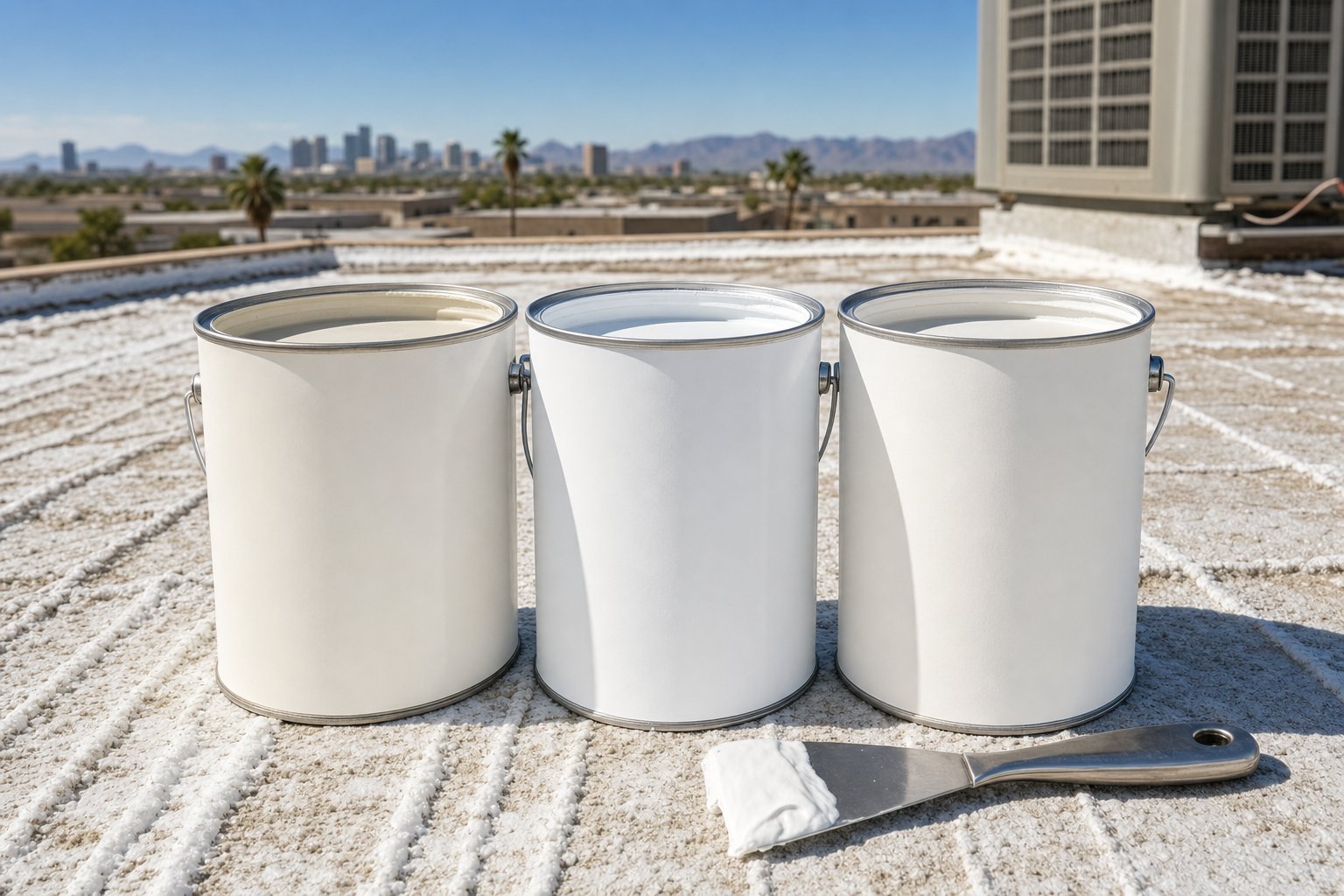
Roof coatings sell easy. Three cans of white liquid, all look the same in the sales meeting, all get pitched as "the last roof you'll ever need." One is $1.85 per sq ft, one is $3.50, one is $4.25. Property manager sees the low number and books it. Two Phoenix summers later, the coating is chalking off, blistering in the low spots, or delaminating at the seams — and the contractor who sold it is either out of business or "no longer offers that product." I've been on those roofs. I've torn those coatings off. The silicone vs acrylic vs polyurethane decision is the single most important call in a commercial roof coating project, and it's the one property managers get talked into wrong more often than any other.
The one-line answer: For most Phoenix commercial roofs — foam substrates, TPO, modified bitumen, or metal with any drainage imperfection — high-solids silicone wins. It survives our UV, tolerates ponding water, and lasts 15 to 20 years. Acrylic is cheaper up front and fine in narrow cases. Polyurethane is tougher but usually overkill unless you have real foot traffic.
What each coating actually is
Before the comparison, a 90-second chemistry primer. All three coatings arrive as a liquid, cure into a flexible membrane, and reflect solar heat. What's different is the polymer backbone — and that backbone determines how the coating handles Phoenix's specific abuse: 115+ F ambient, 130+ F rooftop surface temperature, monsoon downpours, dust storms, and eight months a year of relentless UV. According to the U.S. Department of Energy, a properly reflective cool roof can drop peak surface temperature by 50 F compared to a traditional black roof — but only if the coating chemistry survives the environment long enough to keep reflecting.
- Acrylic (water-based) — a water-carried polymer emulsion. Cheap, easy to apply, cures in 4 to 8 hours. Vulnerable to water while curing and to ponding water after it cures. Breaks down under UV faster than the other two. Common brands: Sherwin-Williams Kool Seal, Henry 587, GAF Unisil.
- Silicone (solvent-based, moisture-cure) — 100% solids or high-solids silicone that cures on contact with humidity. Essentially inert once cured. Doesn't care about ponding water. Naturally UV-stable. Slightly tacky surface attracts dust. Common brands: Versico VersiFlex, GacoRoof, ARMORCOAT, Karnak 401, Henry Silastic.
- Polyurethane (single or two-part urethane) — a tougher, more abrasion-resistant polymer often used as a basecoat under silicone. Excellent tensile strength and puncture resistance. More expensive, more complicated to apply, and requires strict recoat windows. Common brands: Uniflex, Versico Uni-Bond, Henry 887 Tropi-Cool.
The head-to-head comparison table
This is the honest table. Numbers reflect installed pricing in the Phoenix metro in 2026 for a 2-coat system at manufacturer-specified mil thickness on a prepped substrate. Lifespan assumes correct install and proper substrate repair — cut those corners and every number shrinks by 30 to 50 percent.
Acrylic
- Installed cost (2-coat)
- $1.75–$2.75 per sq ft
- Realistic Phoenix lifespan
- 7–10 years
- Ponding tolerance
- Poor — voids warranty
- UV resistance
- Moderate — chalks by year 4
- Foot traffic
- Weak — walk pads required
- Dirt pickup
- Low — stays cleaner
- Recoatability
- Easy — recoat with more acrylic
- Warranty
- 5–10 years (mfr)
- Solar reflectance
- 0.83 initial → 0.68 aged
Silicone
- Installed cost (2-coat)
- $2.75–$4.25 per sq ft
- Realistic Phoenix lifespan
- 15–20 years
- Ponding tolerance
- Excellent — unlimited
- UV resistance
- Excellent — chemically inert to UV
- Foot traffic
- Moderate — soft surface
- Dirt pickup
- High — tacky surface attracts Phoenix dust
- Recoatability
- Easiest — silicone bonds to silicone with wash + respray
- Warranty
- 10–20 years (mfr)
- Solar reflectance
- 0.85 initial → 0.70 aged
Polyurethane
- Installed cost (2-coat)
- $3.25–$4.75 per sq ft
- Realistic Phoenix lifespan
- 12–18 years
- Ponding tolerance
- Good — rated 48 hr
- UV resistance
- Good — needs a UV-stable topcoat
- Foot traffic
- Excellent — best in class
- Dirt pickup
- Moderate
- Recoatability
- Hard — narrow recoat window between coats
- Warranty
- 10–15 years (mfr)
- Solar reflectance
- 0.82 initial → 0.73 aged
Reflectance numbers reflect typical ENERGY STAR-listed roof coating values sourced from the Cool Roof Rating Council (CRRC) Rated Product Directory. Aged values are 3-year measured, not manufacturer marketing claims. Actual field performance in Phoenix runs 5 to 10 percent lower because our dust is aggressive and our sun is unforgiving.
The Phoenix-specific factors nobody talks about
Coating comparisons published nationally are calibrated for national conditions. Phoenix isn't the national average. Four things matter here that don't matter in Ohio, and they change the answer.
1. Monsoon ponding on foam roofs
Nearly every foam roof in the Phoenix metro has at least some low areas that pond water for 24 to 72 hours after a monsoon storm. The National Weather Service Phoenix office logs an average 2.71 inches of monsoon rainfall per season, but it arrives in a handful of intense events (NWS Monsoon summary). Acrylic re-emulsifies wherever water sits. This alone eliminates acrylic from consideration on most foam roofs in Phoenix — the roof geometry the acrylic warranty demands does not exist here.
2. HVAC service traffic
Phoenix commercial buildings run their rooftop AC units harder than any other market in the country — often 8 months a year, 18 hours a day. That means service techs on the roof monthly, and every visit is foot traffic that abrades a soft coating. Silicone will scuff and dent at every service path. Polyurethane holds up better. If your building has 10+ HVAC units per 5,000 sq ft, budget for either a polyurethane basecoat under silicone or dedicated walk pads on every service route.
3. Dust load and reflectance decay
The APS commercial cool-roof rebate and the SRP commercial energy programs both weight reflectance heavily. Silicone's tacky surface loses reflectance faster than acrylic or polyurethane because Phoenix dust bonds to it. If your utility rebate or LEED credit is calculated off 3-year aged reflectance, ask specifically for dirt-resistant silicone formulations — most Tier-1 brands offer them at a small premium.
4. Recoat behavior at year 15
This is the single most underweighted factor in every coatings pitch. When your coating hits end of life, what does the next coating cost? Silicone-over-silicone is a wash and respray — 50 to 60 percent of the original cost. Acrylic-over-acrylic is similar but with a shorter cycle, so more frequent recoats. Polyurethane-over-polyurethane requires strict recoat windows and often full re-prep. This is why silicone typically wins on 30-year total cost of ownership even though it costs more up front.
When each coating is actually the right choice
Red flags in a coating quote
Here's what to look for in a proposal so you can tell whether the contractor is selling you the right coating or the coating that pads their margin:
- No dry film thickness (DFT) spec. The proposal should specify total mil thickness at 20 to 30 mils for silicone, 20 to 25 for acrylic, 25 to 40 for polyurethane. A quote that says "2 coats" without a mil target is a quote to underapply.
- No manufacturer warranty mentioned. If it's just a contractor warranty, the contractor is buying builder-grade coating. Ask for the specific product SKU and the manufacturer's warranty registration.
- Silicone over acrylic without primer. Compatibility failure — the coating will delaminate within a year. Confirm the primer is spec'd if there's any existing coating on the roof.
- Acrylic on a foam roof. Unless the foam roof is perfectly drained (rare), this is a warranty-void install waiting to happen.
- No blister / low-spot repair line item. Every foam roof coating job in Phoenix needs blister cut-out and low-spot fill priced separately — $0.35 to $0.75 per sq ft for the repair work. A quote without it means the contractor plans to coat over the failures. See our foam roof warning signs guide for what to demand.
- No mil-thickness verification method. A real coating install includes wet mil gauge readings during application and a dry film verification after. If nobody's measuring, nobody's applying at spec.
The industry standard: Both the NRCA (National Roofing Contractors Association) and IIBEC publish coating installation specifications that require documented mil thickness verification and manufacturer-approved primer chemistry for compatibility. If a contractor's proposal doesn't reference either standard, ask why.
The 30-year cost picture
For a hypothetical 20,000 sq ft Phoenix commercial roof, here's the 30-year total cost of ownership for each coating strategy, assuming one initial install and required recoats at end of service life. All numbers include prep, install, and recoat labor at current Phoenix rates. This is why silicone is usually the honest winner despite the higher up-front number: acrylic requires 3 to 4 install cycles over 30 years, silicone requires 1.5 to 2.
The catch: those TCO numbers assume no premature failures. In reality, mismatched coating chemistry, ponding on acrylic, or underapplied mil thickness compresses those cycles by 30 to 50 percent, and the acrylic column can easily balloon past silicone's number. This is why picking the right coating for the right roof — not just the cheapest coating — is the whole game.
FAQs
Which roof coating is best for Phoenix heat and UV?
For most Phoenix commercial roofs, silicone wins on raw performance. High-solids silicone holds up to Arizona UV, tolerates ponding water without softening, stays flexible through 130 F rooftop surface temperatures, and typically lasts 15 to 20 years before recoat. Acrylic is cheaper up front but breaks down faster under UV and cannot survive ponding. Polyurethane is tougher against foot traffic but usually overkill unless you have real abuse from HVAC service crews. If money is no object and drainage is uncertain, silicone. If drainage is excellent and budget is tight, acrylic. If foot traffic is heavy, a polyurethane basecoat with a silicone topcoat is the honest winner.
How much do silicone, acrylic, and polyurethane roof coatings cost in Phoenix per square foot?
In the Phoenix metro in 2026, installed pricing for a 2-coat commercial roof coating system runs roughly: acrylic $1.75 to $2.75 per sq ft, silicone $2.75 to $4.25 per sq ft, polyurethane $3.25 to $4.75 per sq ft, and hybrid polyurethane basecoat with silicone topcoat $3.75 to $5.25 per sq ft. Numbers vary by substrate condition, roof size, number of penetrations, warranty length, and how much prep and repair the roof needs before coating. A 20,000 sq ft warehouse coating a smooth, well-drained TPO surface prices at the low end. A cut-up 8,000 sq ft foam roof with dozens of blisters and 20+ HVAC curbs lands at the top.
How long does a silicone roof coating last in Phoenix?
A properly installed 2-coat silicone system on a prepped Phoenix commercial roof will typically last 15 to 20 years before it needs a maintenance recoat, and silicone is the easiest coating to recoat because it bonds to itself with just a wash and respray. Manufacturer warranties from Versico, GAF, and other Tier-1 silicone systems run 10 to 20 years depending on mil thickness, substrate, and inspection cadence. Real-world Phoenix service life usually beats warranty length when the coating is installed at the correct dry film thickness (20 to 30 mils) and the substrate was properly repaired first.
Can acrylic roof coating handle ponding water on a Phoenix commercial roof?
No. Acrylic coatings absorb standing water, and most manufacturer warranties explicitly exclude ponding water damage. If your roof has low spots that hold water more than 48 hours after a monsoon storm, an acrylic coating will re-emulsify, blister, and fail in one to three years. Silicone tolerates ponding indefinitely with no impact on the manufacturer warranty and is the correct choice for any roof with drainage problems that aren't being corrected at coating time.
Why does silicone coating attract so much dirt on Phoenix roofs?
Silicone has a naturally tacky surface, and Phoenix dust bonds to it. Within 6 to 12 months of installation, a bright white silicone roof will look dingy gray. This is cosmetic — the coating still performs — but it does reduce cool-roof reflectivity over time by 15 to 25 percent. Higher-end silicones include dirt-resistant additives that slow this significantly. If reflectivity matters to your electric bill or LEED credit, ask your contractor which silicone formulation they're using and get the ENERGY STAR-listed initial and 3-year aged SR values in writing.
Can I put a silicone coating over an old acrylic roof?
Not directly. Silicone will not bond reliably to cured acrylic — you'll get delamination within a year. The correct approach is to apply a compatible bonding primer that bridges the two chemistries. Most Tier-1 silicone manufacturers publish adhesion charts and require an approved primer over acrylic. Do this wrong and your $50,000 recoat delaminates in sheets. This is one of the top three reasons commercial roof recoats fail early in Phoenix — a contractor puts silicone over acrylic without primer to save $2,000 on materials.
Related reading
- Silicone Roof Coating in Phoenix: Full Deep Dive — how silicone actually installs, what mil thickness matters, and Versico vs GacoRoof vs ARMORCOAT
- Foam Roof Replacement Warning Signs — how to tell if your foam roof is ready for a coating or needs to be replaced first
- The True Cost of Commercial Roof Replacement in Arizona (2026) — full-system pricing when a coating won't save the roof
- Commercial Roofing Warranties Explained: Manufacturer vs Contractor — what the coating warranty actually covers (and what voids it)