
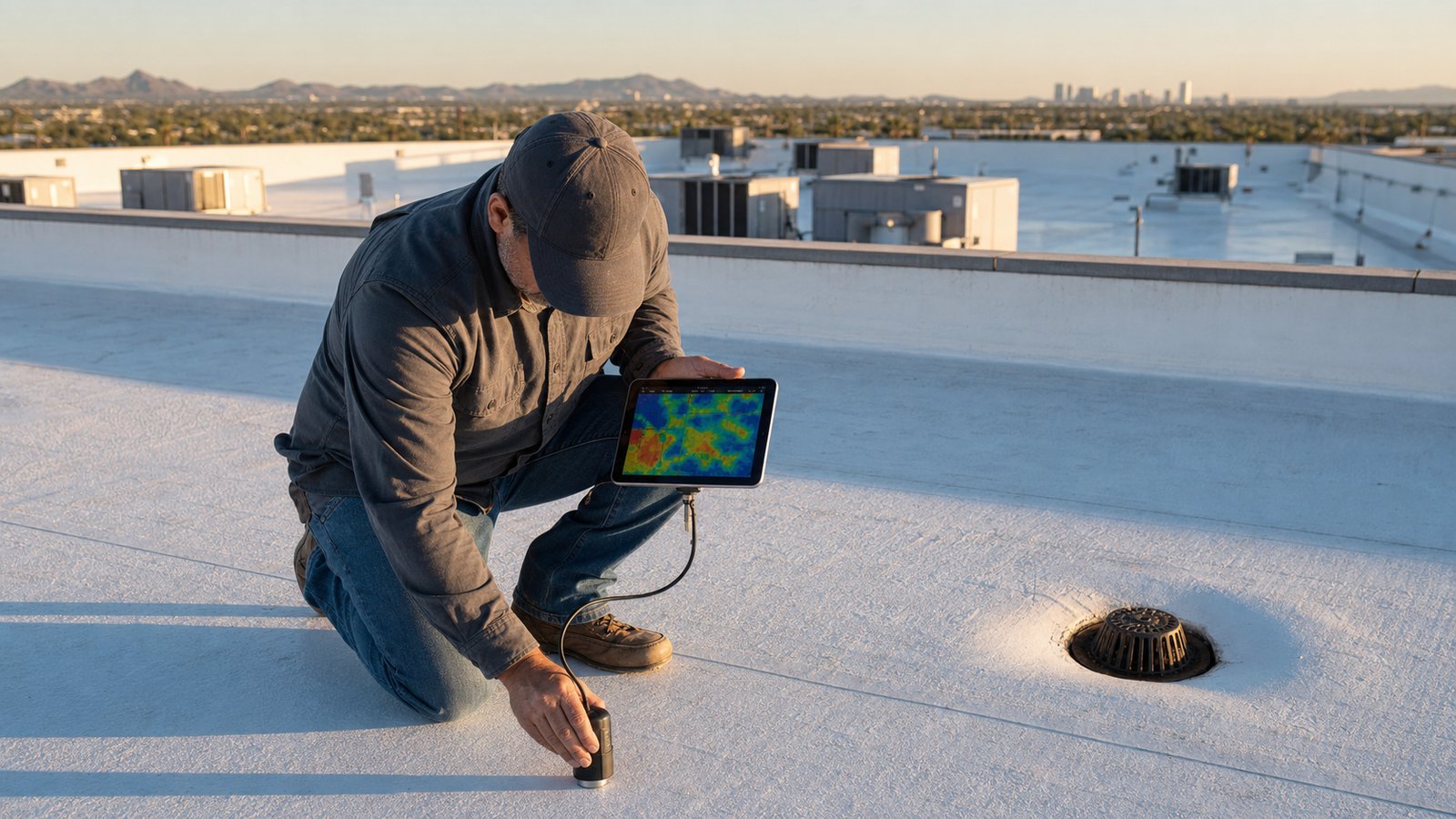
I get called out to Phoenix commercial roofs every week where a property manager waves a stack of "inspection reports" at me from other contractors, and the whole stack tells them nothing. No mil readings. No moisture scan. No photos of the actual defects. Two paragraphs of generic language, a signature, and a $28,000 recoat proposal on the back page. That is not an inspection — that is an estimate wearing an inspection's clothes.
A real commercial roof inspection is a diagnostic. It answers one question: what condition is this roof in, right now, on this date, with these readings. The estimate — what to do about it and what it will cost — is a separate document, produced after the diagnostic is done. Property managers who understand that distinction save themselves five-figure mistakes every year. This post is the checklist for what to demand from your next inspection in Phoenix, Chandler, Mesa, Tempe, Gilbert, Scottsdale, Glendale, or Peoria.
If you only remember one thing: ask the inspector, in writing, what tools they will bring and what deliverable you will receive. If the answer is "I'll walk the roof and let you know what I see," schedule someone else. A commercial roof inspection without a mil gauge is a Yelp review with insurance.
The 9 things a real commercial roof inspection includes
When we do a full inspection on a Phoenix commercial roof, this is the field checklist. If your inspector is skipping items, they are skipping the value.
- Coating mil-thickness readings in 6+ locations. On foam and coated roofs, a wet-film or dry-film gauge measures how much coating is left. Readings mapped on a roof diagram tell you where the roof is thin, where it's failing first, and how much life is left. According to IIBEC (Institute of Roofing, Waterproofing, and Building Envelope Professionals), mil readings are the single most objective data point in a coated-roof inspection.
- Moisture scan (roofs 8+ years old). Infrared imaging at night or capacitance meters during the day find wet insulation hidden under a dry surface. This is the single most valuable diagnostic on aging foam and membrane roofs — and the most commonly skipped.
- HVAC curb and penetration flashing inspection. Every mechanical unit, vent, pipe, and duct penetration gets a hands-on flashing review. HVAC curbs are the number-one leak source on Phoenix commercial roofs.
- Drain and scupper evaluation. Clogged? Sealed? Draining fully within 48 hours after a storm? Standing water within 15 feet of a drain? Every drain and scupper photographed and evaluated.
- Parapet wall, coping cap, and edge metal review. Coping seams, terminations, and edge flashings are second only to HVAC curbs for hidden leak paths.
- Seam / expansion joint / termination bar check. On TPO, PVC, EPDM, and modified bitumen, every seam and termination gets probed and photographed for separation.
- Ponding water evidence. Even on a dry day, sediment rings, algae staining, and coating discoloration reveal where water sat after the last storm. Ponding areas require different repair approaches than the rest of the field.
- Photo documentation of every defect. Every finding — big or small — photographed with location context, and cross-referenced to a roof diagram or map.
- A written condition report within 5 business days. Not verbal. Not an emailed proposal with a "condition" line item at the top. A separate, dated, signed condition report with the inspector's name and AZ ROC license number.
Warning: If a contractor performs items 1-8 but refuses to leave a written report, they are protecting themselves from a competitor using their diagnostic. That's fine as a business practice — but it means their inspection is only useful if you buy from them. For reserve fund planning, insurance documentation, or board approval, you need a written deliverable in your hands.
What separates a commercial roof inspection from a sales walkaround
Both look identical from the parking lot — a guy in a truck arrives, climbs to your roof, spends 30-45 minutes up there, comes down, and hands you a piece of paper. The difference is in what tools he brought, what he measured, and what document you get. Here's the field distinction based on actual Phoenix reports we've reviewed:
Tools on site
- Real inspection
- Mil gauge, moisture meter or IR scanner, camera, roof plan.
- Sales walkaround
- Phone camera, sometimes a tape measure.
Time on roof
- Real inspection
- 60-120 minutes for a 10,000 sq ft roof.
- Sales walkaround
- 15-30 minutes with an estimate on the way down.
Mil-thickness readings
- Real inspection
- 6+ locations, mapped on a diagram.
- Sales walkaround
- None ("looks thin in spots").
Moisture scan
- Real inspection
- IR or capacitance scan on roofs 8+ years old.
- Sales walkaround
- Never mentioned.
Deliverable
- Real inspection
- Written condition report, 5-15 pages, with photos and roof diagram.
- Sales walkaround
- One-page estimate with a "condition" paragraph at the top.
Pressure to buy
- Real inspection
- None during the visit; the estimate follows as a separate document.
- Sales walkaround
- "Discount if you sign today."
Cost
- Real inspection
- Free visual + mil readings; $200-$1,200 for moisture scan or full condition report.
- Sales walkaround
- "Free" — because it's a sales call.
Why Phoenix commercial roofs need semi-annual inspections
Every climate is hard on roofs, but Phoenix is a specific kind of hard. According to NOAA's Phoenix climate summary, we average over 300 sunny days a year, with roof-surface temperatures on a black or dark commercial roof routinely hitting 150°F to 170°F in July. Monsoon season delivers 60-70 mph gusts, hail, and 2-inch-per-hour rainfall bursts. Then it's back to 300+ sunny days of UV. That cycle — thermal shock plus UV plus monsoon debris — chews through commercial roofs faster than most manufacturer specs assume.
A twice-a-year inspection cadence catches problems in two specific windows:
- April to May: pre-monsoon inspection. Clear drains, tighten HVAC curb flashings, spot-repair any hairline cracks, and confirm coating mil thickness before storm impact starts. This is the highest-value visit of the year.
- October: post-monsoon inspection. Document any storm damage while it's still fresh (for insurance timing), assess any ponding paths that developed, and plan winter or early-spring recoat work if needed.
Most manufacturer warranties — including GAF commercial systems and Versico single-ply — require documented semi-annual inspections to stay in force. Skipping the paperwork is one of the top three reasons legitimate warranty claims get denied. If your inspection reports are living in someone's inbox instead of your building's capital file, you don't have documentation — you have a hope.
What actually kills Phoenix commercial roofs first (so you know what the inspector should be photographing)
When we open up failed commercial roofs in the Phoenix metro, the failure almost never starts in the middle of the field. It starts at seven specific weak points — and these are the ones a good inspector should be spending 70% of their time on. If your last inspection report has generic "field is in fair condition" language and no photos of these spots, you paid for the wrong inspection.
- HVAC curb corners. Every rooftop unit sits on a raised curb, and the four corners of that curb are where thermal expansion tears the flashing apart first. On a Phoenix roof running 150°F+ surface temps in July, sheet metal expands and contracts every day of the year. Corners fail first, always. The inspector should be lifting up flashings and probing seams — not just photographing the top of the unit.
- Perimeter edge metal terminations. Coping cap seams, drip edge terminations, and gravel-stop laps take direct monsoon wind uplift. The IIBEC and NRCA both call edge-metal failure the number-two cause of catastrophic commercial roof loss after HVAC penetrations. Phoenix's 60-70 mph monsoon microburst gusts routinely peel edge metal that was installed to code five years earlier.
- Plumbing vent stack collars. Boot flashings and lead collars around plumbing stacks dry-rot in Phoenix UV inside 8-10 years. A collar that looks intact from above is often cracked at the base against the stack — invisible unless the inspector physically pushes on it.
- Drain sumps. Every drain is a low spot with standing water after every storm. On foam and coated roofs, drain sumps are where coating erodes fastest — sometimes years faster than the field. On membrane roofs, drain-corner welds are stress points. Inspector should stand in every drain sump and photograph coating condition or seam integrity.
- Wall-to-roof transitions. Where a low-slope roof meets a taller parapet or a stepped-up building section, the flashing has to move independently from the wall. Sealant fails. Termination bars pull loose. This is a top-five leak location and one of the hardest to inspect without lifting flashings.
- Old satellite-dish, solar-mount, and abandoned-penetration patches. Every previous trade that put something through your roof left a patch. Nine times out of ten, at least one of those patches is failing. Solar-mount penetrations added in the last 3-5 years are a specific problem in Arizona — many were done by solar contractors without roofing licenses, and those penetrations are showing up in year-4 leaks now.
- Field areas under ponding water. Standing water on flat Phoenix roofs isn't just aesthetic — it accelerates coating breakdown, hides UV damage, and (on membrane) softens seams. A moisture scan is the only reliable way to know what's happening under a ponding zone. If the roof has ponding and the inspector didn't scan those specific areas, they missed the most likely failure point on your roof.
The commercial roof inspection deliverable checklist
When the inspection is done, this is what should land in your inbox within 5 business days. Print this list, hand it to the contractor before scheduling, and cross off what's missing.
- Cover page with property address, inspection date, inspector name, and AZ ROC license number
- Roof system type, approximate age, square footage, and manufacturer if known
- Roof diagram or aerial with defect locations pinned
- Coating mil-thickness readings by location (6+ points)
- Moisture scan results (if performed) with wet-area map
- HVAC curb / penetration condition, one photo each
- Drain and scupper condition, one photo each
- Parapet and coping cap condition
- Seam / termination / expansion joint condition
- Ponding evidence and locations
- Full photo log of every defect, labeled and cross-referenced
- Remaining useful life estimate (in years)
- Clear recommendation: monitor, spot-repair, recoat, or replace
- Preliminary budget range for the recommended action
- Inspector signature, date, and license number
Reserve fund tip: This deliverable is what an HOA board or CFO needs to justify the next year's capital line item. A one-paragraph "condition" summary buried in an estimate is not defensible. A separate, dated, signed condition report is.
How to prep your building before the inspector shows up
Ten minutes of prep on the property manager's side gets you a materially better inspection. When we show up to a building that has done these five things, we can spend our full time on diagnostics instead of hunting for information.
- Pull the last roof invoice or warranty document. Manufacturer, install date, roof system, and any past warranty claims. This tells the inspector what they're looking at before they climb the ladder and often flags known-defect batches or expired warranty windows.
- Compile any leak history from the last 24 months. Tenant complaints, work-order logs, dates, locations. A leak inside a specific suite tells the inspector exactly where on the roof to focus the moisture scan. Without that, they're scanning blind.
- Confirm safe roof access. Interior ladder, exterior hatch, or lift required? Any lockout keys needed? If we get to the building and can't get on the roof, the inspection is a wasted trip. This is the number-one reason inspections get rescheduled in Phoenix.
- Note any recent HVAC or solar work. Any trade that has been on the roof in the last 12 months is a suspect for a new leak path. Solar installers, HVAC service techs, satellite installers, and refrigeration guys all cut and patch — and a lot of them do it poorly. Flag any work performed since the last inspection.
- Have the roof plan ready if you have one. Even a rough site plan or aerial photo saves 20 minutes of the inspector's time and gives them a document to mark defect locations on. If you don't have one, we sketch it — but if you do, use it.
Red flags: when a Phoenix commercial roof inspection is really a sales call
You'll spot these patterns before the inspector is off your roof. If two or more show up, get a second opinion before authorizing any work.
- No tools other than a phone. No mil gauge, no moisture meter, no clipboard. Just eyeballs.
- Under 30 minutes on the roof. A 10,000 sq ft commercial roof cannot be legitimately inspected in 20 minutes.
- Estimate handed over the same day. An estimate produced without the diagnostic being written up first is a canned sales number, not a scope-driven price.
- "Sign today for a discount." A legitimate contractor's price does not have a same-day expiration. This is the oldest trick in the ripoff playbook and it still runs on Phoenix property managers who don't have the time to fight it.
- Refuses to provide the AZ ROC license number in writing. Verify at the Arizona Registrar of Contractors. If they can't or won't, they aren't licensed for the class of work they're pitching.
- "You need a full replacement" without a moisture scan. On a foam or membrane roof, that recommendation without moisture data is a guess dressed as a diagnosis. A guess costs you $80,000+.
- No written report — only a verbal summary. If the contractor won't put the diagnosis in writing, the diagnosis is not defensible for insurance, warranty, or capital planning.
What to do with the inspection report once you have it
A written condition report is a working document. Filed in an inbox it does nothing. Used correctly it protects your warranty, your reserve fund, your insurance position, and your next board or CFO conversation. Here's how Phoenix property managers who do this well handle each report:
- Save it into your capital file the day it arrives. Manufacturer warranties (GAF, Versico, Firestone, Carlisle) require documented semi-annual inspections. If a claim ever comes up, the manufacturer's first question is "send us your inspection history." Property managers who can produce a clean chronological file of dated, signed reports win claims. Property managers who can't, lose them.
- Match the recommended action to your reserve or capital cycle. If the report says "recoat within 24 months, estimated $28,000-$42,000," that number goes into next year's capital plan — not this year's operating budget. A one-line "condition" summary buried in an estimate can't drive that conversation. A separate signed condition report can.
- Get a second bid from the report, not from a separate walkaround. This is the single most valuable move a property manager can make. Give the inspection report to a second contractor and ask them to bid the recommended scope. That comparison — same scope, different contractor — is how you spot upsells. Bidding from two separate walkarounds is how you get two different scopes and no way to compare.
- Use it for post-storm insurance documentation. Every October in Phoenix, we get calls from property managers whose roofs took monsoon damage but they can't prove pre-storm condition. If you have a signed April/May inspection report on file, you have proof of pre-storm condition — one of the most useful documents you can have in a wind or hail claim. It doesn't guarantee coverage, but it makes it much easier to show the damage is new.
- Share it with your tenants (retail and industrial). When tenants know the roof was inspected and the report is in the manager's file, work-order complaints about "the roof" drop significantly. It's a small trust move that saves you multiple call-outs a year.
How much a commercial roof inspection should cost in Phoenix
Real numbers from Phoenix inspections we and other reputable contractors have priced in 2026:
- Free visual + mil-thickness readings: $0. Standard for any reputable Phoenix commercial roofer as a customer-acquisition service.
- Standalone infrared moisture scan (nighttime IR): $0.02 to $0.06 per sq ft — $200 to $600 on a 10,000 sq ft roof. Best value for aging foam and membrane systems.
- Full condition assessment with moisture scan + written report: $350 to $1,200 depending on complexity, roof size, and access. Better value than a "free" visual for anything over 8 years old.
- Multi-building portfolio inspection (5+ roofs): Usually discounted to $0.03 to $0.05 per sq ft with a portfolio condition summary as part of the deliverable.
- Insurance-driven post-storm inspection: Often free with signed engagement, or $500 to $1,500 fixed fee. Adjuster-ready photo log and storm-cause narrative included.
If you're being quoted more than $1,500 for a single-building inspection with no unusual complexity, you're being upsold. If you're being told the visual-only inspection is worth $500, you're being upsold in the other direction. Neither is normal in the Phoenix metro.
What we do on a Vanguard commercial roof inspection
For transparency, here's the exact process on any Phoenix commercial roof we inspect, so you know what to compare us against:
- Roof plan sketched or downloaded from records before we go up
- Mil-thickness readings at a minimum of 6 field locations plus every visible transition
- Nighttime IR moisture scan on any roof over 8 years old or with any leak history (scheduled separately)
- Every HVAC curb, drain, scupper, penetration, and parapet condition photographed
- Ponding evidence mapped even on dry days
- Written condition report emailed within 5 business days, with defect map, photo log, remaining life estimate, and a recoat-or-replace recommendation
- Estimate — if you want one — sent as a separate document after the report
No pressure. If your roof still has 3-5 years left, we tell you that and we tell you when to re-inspect. Selling a $40,000 recoat that a building doesn't need is a great way to lose a referral for a decade — and referrals are how commercial roofing companies survive in Phoenix.
Frequently asked questions about commercial roof inspections in Phoenix
How often should a commercial roof be inspected in Phoenix?
Twice a year is the honest baseline — one visit in April or May before monsoon season, and one in October after the last storms. That cadence matches the two windows when Arizona roofs take the most damage. Most manufacturer warranties (GAF, Versico, and others) also require documented semi-annual inspections to stay in force. Skipping the paperwork is one of the top three reasons legitimate warranty claims get denied.
What is a real commercial roof inspection supposed to include?
Coating mil-thickness readings at 6+ locations, an infrared or capacitance moisture scan for any roof over 8 years old, HVAC curb and penetration flashing inspection, drain and scupper evaluation, parapet and coping cap review, seam or expansion joint check, photo documentation of every defect, and a written condition report with a recoat-or-replace recommendation and a rough dollar range. A visual walk with no readings, no photos, and no written report is not an inspection — it's a sales call.
How much does a commercial roof inspection cost in Phoenix?
Most reputable Phoenix commercial roofers offer a free visual inspection with mil readings and a written condition report. Full infrared moisture scans typically run $0.02 to $0.06 per square foot when performed as a standalone service — $200 to $600 on a 10,000 sq ft roof. Full paid condition assessments run $350 to $1,200 for buildings over 8 years old and are usually better value than a "free" visual-only report.
What should the written commercial roof condition report include?
Roof system type and age, coating mil-thickness readings mapped on a diagram, a photo log with every defect labeled, HVAC curb and penetration condition, drain and scupper condition, parapet and coping condition, moisture scan results if performed, remaining useful life estimate, a clear recommendation (monitor, spot-repair, recoat, or replace), a preliminary budget range, and the inspector's name and AZ ROC license number. Property managers should refuse to sign off on any inspection without a written deliverable — verbal reports are not usable for board meetings, reserve fund planning, or insurance documentation.
Do I need an infrared moisture scan on my commercial roof?
If your roof is over 8 years old, has any leak history, uses a foam or membrane system where wet insulation can hide under a dry surface, or is being considered for a recoat — yes. IR moisture scans find wet insulation invisible to a visual inspection. Recoating a foam or membrane roof over wet insulation is one of the most expensive mistakes we see in Phoenix: you seal in the moisture, the new coating fails within 2-3 years, and now you have both a new coating cost and a full replacement bill. A $400 moisture scan can prevent a $50,000 mistake.
What is the difference between a commercial roof inspection and a roof estimate?
An inspection is a diagnostic — condition of the roof, without pressure. An estimate is a sales document — the scope and price for a specific job. A legitimate contractor does the inspection first and produces the estimate afterward, as a separate document. If a contractor walks the roof for 20 minutes and hands you an estimate that day with no readings, no photos, and no written condition report, they sold you an estimate disguised as an inspection. Ask for the inspection deliverable separately.
Related reading
- What Chalky Foam Roofs Actually Mean (And When to Worry) — the 5-minute rub test every Phoenix property manager should run before the next inspection
- Commercial Roofing Warranties Explained: Manufacturer vs Contractor — why documented inspections are the #1 warranty-protection tool
- Foam Roof Replacement Warning Signs — the field indicators an inspector should be photographing
- The True Cost of Commercial Roof Replacement in Arizona (2026) — the numbers your inspection report should be feeding into your reserve fund