
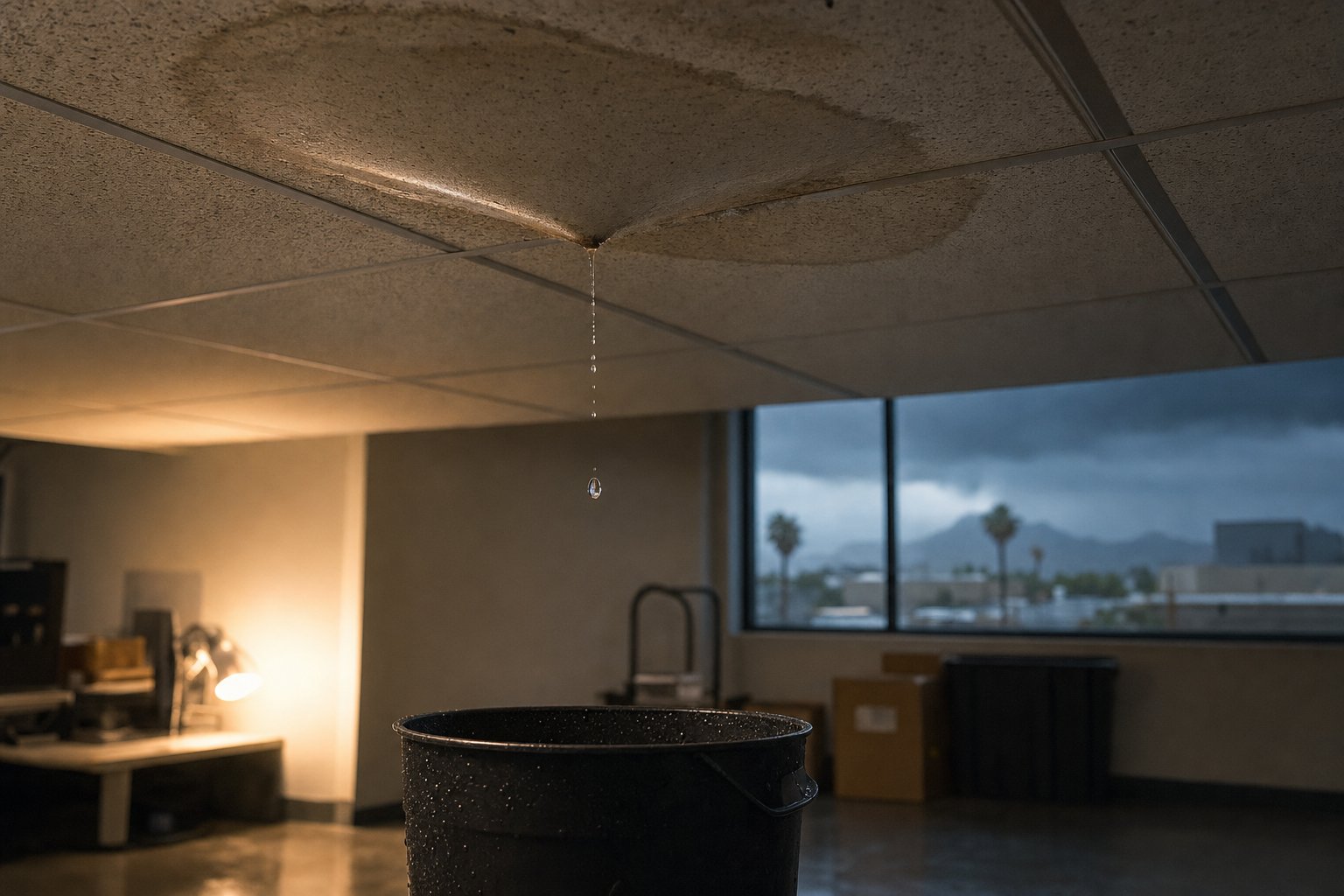
I've walked through this call more times than I can count. Property managers panic, tenants panic, and half the time the wrong thing gets done in the first hour — a well-meaning maintenance tech climbs on a wet roof, or someone tarps a foam roof with roofing nails and voids a five-figure warranty. This is the emergency commercial roof leak playbook I wish every Phoenix property manager had taped inside their file cabinet. It works whether the leak is a monsoon-driven emergency at 10 PM or a slow drip you noticed Monday morning after the weekend storms.
If you only remember one thing: photograph the leak while it is actively dripping, before you do anything else. Timestamped video of water coming out of a ceiling is the single strongest piece of insurance evidence you will ever produce. It takes 45 seconds. Do that first.
The first 60 minutes of a commercial roof leak: a triage checklist
Priorities in order. Do not skip ahead — every step below protects the next.
- Minute 0–5: Photograph and video the active leak. Every drip point, every wet ceiling tile, every stain. Turn on timestamps in your phone camera settings. Shoot video with sound so the leak is audible.
- Minute 5–15: Protect people. Move anyone away from the drip zones. Water on tile floors is the second-biggest injury source in commercial buildings during storms. Water on electrical outlets, exit signs, or fixtures means shut off that circuit.
- Minute 15–30: Protect assets. Move computers, servers, paper files, and inventory out of the drip zone. Cover anything you can't move with plastic sheeting. Photograph asset locations before moving them so the adjuster can see what was affected.
- Minute 30–45: Contain the water. Buckets, mop buckets, contractor-grade trash cans, and plastic sheeting on the floor to channel water. Push a ceiling tile up and out of the way if water is pooling in it — a full ceiling tile weighs 40+ pounds and will collapse onto whoever is under it.
- Minute 45–60: Call your commercial roofer. Leave a detailed voicemail if it's after hours. Note the building address, roof system if you know it (foam, TPO, silicone, modified bitumen), the number of active drip points, and whether the storm is still active. A good contractor will call back within 30 minutes even at 2 AM.
What NOT to do in the first hour: Do not send building maintenance or facility staff onto a wet commercial roof during an active storm. According to OSHA 1910.28 fall protection standards, working on commercial roofs during active weather without proper fall arrest is a serious violation, and every year Phoenix ERs see cases of maintenance staff falling through wet skylights they couldn't see in the dark. Wait for daylight and a properly equipped contractor.
Where commercial roof leaks actually start (the 6 usual suspects)
Ninety percent of the emergency commercial roof leak calls we run in Phoenix trace to one of six places, and knowing which one you're dealing with helps the phone triage go faster. Here's the field distribution based on our own service records across foam, TPO, silicone, and modified bitumen roofs in the metro:
HVAC curb flashing
- Why it leaks
- Mechanical unit vibration cracks sealant; monsoon wind lifts loose metal flashing.
- Typical emergency fix
- Butyl mastic + peel-and-stick membrane wrap.
Roof drains & scuppers
- Why it leaks
- Clogged with monsoon debris; drain body seal fails under standing water.
- Typical emergency fix
- Clear the drain first, then reseat the drain flange.
Parapet wall coping
- Why it leaks
- Metal cap lifted by wind; sealant joints crack from UV and thermal cycling.
- Typical emergency fix
- Re-secure coping; membrane wrap over joint.
Skylight curbs & domes
- Why it leaks
- UV-degraded gaskets; cracked polycarbonate domes from hail impact.
- Typical emergency fix
- Emergency polycarbonate sheet cover; sealant band.
Seam separation (TPO / modified bitumen)
- Why it leaks
- Adhesive or heat weld fails at high heat; foot traffic accelerates it.
- Typical emergency fix
- Cover strip weld or peel-and-stick patch by trained tech.
Foam roof punctures
- Why it leaks
- Dropped tools, HVAC service traffic, hail impact through worn topcoat.
- Typical emergency fix
- Foam plug + brush-grade coating patch.
When you call, describing which of these six is most likely — even if you're wrong — dramatically speeds up the response. A contractor bringing the right materials to your building at midnight is worth a thousand words of vague description.
Should you tarp it yourself?
Short answer: usually no. Longer answer: it depends on the roof system, and the wrong tarp will cost you more than the leak.
Foam (SPF) and silicone-coated roofs: Do not tarp. Foam roofs cannot take nails, staples, or heavy sandbag point loads without permanent damage. A tarp installed wrong will trap water underneath, delaminate the coating, and give the manufacturer a reason to walk on your warranty claim. Wait for a foam-certified contractor. In the meantime, focus on interior mitigation.
TPO and PVC single-ply roofs: Do not tarp with fasteners of any kind. A heat-welded peel-and-stick patch by a trained technician is the only correct emergency repair. If you tarp with weight bags and no fasteners, you may cause standing water under the tarp that damages the seams you were trying to protect.
Modified bitumen and asphalt cap sheet: This is the one commercial system where a homeowner-grade emergency patch can work in a pinch. Roofing cement in a caulking tube and a 12"x12" peel-and-stick patch from Home Depot can hold overnight. Use gloves. Do not do this alone. Do not do it during an active storm.
Metal roofs: Emergency tarps rarely work on metal because the panels themselves shed the water — the leak is almost always at a fastener, seam, or penetration. A butyl tape wrap on the specific failure point is a better temporary fix than any tarp.
Bigger warranty warning: If your roof has an active manufacturer warranty (GAF, Versico, Firestone, JM, Carlisle), unauthorized repairs by non-certified contractors can void the warranty even if the repair was done correctly. Before any emergency repair, take a photo of the roof warranty certificate and check which contractors are approved. Most manufacturers publish their certified contractor lists online.
Protecting the insurance claim while the leak is still active
The photos you take in the first hour become the entire foundation of any insurance claim you file. Adjusters look for continuity — a story that ties a specific storm event to a specific point of failure with clean visual evidence. Here's what to capture, in order of importance:
- Video of the active drip with sound and visible timestamp. 30 seconds is enough.
- Wide-angle photos of each affected interior area showing the drip location relative to walls and windows.
- Close-ups of every stained ceiling tile before it's removed or replaced.
- Photos of any water-damaged inventory, equipment, or documents in their original location.
- Screenshots of weather alerts for the storm event from the National Weather Service Phoenix office.
- The date, time, and duration of the leak in a notes app — you'll be asked for this later.
For deeper documentation guidance, our full walkthrough is at Commercial Roof Insurance Claim Documentation: A Phoenix 2026 Guide. If the leak is storm-related, notify your insurance carrier within 24 to 48 hours even if you're not sure the damage will exceed your deductible — the notification itself preserves your right to file later.
How to vet a 2 AM commercial roofer
Storm chasers and unlicensed operators flood the Phoenix metro during monsoon season. Some of them are competent and honest. Many are not. If you don't have a commercial roofer you already trust, here's how to vet one in a five-minute phone call:
- Ask for their AZ ROC license number and verify it in real time at roc.az.gov. Commercial roof work requires CR-42 (commercial roofing) or R-42 (residential roofing) — for commercial buildings you specifically want CR-42.
- Ask what roof systems they're certified on. A foam-only contractor cannot correctly emergency-patch a TPO seam. Certifications should match your roof.
- Ask about their emergency call rate and whether they charge a trip fee. Reputable contractors are transparent about after-hours pricing.
- Ask if they'll be present when the insurance adjuster inspects. If they hesitate or say no, hang up.
- Never pay for a permanent repair over the phone. The emergency stabilization is one price; the permanent repair or recoat requires a proper daylight inspection.
What a commercial roof leak repair actually costs in Phoenix
Rough 2026 pricing for the Phoenix metro, based on what we quote and what our peers quote. These numbers are for the emergency stabilization only — the permanent repair or recoat is separate.
- Single-point leak, daylight response: $500 to $1,500 depending on roof system and access.
- After-hours or weekend trip charge: add $200 to $500.
- Multi-point leaks or HVAC curb failure: $1,500 to $5,000 for temporary stabilization.
- Emergency drain unclog + reseat: $400 to $1,200.
- Emergency skylight cover (structural): $600 to $2,000 depending on size.
For context on what the full permanent repair or roof replacement typically costs, our detailed pricing breakdown is at The True Cost of Commercial Roof Replacement in Arizona (2026), including the scale table by roof size and system.
How Vanguard handles a commercial roof leak emergency
For our commercial clients in the Phoenix metro, our monsoon-season emergency response looks like this:
- Phone triage within 30 minutes of the call, including guidance on interior mitigation.
- First-light rooftop response if the storm is still active. We do not climb wet roofs at night.
- Photo & drone documentation of the damage before any repair happens — for the insurance file.
- System-appropriate temporary repair using materials matched to the roof system (foam plug + coating, TPO peel-and-stick, butyl wrap, etc.).
- Written scope of permanent repair within 48 hours, with pricing and manufacturer-approved options.
- Adjuster walkthrough at the property when the insurance inspection happens.
We prioritize existing clients, but we take new-client emergency calls during monsoon season as capacity allows. Our line is answered 24 hours during July, August, and September.
Frequently asked questions
What is the first thing to do when a commercial roof starts leaking?
Photograph and video the active leak before you do anything else. Then protect people, then protect assets, then contain water. Do not send anyone onto a wet commercial roof during an active storm. Call a licensed commercial roofing contractor as soon as it is safe to do a temporary repair, ideally within 24 hours.
Can I tarp a commercial roof myself during a leak?
You can, but on most systems you shouldn't. Foam, TPO, and silicone-coated roofs are damaged by nails, staples, and improper weights. A tarp installed wrong can void your warranty, tear the membrane, block drains, and create a much larger repair bill. On modified bitumen or asphalt, a peel-and-stick patch can buy time. Otherwise, wait for a professional.
How much does an emergency commercial roof repair cost in Phoenix?
A temporary emergency repair typically runs $500 to $1,500 for a single-point leak, plus a $200 to $500 after-hours trip charge. Multi-point or HVAC-related emergencies run $1,500 to $5,000 for temporary stabilization. The permanent repair or recoat is a separate quote after a daylight inspection.
Will insurance cover a commercial roof leak?
Most Arizona commercial property policies cover sudden and accidental water damage from covered perils (hail, wind, storm debris) but exclude wear-and-tear and deferred maintenance. Document the leak with timestamped photos while it's happening, save weather alerts, and get a professional inspection within 72 hours. Missing the 30 to 60 day notification window is the biggest reason legitimate claims get denied.
Should I call a 24-hour commercial roofer at night during a leak?
Call and leave a voicemail describing the situation, but don't expect anyone to safely work on a commercial roof at night during an active storm. A reputable contractor will call back, help you triage the interior over the phone, and schedule a first-light response. Anyone who agrees to climb on a wet, dark commercial roof during an active storm is either misrepresenting what they're doing or taking a serious safety risk.
Related reading
- Commercial Roof Insurance Claim Documentation: A Phoenix 2026 Guide — the full evidentiary playbook after the immediate emergency is over
- Phoenix Monsoon Season Roof Prep: HOA & Property Manager Checklist — pre-season prep so the next storm doesn't create the next emergency
- The True Cost of Commercial Roof Replacement in Arizona (2026) — what the permanent repair or full replacement typically costs, by system
- Foam Roof Replacement Warning Signs — how to tell if this emergency is a symptom of a bigger problem