
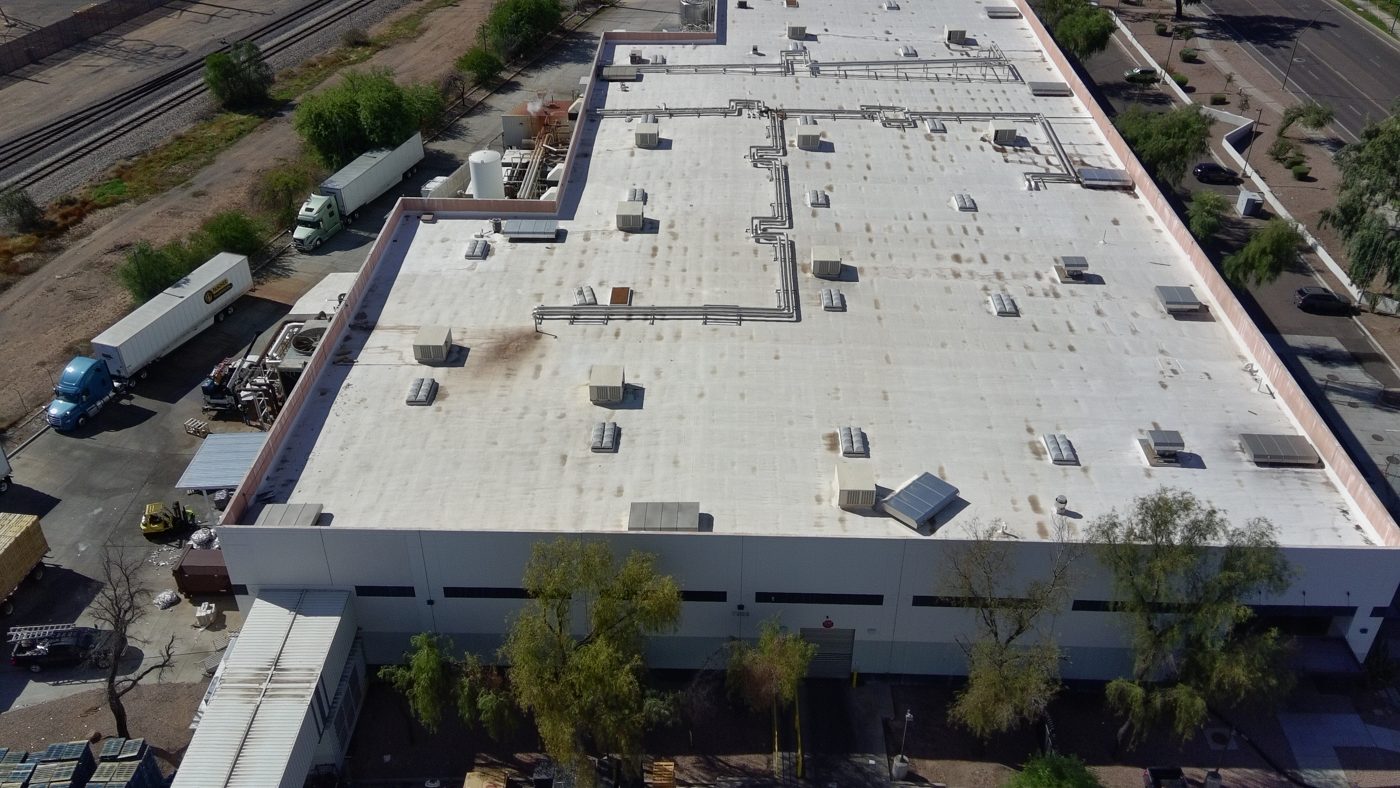
A stained ceiling tile shows up in the warehouse office. A tenant reports a drip over a storefront. Maintenance walks the roof, sees a clean white surface with no obvious holes, and reports back: "The roof looks fine."
Then it rains again, and the leak comes back.
This is one of the most common calls we get at Vanguard Roofing. On a commercial low-slope roof, the surface you see from the roof hatch is only part of the story. Water can enter at one spot, travel through insulation, along the deck or down a conduit, and appear inside 20 or 50 feet away. A roof can look clean from above and still be holding water underneath.
Here is what is usually going on, how a proper leak investigation works, and when a repair or restoration makes more sense than a full replacement.
Why a Commercial Roof Can Look Good While Water Gets Inside
Flat and low-slope roofs work differently than pitched roofs. There is no steep slope pushing water off quickly. Water sits, moves slowly toward drains and scuppers, and looks for any weak point along the way.
On most Phoenix commercial buildings the roof is a system, not a single layer:
- The surface layer — foam with an elastomeric or silicone coating, or a single-ply membrane like TPO, PVC or EPDM.
- Insulation and cover board — the layers under the membrane that hold heat out and give the roof its strength.
- The roof deck — metal, wood or concrete holding the whole assembly.
- Details — flashings, curbs, drains, scuppers, parapet walls, coping and penetrations.
The surface can be in decent shape while a detail has failed. And once water gets under the surface, it can spread through the insulation without leaving any visible sign on top.
What Causes Commercial Roof Leaks You Can't See From the Surface?
1. Failed seams on TPO, PVC and EPDM roofs
Single-ply membranes are installed in rolls, and every roll is joined at a seam. TPO and PVC seams are heat-welded; EPDM seams are usually taped or glued. A seam can look tight and still have a small unbonded section. Arizona heat, building movement and foot traffic slowly open those weak spots. The only reliable way to check is probing the seams, not looking at them.
2. Flashing at walls, parapets and curbs
Most commercial leaks start at transitions — where the roof turns up a parapet wall, wraps a rooftop unit curb or meets a wall. Flashing pulls loose, the sealant at the termination bar dries and cracks, and stucco above the flashing cracks and lets water in behind the roof entirely. From the roof, that can look like a "wall leak" or a roof leak — and often it is both.
3. Coping caps and parapet tops
The top of a parapet wall is easy to ignore because it is not technically "the roof." But loose coping caps, open joints and failed sealant let water run straight down inside the wall cavity. That water often shows up inside along an exterior wall, far from any obvious roof damage.
4. Penetrations: pipes, conduit, gas lines and supports
Every pipe, vent, gas line, conduit and equipment support that passes through the roof is a possible entry point. Pitch pans dry out and shrink. Pipe boots crack. Electricians and HVAC techs add new penetrations years after the roof was installed, and not all of them are sealed correctly.
5. Drains, scuppers and ponding areas
Water that sits on a roof longer than it should keeps working on every seam and crack in that area. Clogged drains, low spots and undersized scuppers put constant pressure on the weakest part of the roof. On foam roofs, low areas that hold water also wear through the coating faster.
6. Hidden damage on foam roofs
Spray polyurethane foam (SPF) roofs are common across the Valley because they insulate well and handle the heat. But once the protective coating wears thin, UV breaks down the foam. Blisters, bubbles and small cracks can let water into the foam itself. A foam roof can look mostly white and intact from a distance while small breaks let moisture in.
7. Wet insulation under the membrane
This is the big one. Once water gets under a single-ply membrane or into a foam roof, the insulation can soak it up like a sponge. The surface still looks fine. But wet insulation loses its R-value, adds weight, can damage the deck and keeps feeding leaks inside every time it rains. If wet areas are left alone, a repair job can turn into a replacement job.
How Arizona Weather Makes Hidden Leaks Worse
Phoenix roofs deal with a combination most of the country doesn't:
- Extreme heat and UV — roof surfaces get far hotter than the air temperature, which ages coatings, sealants and membranes faster.
- Daily expansion and contraction — big swings between day and night temperatures flex seams, flashings and coping joints over and over.
- Monsoon storms — after months of dry weather, wind-driven rain and short, heavy downpours hit every weak point at once.
- Hail events — hail can bruise foam and coatings or damage membranes in ways that aren't obvious until the next storm.
That's why many owners don't find out about a problem until the first big monsoon storm or a fall hail event, even though the damage was building for months.
How Vanguard Roofing Tracks Down a Commercial Roof Leak
Finding a commercial leak is detective work. A quick look from the hatch is not an inspection. When we investigate a leak, we typically:
- Start inside. We note where the water is showing up, what is above that spot, and how the leak behaves — only in heavy rain, only with wind from one direction, or every time.
- Map the roof above it. We look upslope and around the leak area for drains, curbs, penetrations, walls and seams that could be feeding it.
- Probe seams and flashings. On TPO, PVC and EPDM roofs, we check seams and terminations by hand, not just by eye.
- Check the perimeter. Parapet walls, coping caps, stucco above the flashing and scuppers all get checked.
- Look for wet areas. Soft spots, blisters, ponding marks and, when needed, core cuts tell us whether water has gotten into the insulation or foam.
- Document everything. You get photos and a clear explanation of what we found, what needs to be fixed now, and what can be planned for later.
Vanguard Roofing offers free commercial roof inspections, and we aim to be on site the same business day for active leaks.
What We've Found on Real Valley Commercial Roofs
Tempe Industrial Warehouse: 125,000 Square Feet of Foam
This warehouse had multiple roof leaks that were damaging equipment inside. The existing coating was failing, and the foam had blistering, bubbling and cracking across the roof. Instead of tearing the roof off, our crew made all necessary repairs and applied two coats of ARMORCOAT AC100 elastomeric coating. The project was completed in about three weeks, and the owner has reported no leaks since completion.
See the Tempe warehouse project →
Chandler Industrial Building: 9,000 Square Foot Foam Roof
On this Chandler industrial roof, the work focused on the problem areas that let water sit and get into the foam. We raised low areas to improve drainage, cut out and refilled bubbles and blisters, repaired cracks and holes, and then applied two coats of AC100 premium white elastomeric coating.
See the Chandler foam roof project →
Does a Leaking Commercial Roof Need to Be Replaced?
Not always. Many commercial leaks can be fixed with targeted repairs, and many roofs can be restored instead of replaced. The right answer depends on what's under the surface:
- Localized repair — when the leak is traced to a seam, flashing, curb, penetration or coping joint and the surrounding roof is in good shape.
- Repair plus restoration — when the roof has scattered problems but the insulation is mostly dry. Wet areas can be cut out and replaced, the roof repaired, and a new coating system applied.
- Replacement — when wet insulation is widespread, the deck is damaged, or the roof has already been recoated or overlaid as many times as it can be.
The key is not guessing. Patching the spot that looks bad without finding the real source usually means paying for the same leak twice.
For more on making that call, see our guide: 10 Signs Your Commercial Roof Needs Restoration, Not Replacement.
Frequently Asked Questions
Why does my commercial roof only leak during certain storms?
Wind direction, rain intensity and how long water sits on the roof all change where water goes. A leak that only shows up in monsoon storms often points to flashing, coping or wall details that only take water when rain is wind-driven.
Can the leak be far away from where the water shows up inside?
Yes. On low-slope roofs, water often travels along the deck, through insulation or down conduit before it drips inside. The entry point can be well away from the ceiling stain.
How do I know if my roof insulation is wet?
Soft spots underfoot, blisters, recurring leaks in the same area and stains that don't dry out are warning signs. A roofer can confirm with core samples or moisture testing.
Is a foam roof leak repairable?
In many cases, yes. Damaged foam can be cut out and refilled, low areas can be built up, and the roof can be recoated to protect it from UV and water — as long as the foam and deck underneath are still sound.
What roofs does Vanguard Roofing work on?
We work on commercial roofs only, including foam (SPF), TPO, PVC and EPDM systems and silicone and elastomeric coating systems across the Phoenix metro area.
Commercial Roof Leak Repair in Phoenix and the Valley
If your commercial roof is leaking but "looks fine," don't let that stop you from getting answers. Hidden problems with seams, flashing, coping, penetrations, drains or wet insulation get more expensive the longer they wait.
Vanguard Roofing works with property managers, building owners and HOAs across Phoenix, Tempe, Chandler, Mesa, Scottsdale, Glendale and the surrounding Valley.
Schedule a free commercial roof inspection. Call or text: 602-818-5791
Related reading
- Ponding Water on Commercial Roofs: What Phoenix Property Managers Need to Know: how standing water feeds hidden leaks
- Phoenix Hail Storms, Oct. 20–21, 2026: hail damage that hides until the next storm
- Commercial Roof Repairs: leak tracing and targeted repairs
- Emergency Commercial Roof Leak Repair: what to do when it is leaking now