
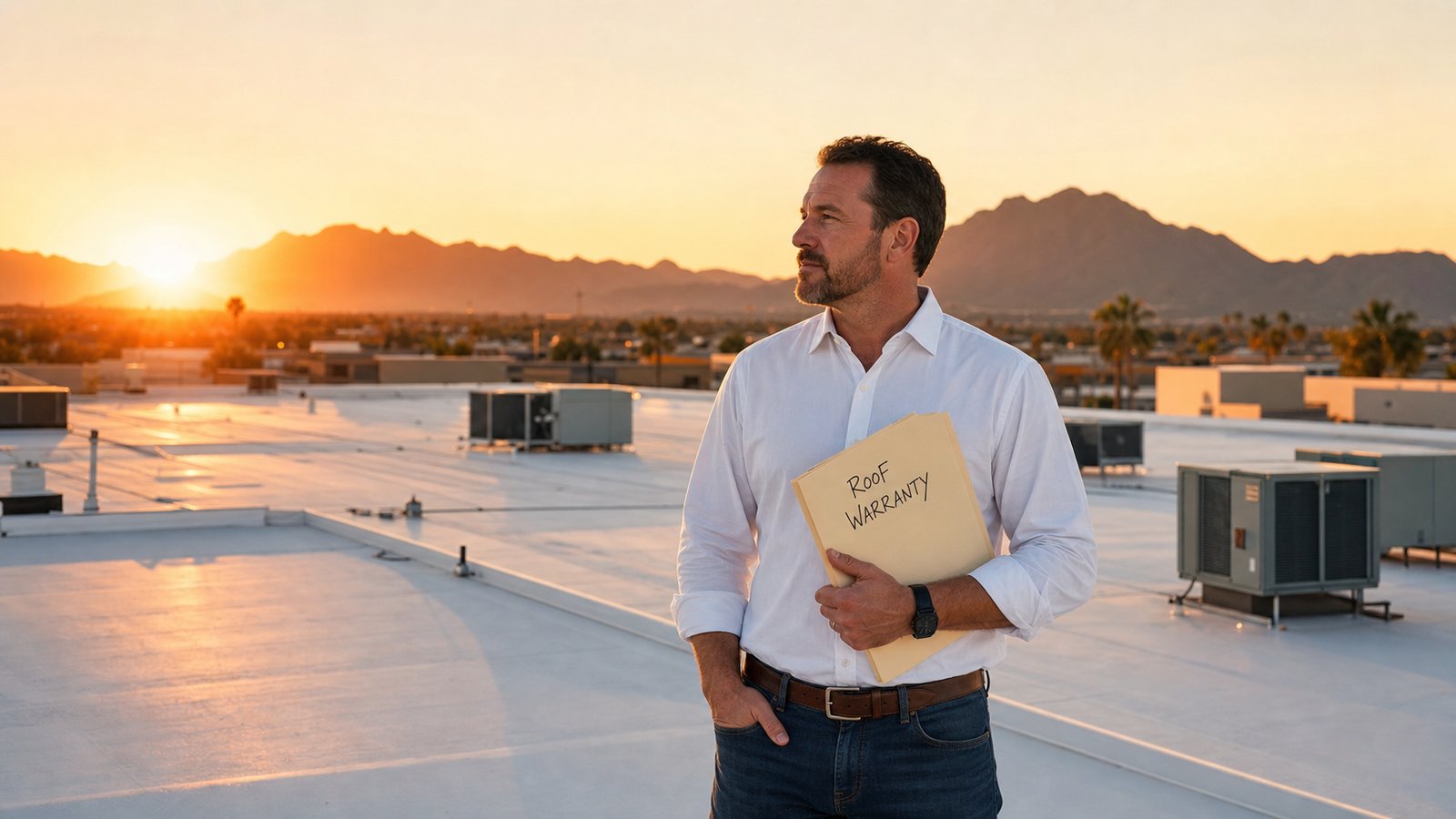
I have sat across the table from property managers, HOA boards, and church trustees who thought they had a 20-year commercial roof warranty in Phoenix and found out the hard way it only covered material defects — not the leaking flashing that was actually the problem. This guide is the honest version of that conversation. What manufacturer warranties actually cover. What contractor warranties actually cover. What voids either one. And the fine-print traps that get triggered every summer in the Arizona sun.
The one-sentence version: A manufacturer warranty covers the roofing material itself. A contractor warranty covers how it was installed. The material almost never fails first in Phoenix — the installation does. Which is why the contractor warranty is usually the more important number, even though the manufacturer's is bigger and louder in the sales pitch.
The two warranties on every commercial roof
Every legitimate new commercial roof in Phoenix comes with two separate pieces of paper. If a contractor gives you one and calls it your "roof warranty," ask which one is missing.
- The manufacturer warranty (product warranty) — issued by GAF, Versico, Firestone, Carlisle, JM, or the coating manufacturer. Covers defects in the actual roofing material. Runs 10 to 30 years depending on the system and tier. Almost never covers labor to install a replacement.
- The contractor warranty (workmanship warranty) — issued by the installing roofing company. Covers how the roof was installed — seams, flashings, terminations, penetrations, drains. Runs 1 to 10 years in most cases. Covers the labor to fix installation defects.
Here is where it gets interesting. If your commercial roof in Chandler springs a leak in year 4, which one pays?
Statistically, in the Phoenix metro, over 85% of commercial roof leaks in the first 10 years trace back to a workmanship issue — a seam that wasn't welded fully, a flashing that wasn't lapped correctly, an HVAC curb that wasn't sealed to spec, a drain that wasn't reset. All of those are the contractor's warranty. The manufacturer's warranty says "membrane worked fine — the labor failed" and pays nothing.
The ripoff pattern: A contractor advertises a "30-year warranty" on a commercial TPO roof in Phoenix. What they mean is the manufacturer product warranty. Their own workmanship warranty is 1 year. In year 3, when a seam pops from Phoenix heat cycling, they are legally off the hook, and the manufacturer says the material is fine. You get to pay to fix their bad install out of pocket. This happens more than most owners realize.
Manufacturer warranty tiers you'll actually see in Arizona
Not all manufacturer warranties are created equal. Most manufacturers offer three tiers, with dramatically different coverage. The one on your quote page matters more than the number of years next to it.
NDL is the tier you actually want on a commercial roof over $150,000. It adds roughly 5 to 12 percent to the project cost, requires a manufacturer-certified installer (Vanguard is GAF-certified and Versico-certified for exactly this reason), and typically includes a mandatory pre-install and post-install manufacturer inspection. On a 40,000 sq ft warehouse in Mesa, the NDL upgrade might cost $18,000 more up front and pay back the first time you have a covered seam failure in year 12. On a 5,000 sq ft strip center, the standard system warranty is usually enough.
Contractor workmanship warranties: what to demand
The workmanship warranty is your only real protection against a bad install. Here is how to read it and what to insist on:
- Minimum length. Never accept less than 2 years workmanship on a commercial roof over $50,000. Industry standard is 2 to 5 years. Strong contractors offer 5 to 10 years. Anything under 2 years is a red flag — the contractor knows their install won't hold and they're pricing that risk into a short warranty.
- Coverage scope. The warranty document should specifically list seams, flashings, terminations, penetrations, drains, HVAC curbs, and edge metal. If any of those are excluded, it's a limited warranty and worth less.
- Response time. A good workmanship warranty specifies a response window — 48 to 72 hours for non-emergency, same-day for active leaks. Vague language like "reasonable time" is a red flag.
- Transfer clause. If you sell the property, does the warranty transfer? Some do (usually with a fee), most don't. If you own multiple commercial buildings and might sell one, this matters a lot.
- Voiding conditions. Read this section twice. If the warranty says "any modifications to the roof void this warranty," a solar install or new HVAC unit will kill it. Ask for the manufacturer notification carveout in writing.
- Contractor's business stability. A 10-year workmanship warranty from a 2-year-old contractor with no AZ ROC bond is worth less than a 5-year warranty from a 15-year contractor with a $50,000 bond. Verify AZ ROC status at roc.az.gov before you sign.
Vanguard's standard commercial roof workmanship warranty is 5 years on installs, 2 years on repairs, and 3 years on coatings, matched to the manufacturer's warranty schedule. On NDL projects we extend the workmanship warranty to match the manufacturer's 20-year window through Versico's Total System certification.
The 8 things that quietly void your Phoenix commercial roof warranty
These are the warranty killers I see triggered every summer in the Arizona sun. Almost every one of them is preventable if you know it's in the exclusions list.
- Unauthorized repairs. A different roofing company patches a leak. Even if the repair is technically fine, most warranties immediately void because a non-certified contractor touched the system. This is the number one warranty killer in Phoenix.
- Rooftop equipment additions without notification. Solar panels, satellite dishes, new HVAC units, sign supports, EV chargers, cellular equipment. Every penetration and every point load must be pre-approved and installed to the manufacturer's spec. Add a solar array without telling them and the warranty is gone.
- Missed annual inspections and maintenance. Virtually every manufacturer warranty requires documented annual inspections. No inspection records = no warranty claim. Save every invoice.
- Ponding water over 48 hours. Manufacturer language calls this "positive drainage failure." If any spot on your Phoenix roof holds water more than 48 hours after a rain, that area is excluded from warranty coverage — even if the roof itself is fine.
- Chemical exposure. HVAC oil, kitchen exhaust grease, industrial discharge, cleaning chemicals. TPO especially hates hydrocarbon oil. Any documented chemical exposure voids the warranty around that area.
- Foot traffic without walk pads. HVAC service traffic, satellite installers, window washers. If they leave marks and there are no walk pads, the resulting damage isn't covered.
- Hail damage above policy limits. Most warranties exclude damage from hail above a certain size (usually 1.25" to 1.5"). This one is expected — that's why you have insurance — but many owners don't realize it isn't the warranty's job.
- Property sale without transfer registration. If you sell the property without registering the warranty transfer, the new owner has nothing. And you're no longer covered either. This is the sneakiest one.
Warranty by roof system in Phoenix
Typical 2026 Phoenix metro warranty tiers by commercial roof system, based on what we quote and what our manufacturer partners publish.
Notice that Vanguard's workmanship warranty is always as long or longer than the industry standard for that system. That's not marketing — it's a function of how we spec the job and which manufacturer program we run it under. When we tell you the workmanship warranty is 5 years, that means we know the install will hold that long in the Phoenix sun.
Reading the fine print: 5 questions to ask before you sign
Bring these five questions to your next Phoenix commercial roofing proposal walk-through. If the contractor can't answer any of them clearly, you have your answer about the warranty.
- Which warranty tier are you quoting — standard, system, or NDL? If they hesitate, they don't know the difference. Walk.
- How long is your workmanship warranty specifically? Get the number. In writing. Signed. Anything under 2 years is a red flag.
- What are the exclusions and voiding conditions? Request the actual warranty document, not the marketing summary. Read the exclusions section. All of it.
- What does an annual maintenance inspection cost, and is it required to keep the warranty in force? Most manufacturer warranties require it. Some contractors bundle it. Some don't. Know before you sign.
- Are you manufacturer-certified for the tier you're quoting? Verify at the manufacturer's website. GAF, Versico, Carlisle, JM all have public contractor lookup tools.
The Phoenix-specific warranty traps
Some warranty exclusions hit Arizona owners harder than owners anywhere else in the country. Watch for these:
- High-UV degradation exclusions. Some manufacturers reduce the warranty period in high-UV zones. Phoenix averages UV index 11+ for 4 to 5 months per year, which is technically "extreme." Look for the UV zone language.
- Monsoon ponding exclusions. "Damage from prolonged water contact" is standard language, but in Phoenix that means every monsoon storm creates warranty-excluded ponding on flat sections without perfect drainage.
- Thermal cycling exclusions on foam roofs. Phoenix daily temperature swings of 40°F+ are hard on SPF and its topcoat. Some warranties exclude damage from "abnormal thermal stress." That language is squishy — get clarification in writing.
- Solar panel integration. If you plan to add solar within the warranty period, get the roof manufacturer's approved solar mounting spec before installation. APS and SRP incentive programs are pushing solar hard in Arizona, and many owners add panels 3 years in and unknowingly void a 20-year warranty.
None of these are dealbreakers — but they're negotiable line items you can push back on before signing. The right time to fix a warranty problem is at the proposal stage. The wrong time is when you have a leak.
How Vanguard structures warranties on our commercial installs
For our Phoenix metro commercial clients, here's how we structure warranty coverage on a new installation:
- Manufacturer warranty at the highest tier the project qualifies for — usually a Versico 20-year NDL for TPO or a GAF Diamond Pledge for modified bitumen. NDL is our default recommendation on any commercial roof over 15,000 sq ft.
- 5-year workmanship warranty on installs as standard. Extended to match manufacturer NDL length on eligible projects.
- 2-year workmanship on repairs and 3-year workmanship on coatings.
- Written annual inspection and maintenance schedule included with every warranted install so you never miss a required inspection.
- Full warranty documentation package at project close, including the manufacturer's warranty certificate, our workmanship warranty, the roof system spec, all invoices, and photo documentation of every stage.
- Transferable coverage where the manufacturer allows, with clear language in your workmanship warranty about property sale transfer.
If you're comparing warranty proposals from multiple contractors on a Phoenix commercial project, our related deep-dive at Why Your Commercial Roof Warranty Might Be Void Right Now walks through the specific voiding conditions in more detail.
Frequently asked questions
What is the difference between a manufacturer and a contractor roof warranty?
The manufacturer warranty covers the physical roofing material against defects. The contractor warranty covers how the roof was installed — seams, flashings, terminations, and penetrations. Manufacturer warranties are longer but rarely cover labor. Contractor warranties are shorter but cover the labor. On a real Phoenix commercial roof leak, the failure is almost always at a workmanship point, so the contractor warranty is what actually pays.
What voids a commercial roof warranty in Phoenix?
The five most common warranty killers in Phoenix: unauthorized repairs by non-certified contractors, rooftop equipment additions like solar or HVAC without manufacturer notification, missed annual inspections, ponding water lasting over 48 hours, and chemical exposure from HVAC oil or kitchen exhaust. Read the exclusions section of your specific warranty — it will list all of these and more.
What is an NDL warranty on a commercial roof?
NDL stands for No Dollar Limit. It's the top tier of manufacturer warranty for TPO, PVC, and modified bitumen commercial roofs. The manufacturer covers full material and full labor for any covered defect with no maximum payout cap. NDL warranties require a manufacturer-certified installer, add 5 to 12 percent to the project cost, and typically run 20 years. On commercial roofs over $150,000, they almost always pay back.
How long is a typical commercial roof warranty in Arizona?
Manufacturer warranties on commercial roofs typically run 10 to 30 years — 20 to 30 on TPO NDL, 10 to 20 on foam and silicone, 15 to 20 on modified bitumen. Contractor workmanship warranties typically run 1 to 10 years; 2 to 5 is standard, 10 is strong. Anything under 2 years on a commercial roof is a red flag.
Should I choose a longer manufacturer warranty or a longer contractor warranty?
Both matter, but they cover different failure modes. For new installs, prioritize the workmanship warranty — installation defects show up in years 1 to 5. For recoats and restorations, the manufacturer coating warranty is usually the more important number. A good rule: never accept less than a 5-year workmanship warranty on any new commercial roof over $50,000.
Can I transfer a commercial roof warranty to a new building owner?
Most manufacturer commercial roof warranties are transferable one time to a new owner within 30 to 60 days of the property sale. Some require a formal transfer application and a $100-$500 fee. Contractor workmanship warranties are typically not transferable unless the new owner signs a maintenance contract with the same contractor. If you're buying a Phoenix commercial building, request all warranty documents and start the transfer process before closing.
Related reading
- Why Your Commercial Roof Warranty Might Be Void Right Now — the exclusions and voiding conditions in more detail
- 5 Things Property Managers Should Know About TPO Roofing — TPO warranty tiers and mil thickness explained
- The True Cost of Commercial Roof Replacement in Arizona (2026) — pricing by system and how warranties affect the number
- Commercial Roof Insurance Claim Documentation: A Phoenix 2026 Guide — when warranty ends and insurance begins