
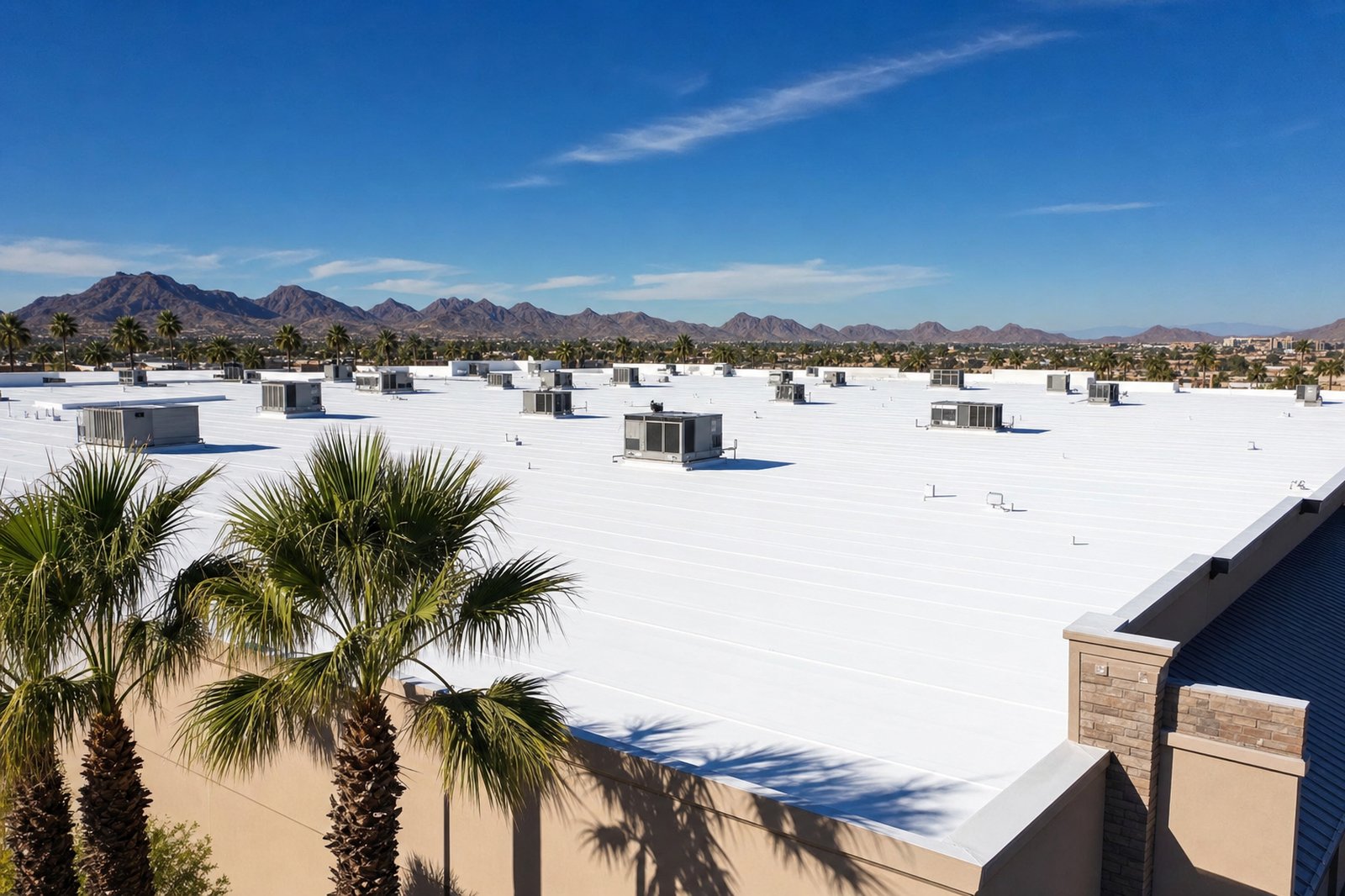
TPO roofing in Phoenix has become the default answer for a lot of property managers who want a white, reflective, single-ply roof at a reasonable price. It deserves the popularity — TPO is a legitimately good system. But most of the property managers I meet buy TPO the same way they'd buy carpet: they pick a color, they get three bids, they take the middle one. That works for carpet. It doesn't work for a system that has to survive twenty summers of Phoenix UV and monsoon.
The short version: TPO thickness matters way more than the sales pitch admits. Seam welding quality is the whole game. Reflectivity fades. Warranties have teeth. And TPO is not always the right call — sometimes foam or PVC beats it hands down for a specific building. Read these five things before you sign anything.
1. Thickness is not a spec detail — it's the whole conversation
TPO membrane comes in three common thicknesses: 45-mil, 60-mil, and 80-mil. A mil is one thousandth of an inch. That means the difference between the cheapest and most durable TPO on a Phoenix roof is less than a millimeter of total thickness — and it changes everything about how long the roof lasts.
The National Roofing Contractors Association and IIBEC (the building enclosure engineers) both flag membrane thickness as the number-one predictor of TPO service life in high-UV climates. In Phoenix, where NOAA data shows we hit 100°F or higher for 100+ days most years, that number matters more here than almost anywhere else in the country.
Here's the sales trick to watch for: a contractor bids "60-mil TPO" at a price that's suspiciously close to another contractor's "45-mil TPO". Read the contract. Sometimes what shows up on the truck is 45-mil. If the delivered mil isn't specified in writing with the manufacturer part number, you have no recourse. Ask for the material submittal before you sign. Every legitimate TPO manufacturer publishes it — GAF EverGuard TPO, Versico VersiWeld, Carlisle Sure-Weld, Firestone UltraPly. Get the exact SKU.
2. The seams are the roof — not the membrane
TPO doesn't fail in the middle of a sheet. It fails at the seams — every single time. Every seam in a TPO roof is heat-welded on site by a technician running a hot-air welder at roughly 900°F. Two sheets of TPO fuse together into what should be a monolithic bond. When it works, it's better than the parent material. When it doesn't, water finds it in the first monsoon.
A cold weld — one where the temperature was too low, the pressure was wrong, or the surface was dirty — looks identical to a good weld on install day. It might hold for a year. It will not hold for twenty. The NRCA and every major TPO manufacturer require probe testing (running a metal probe along each seam under tension) to verify weld integrity. On a properly run job, every linear foot of seam is probed. On a rushed job, they check a few and call it good.
What this means for a Phoenix property manager: who installs your TPO matters more than which TPO you buy. A 45-mil TPO installed with clean, probed, hot-welded seams by an experienced crew will outlast an 80-mil TPO thrown down by a crew learning on the job. Ask three questions before you sign: (1) Is the crew manufacturer-certified? (2) What's their weld temperature protocol? (3) Do they probe-test every seam? Any hesitation is a red flag.
3. Reflectivity is real — but it fades
TPO is one of the reasons Phoenix commercial buildings went from black roofs to white roofs over the last twenty years. A new white TPO membrane reflects about 78-85% of solar radiation and carries an ENERGY STAR label along with CRRC-listed initial solar reflectance values. That reflectivity translates to real cooling savings — the U.S. Department of Energy estimates cool roofs can cut peak cooling demand 10-15% on a Phoenix commercial building.
Here's what most sales pitches don't tell you: reflectivity fades. Three years of Phoenix UV, monsoon dust storms, and rooftop foot traffic drops TPO reflectance by 15-25% from the original spec. The CRRC also publishes aged reflectance values (measured after three years of weathering) — always look at those, not the initial numbers, when calculating expected cooling savings. A 60-mil white TPO that starts at 0.79 initial reflectance is typically down to 0.60 by year three in Phoenix.
The fix is cleaning. A TPO roof washed once every 18-24 months in the Phoenix metro can hold reflectance meaningfully higher than one that never gets touched. Some manufacturers include cleaning in the required maintenance to keep the warranty valid. Check yours.
4. The warranty is the product — but only if you actually maintain it
A TPO roof without a manufacturer NDL warranty is a much worse asset than a TPO roof with one. NDL — No Dollar Limit — means the manufacturer will pay to repair or replace defective material up to whatever it costs, with no ceiling. On a 40,000 SF Phoenix warehouse, that's the difference between a covered claim and a $300,000+ out-of-pocket surprise.
But — and this is the part that catches property managers off guard — every NDL TPO warranty comes with maintenance conditions. Miss the annual inspection, let an HVAC crew punch a hole without notifying the manufacturer, or let ponding water sit past 48 hours during monsoon, and the warranty can be voided silently. About half the Phoenix TPO roofs I inspect have warranties the owner thinks are active but that the manufacturer has already voided due to a missed maintenance event.
Warranty length is also negotiable at bid time — many contractors bid the shorter warranty (15 or 20 years) because it lowers their material cost. If you're the buyer, ask for the 25 or 30-year NDL option and compare the price delta. Often it's less than 5% of the total roof cost. Full breakdown of how commercial roof warranties actually work is in our recent post on why your commercial roof warranty might be void right now.
5. TPO isn't always the right call
I'll install TPO all day when it's the right system. It's not always the right system. The three most common Phoenix scenarios where a different roof beats TPO:
- Existing roof with heavy HVAC penetrations and no tear-off budget. Spray polyurethane foam (SPF) can go directly over an existing built-up or modified bitumen roof and self-flash every penetration seamlessly. Less labor, no seams, and a monolithic surface. When the deck is intact but riddled with 40 HVAC curbs, foam wins.
- Restaurants, medical, or high-chemical exposure. PVC (not TPO) holds up to grease, restaurant exhaust, and chemical spills much better than TPO. If your tenants are commercial kitchens or medical, look at PVC — the material cost is higher but the roof lasts longer in that environment.
- Buildings you're going to hold 25+ years. If you're a long-hold owner with intent to keep the property through multiple roof cycles, an 80-mil TPO or an SPF/silicone recoat system can both make sense. Do the 25-year total-cost-of-ownership math with your contractor, not just the year-one bid.
The honest recommendation: for a typical Phoenix commercial building on a 20-year hold cycle — retail center, office building, warehouse — a 60-mil TPO with a 25-year NDL warranty from a manufacturer-certified installer is one of the best value roofing systems you can buy in Arizona. Just don't confuse "TPO" with a commodity purchase. The thickness, the installer, the warranty, and the annual maintenance all matter more than the sticker price.
Frequently asked questions
How long does TPO roofing last in Phoenix?
In the Phoenix metro, a properly installed 60-mil or 80-mil TPO roof typically delivers 18 to 22 years of service life, with the manufacturer's NDL warranty running 20 to 30 years. Reflectivity drops meaningfully after year 8-10 as UV cooks the surface, but the membrane itself keeps water out well past two decades if seams and penetrations are maintained. 45-mil TPO — the thinnest common thickness — usually taps out around 12 to 15 years in Phoenix and is not what I recommend for our climate.
What thickness of TPO should I use in Phoenix?
60-mil is the minimum I install in Phoenix for any commercial roof I'm putting my name on. 80-mil (or 90-mil, if the manufacturer offers it) is the smart choice for buildings with heavy HVAC traffic, foot traffic from tenants, or high-heat exposure. 45-mil is fine for a Portland warehouse. It's not adequate for a 118°F rooftop with three-inch monsoon downpours.
Is TPO better than foam roofing in Arizona?
It depends on the building. TPO is excellent for new construction and total tear-off replacements where you're starting fresh — you get a bright white, ENERGY STAR-rated roof with a clean warranty. Foam (SPF) is often better for existing buildings with irregular decks, HVAC penetrations, or where a full tear-off would trigger structural work. Neither is universally "better" — the honest answer depends on your deck, your penetration density, and how long you plan to hold the property. Our TPO vs foam comparison goes deeper.
Do TPO seams really fail?
The membrane rarely fails. The seams do — because the seams ARE the roof system in TPO. Every seam is heat-welded on site with a hot air welder at 900°F. A cold weld looks fine on install day and starts leaking two years later. Seam quality is entirely dependent on installer skill, welder temperature, weld probe testing, and site conditions. This is why "lowest bid TPO" is one of the most expensive mistakes a property manager can make.
What voids a TPO roof warranty?
The usual list: skipped annual inspections, unapproved contractors performing repairs, HVAC or solar penetrations installed without manufacturer signoff, ponding water past 48 hours, and any modification to the drainage plan. TPO warranties from GAF, Versico, Carlisle, and Firestone are strict on these — a single missed inspection can silently void a 25-year NDL. Same rules as any commercial NDL warranty.
How much does TPO roofing cost per square foot in Phoenix?
As of 2026, a 60-mil TPO commercial roof installation in the Phoenix metro runs $8 to $14 per square foot for a full replacement, depending on deck condition, insulation R-value, tear-off costs, and manufacturer/warranty tier. 80-mil TPO runs $10 to $17. A recoat is not applicable to TPO — unlike foam, TPO doesn't get recoated, it gets repaired or replaced. Budget accordingly on a 20-year cycle.
Related reading
- TPO vs Foam Roofing in Phoenix — head-to-head comparison for Arizona commercial buildings
- Why Your Commercial Roof Warranty Might Be Void Right Now — the 8 clauses that quietly kill coverage
- Commercial Roof Replacement Cost in Arizona — real 2026 numbers by system
- Monsoon Season Roof Prep Checklist — the annual walkthrough that also keeps your warranty alive