
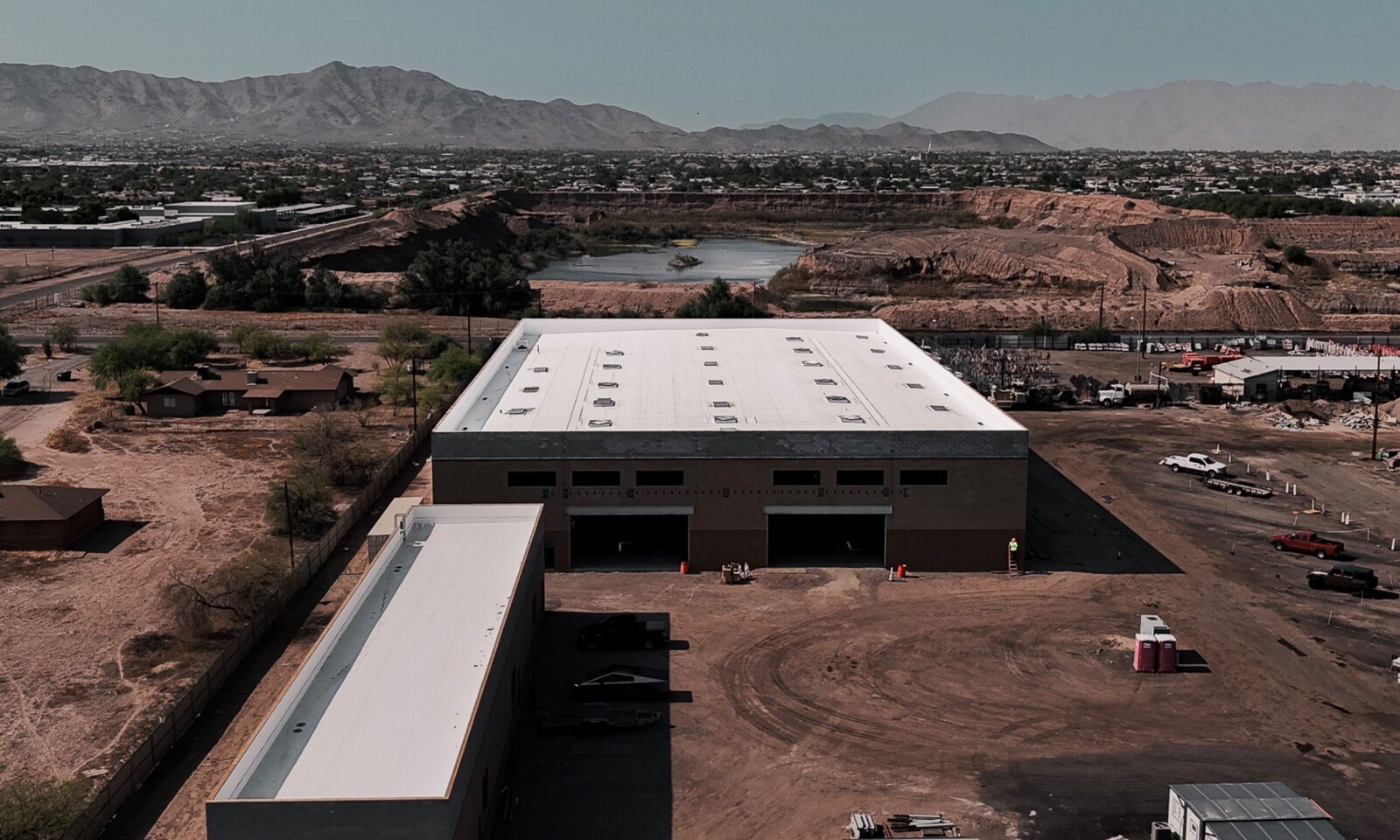
Case Study: 41,550 SF Versico TPO Industrial New Construction — South Phoenix
A new multi-bay industrial facility in one of the Valley's fastest-growing submarkets, a bare steel deck the size of nearly an acre, and a general contractor's schedule with no room to slip. We installed 41,550 square feet of 60-mil Versico fully adhered TPO over Versico R26 poly iso in 14 working days — every square foot bonded to the substrate for maximum wind uplift, positive-slope crickets for drainage, and adhesively applied walk pads at every service point — backed by a 20-Year Versico NDL warranty.
Project SnapshotThe Talis Industrial roof at a glance
This is 41,550 square feet of new industrial roofing at 4002 W Wier Ave in South Phoenix, one of the Valley's fastest-growing industrial submarkets. Talis Construction, the general contractor, hired Vanguard Roofing AZ directly for the roof scope on this multi-bay facility. Here are the project facts at a glance.
Talis Industrial — 4002 W Wier Ave, South Phoenix, AZ
| Property | 38,200 sq ft industrial facility (multi-bay) |
| Location | 4002 W Wier Ave, Phoenix, AZ 85041 (South Phoenix) |
| Roof Size | 41,550 sq ft total (main + tapered + parapets) |
| Substrate | Steel deck (new construction) |
| Insulation | Versico R26 — two layers 2" poly iso + tapered polyisocyanurate |
| System | 60-mil Versico Fully Adhered TPO |
| Timeline | 14 days |
| Investment | $7–$12 per sq ft |
| Warranty | 20-Year Versico NDL |
| General Contractor | Talis Construction |
| Completed | July 2026 |
The ProjectNearly an acre of new industrial roof in South Phoenix
South Phoenix has become one of the Valley's fastest-growing industrial submarkets — a corridor of distribution, manufacturing, and logistics facilities rising along the freeways south of downtown. The Talis Construction project at 4002 W Wier Ave is a textbook example: a 38,200 sq ft multi-bay industrial building whose roof, once parapets and tapered areas are counted, totaled 41,550 square feet of TPO — very nearly an acre of continuous membrane going down over a brand-new steel deck.
Talis Construction, the general contractor, brought Vanguard in directly for the roof scope rather than layering it through a chain of subcontractors. At this scale, and on a tight new-construction schedule, that direct relationship matters: one certified roofing contractor owns the entire assembly from bare deck to warranty registration, and coordinates with the GC so the roof is never the bottleneck. Two factors drove the system choice — the sheer scale of the roof and Arizona's monsoon wind loads — and both pointed to the same answer: a fully adhered TPO system with maximum insulation. For more on how we serve builders and owners across the region, see our industrial and warehouse roofing page and our Phoenix commercial roofing overview.
The SystemWhy Versico fully adhered TPO
Versico, part of the Carlisle family of roofing companies, is one of the top three commercial TPO brands in North America. For a building this size in Arizona's wind country, we specified 60-mil Versico fully adhered TPO — specifically the VersiWeld reinforced membrane with Versico's OctaGuard XT weathering package — and the word that matters most there is adhered. See our full TPO roofing services for how the system fits the broader commercial picture.
- Fully adhered — every square foot bonded. Rather than screwing the membrane down at intervals, a fully adhered system bonds the entire membrane to the substrate with Versico bonding adhesive. There are no fasteners penetrating the deck, which means superior wind-uplift performance — critical for a large industrial roof exposed to Arizona monsoon gusts.
- 60-mil membrane — the industrial-grade spec. The 60-mil thickness gives a robust weathering layer above the reinforcing scrim, standing up to decades of UV, heat, and the heavy service traffic an industrial roof attracts.
- Fewer leak points, quieter roof. No fastener penetrations means fewer potential leak points and less wind flutter — a meaningful benefit for a facility with sensitive equipment or occupants below.
- 20-Year Versico NDL warranty. Versico's No Dollar Limit warranty matches or exceeds every competitor in the fully-adhered category, covering materials and labor with no dollar cap for the full term.
For a smaller or lower-risk building, mechanically fastened TPO is often the smarter economic choice — it's exactly what we used on our Verde at Cooley Station retail project. But at 41,550 square feet in a wind-exposed industrial corridor, the wind performance and longevity of a fully adhered system earn their premium.
The Insulation StoryR26 plus tapered — energy and drainage in one assembly
The insulation on a flat roof does two jobs, and on Talis Industrial we engineered the assembly to do both. First, thermal performance: we built R26 from two staggered layers of 2-inch Versico poly iso board. Staggering the joints between the two layers eliminates the thermal bridging and gaps that a single layer would leave, giving a continuous, code-compliant R-value that meaningfully lowers cooling load — a serious consideration for an industrial building baking in the South Phoenix sun.
Second, drainage. A structural steel deck is essentially dead flat, and dead-flat roofs pond water. To solve that, we set tapered polyisocyanurate insulation in the low areas and cricket zones. Tapered polyiso is cut at an angle so it builds slope on top of the flat deck, steering water toward the drains instead of letting it collect. Ponding water is the number-one cause of premature TPO failure, so building positive slope into the insulation isn't a nicety — it's how the roof stays dry and how the warranty stays valid. If you're weighing TPO against a foam system for a low-slope roof, our guide to TPO vs. foam roofing in Phoenix compares how each handles drainage.
Our ApproachThe 14-day industrial install, day by day
A roof this size is a logistics operation as much as a roofing one. Here's how the fourteen days ran, from the first material delivery to Versico warranty registration and turnover to Talis Construction.
Project sequence — 14 days on site
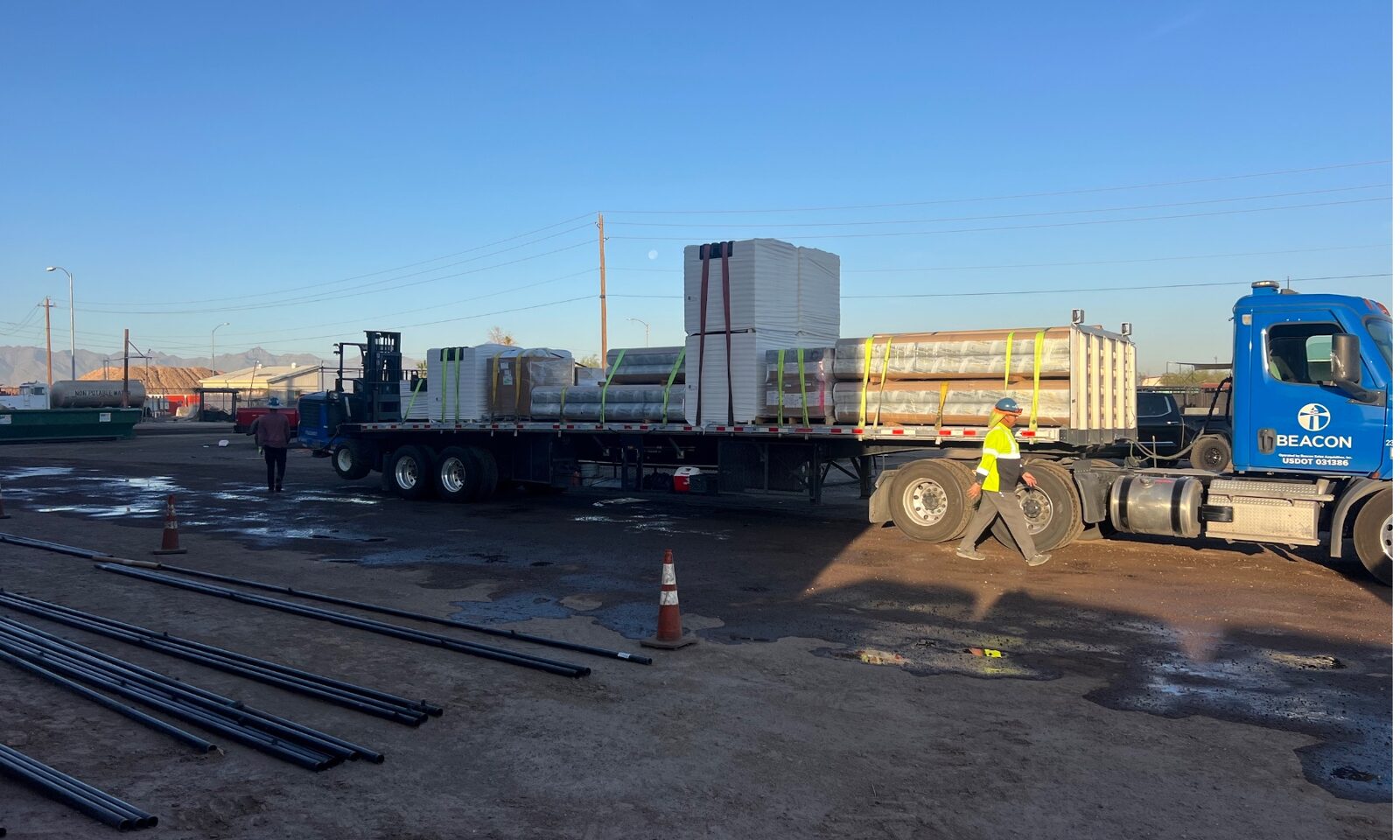
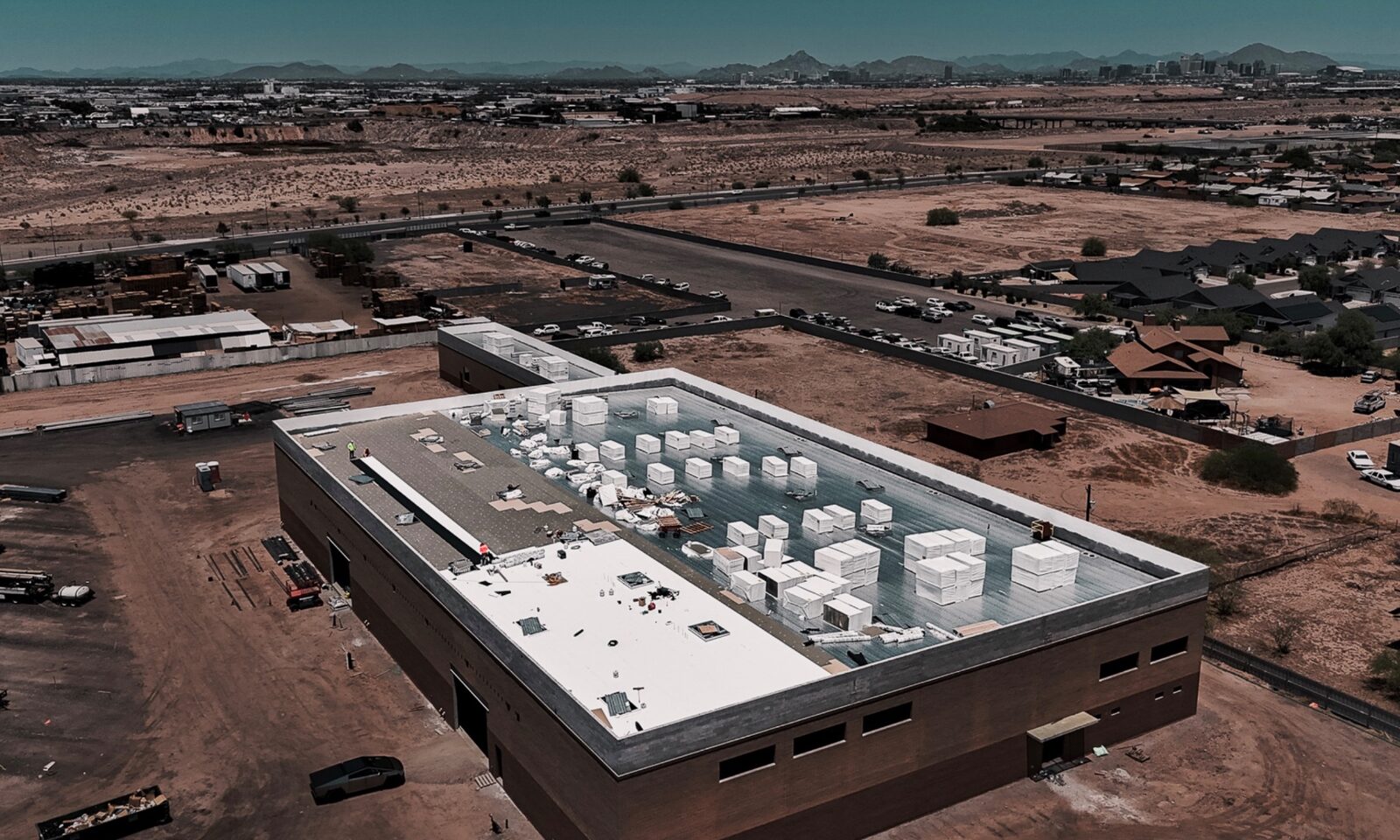
- Days 1–2 — Layout, moisture check, and staging. Set the layout, verified the deck was clean and dry, and took delivery of the Versico membrane and R26 poly iso, staging the boards across the deck for an efficient install.
- Days 3–5 — R26 poly iso. Installed the first 2-inch layer of poly iso, then a staggered second layer, plus tapered polyiso in the cricket zones — all fastened with screws and washer plates per Versico spec.
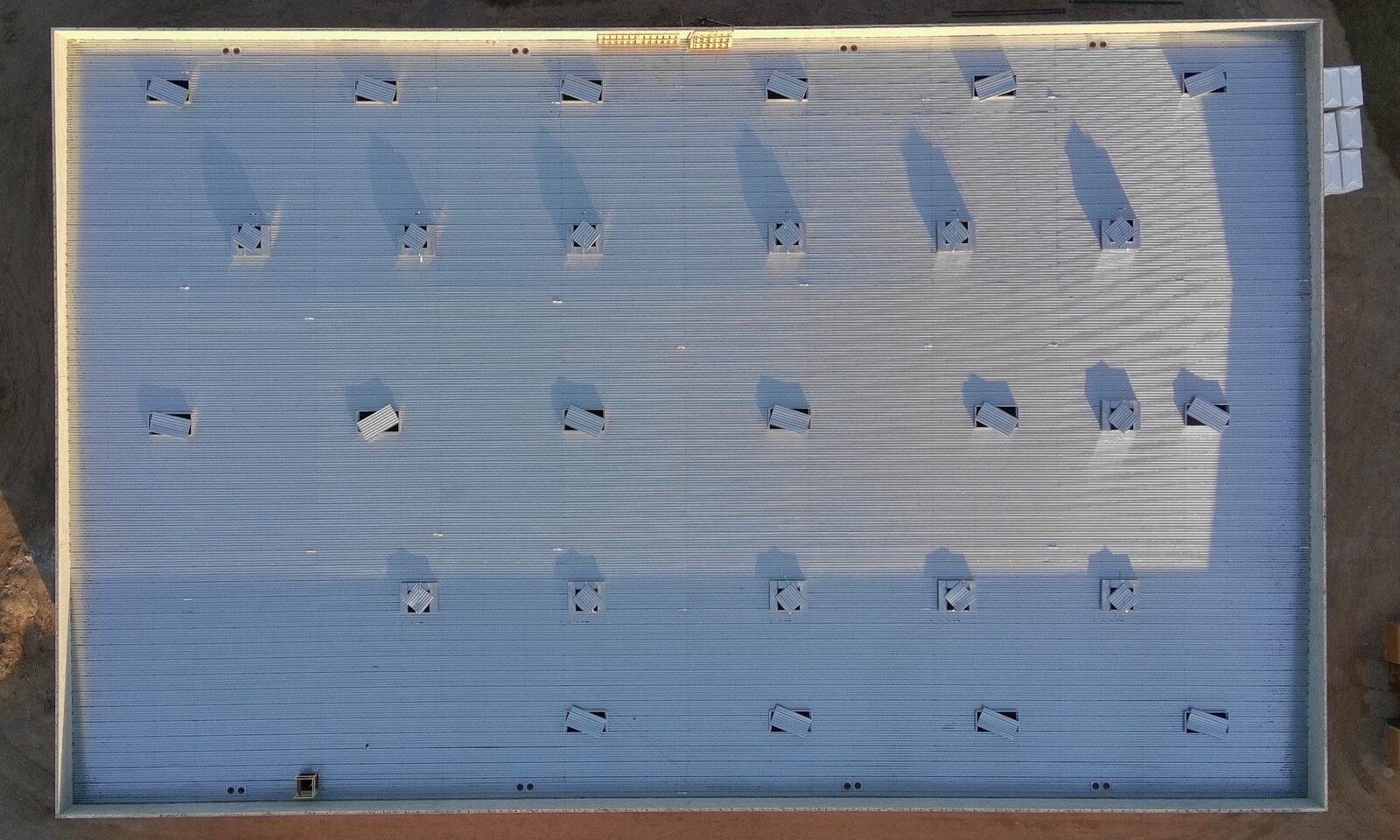
- Days 6–7 — Cricket system. Built the positive-slope Versico cricket system in the corners (per plans page 2) for guaranteed drainage.
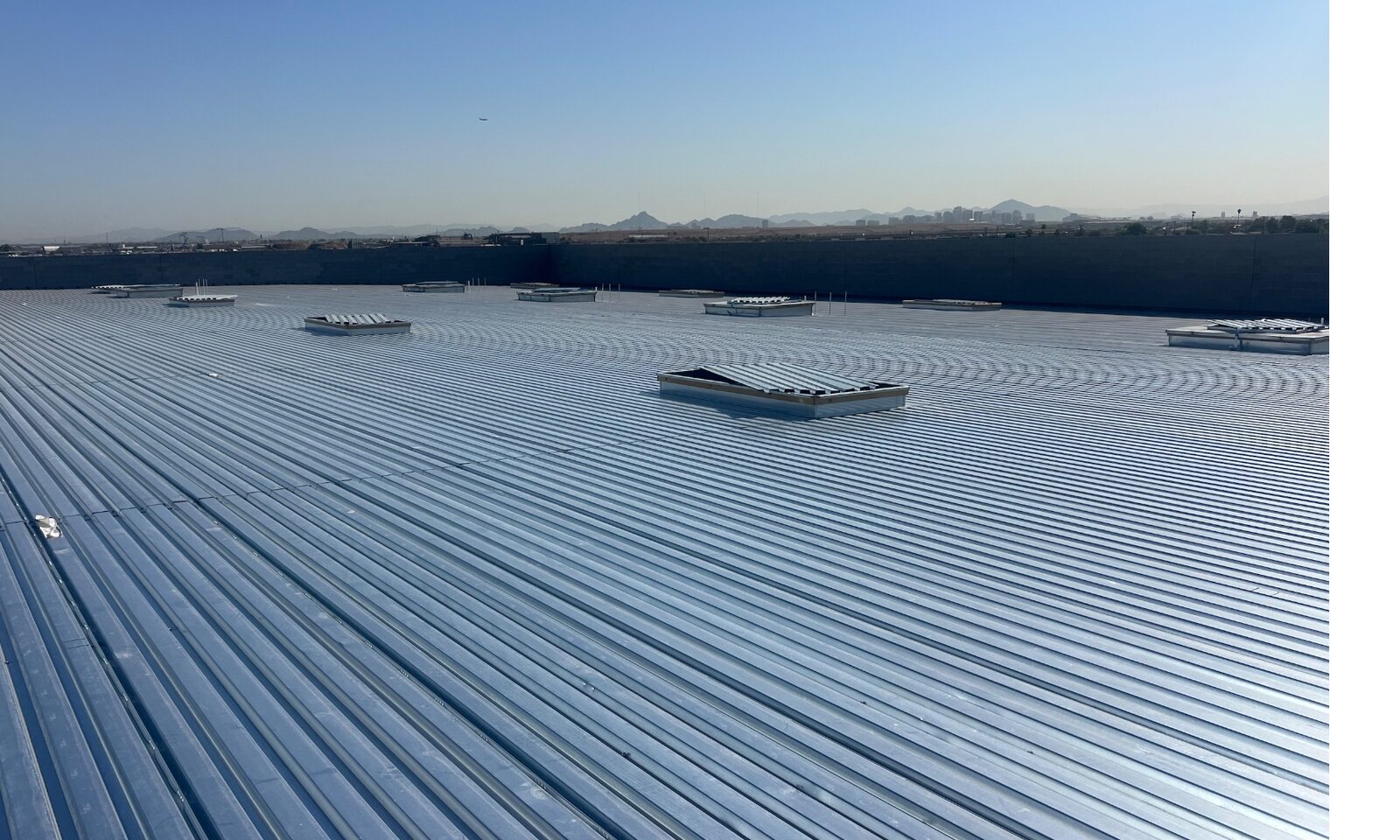
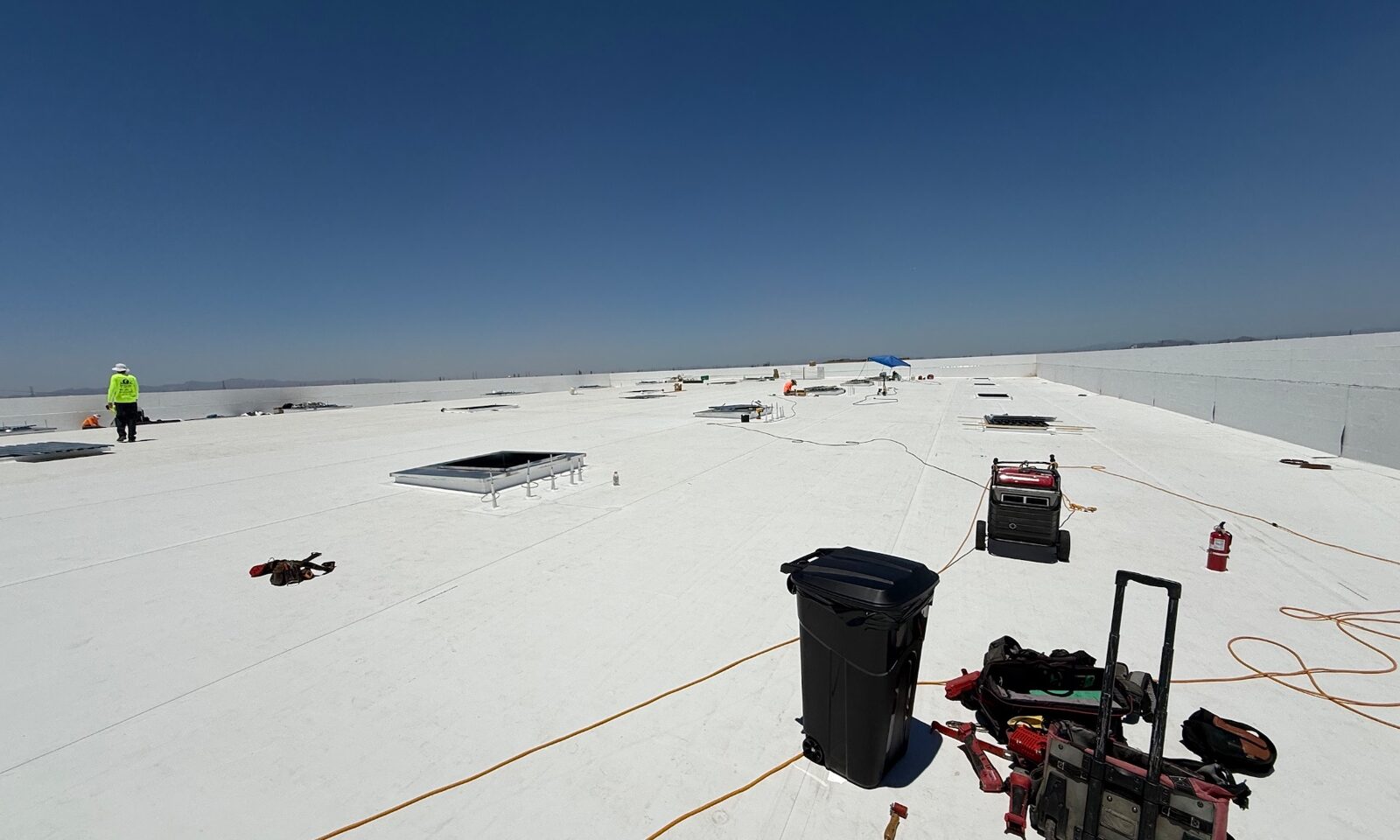
- Days 8–11 — 60-mil Versico TPO. Rolled out the membrane, applied Versico bonding adhesive, seated the TPO, hot-air welded every seam, and probe-tested each weld across the whole roof.
- Day 12 — Flash every penetration. Manufactured pipe cones, field-wrapped HVAC curbs in TPO, and TPO-into-drain terminations sealed with tape and adhesive.
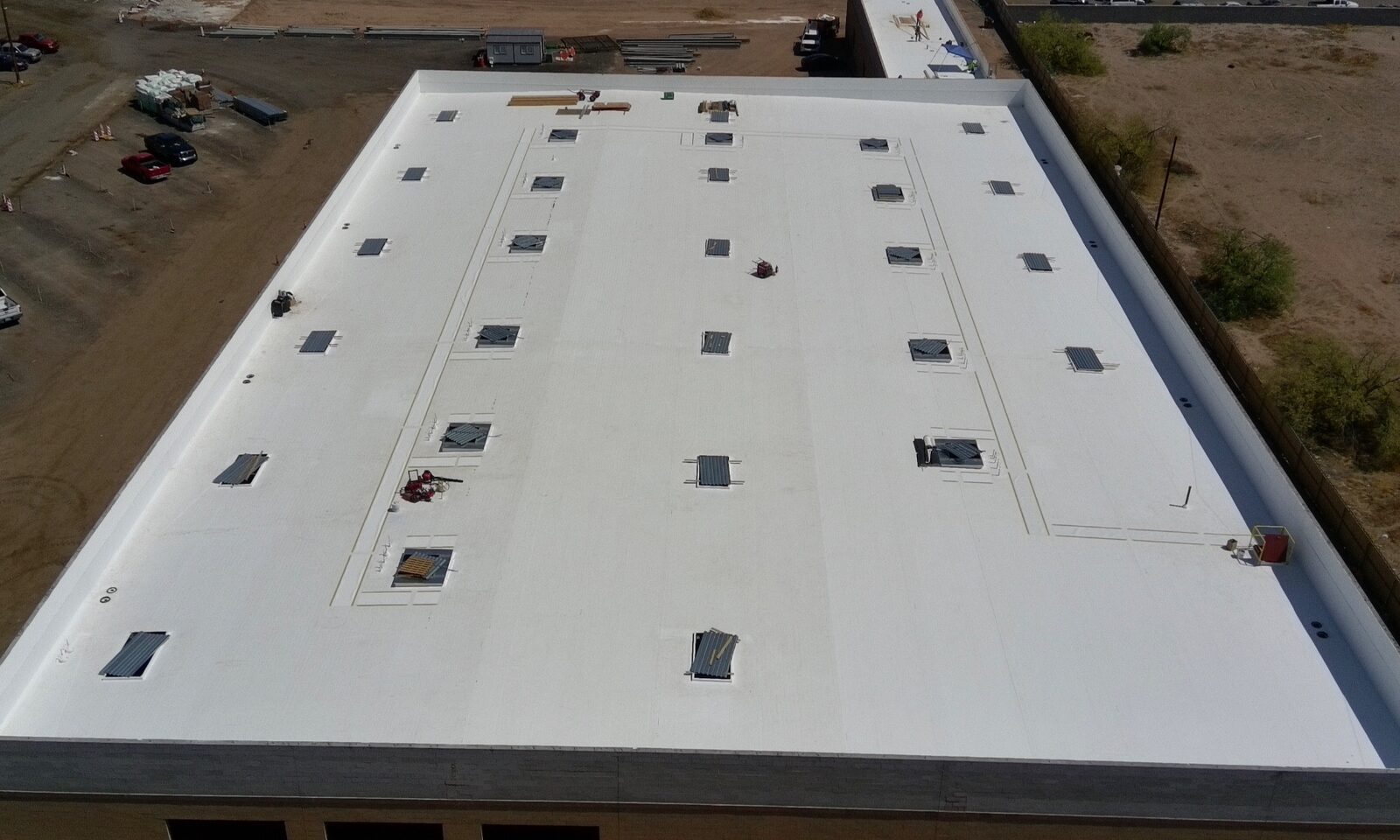
- Day 13 — Walk pads. Installed adhesively applied grey walk pads over the membrane — from the access door, around the AC units, and at the operational side of the outlying units.
- Day 14 — QC and warranty. Final quality control, full seam probe, wet-gauge verification, Versico warranty registration, and turnover to the GC.
Because Talis Construction hired Vanguard directly, we compressed this sequence around the GC's broader schedule without hand-offs — the roof was watertight, probe-tested, and warranty-registered on time, clearing the building for occupancy.
The ComparisonFully adhered vs. mechanically fastened — a plain-English breakdown
These are the two dominant ways to attach a TPO roof, and neither is universally "better" — the right one depends on the building. Here's the honest side-by-side we walk owners and GCs through:
- Fully adhered (what we used here) — the entire membrane is bonded to the substrate with adhesive. Better wind-uplift performance, no fastener penetrations, a quieter roof, and fewer potential leak points. Ideal for large industrial buildings and structures with sensitive equipment.
- Mechanically fastened — the membrane is screwed down at intervals with plates hidden in the seams. Faster to install and lower cost, making it a strong fit for smaller or lower-risk buildings.
On a 41,550 sq ft industrial roof in a wind-exposed South Phoenix corridor, the case for fully adhered was straightforward: the wind performance and longevity justify the higher cost. On a single-story retail box, the calculus flips — which is precisely why we used mechanically fastened on our Verde at Cooley Station retail case study. Matching the system to the building is the job; defaulting to whatever is cheapest to install is not.
The DetailWalk pads — the detail nobody talks about
Industrial roofs see more foot traffic than any other building type. HVAC technicians, solar installers, refrigeration crews, and general maintenance staff will be walking this roof for the next two decades — and concentrated foot traffic is one of the fastest ways to wear a TPO membrane thin at exactly the points where equipment gets serviced. That's why we installed adhesively applied grey walk pads over the membrane along every service route: from the access door, around the AC units, and at the operational side of the outlying units.
It's an unglamorous detail that never wins a bid, but skipping it is a false economy. Premature membrane damage from unprotected foot traffic can void the warranty and shorten the life of an otherwise sound roof. Protecting the membrane where people actually walk is one of the small, deliberate choices that separates a roof built to last from one built to look good on turnover day — the same standard we hold on every commercial and industrial project across Arizona.
The WarrantyThe 20-year Versico NDL — what it actually covers
The Talis Industrial roof is backed by a 20-Year Versico NDL warranty. Just like GAF's NDL, Versico's No Dollar Limit warranty covers materials and labor with no dollar cap for the full 20-year term if a covered defect causes a leak. That's a meaningful step up from a standard, material-only warranty, which would leave the building owner covering the labor — usually the larger cost — to open up and repair the roof.
As with every top-tier manufacturer warranty, there's a gate that protects the owner: only Versico-certified contractors can register the NDL. Vanguard's Versico certification — referenced across our site and on our about page — is what lets us extend this coverage. As a family-owned Arizona contractor operating since 1957 under founder Robert Wilson and licensed under AZ ROC CR-42 #289663 and R-62 #283025, we back that warranty with certified crews and the full documentation a GC and building owner need on file.
The Results41,550 sq ft, 14 days, zero deficiencies
The numbers tell the story of a large, complex industrial roof delivered clean and on schedule:
The finished roof cleared its Versico inspection with zero deficiencies, the 20-year NDL warranty was registered before the crew demobilized, and Talis Construction took over a watertight, probe-tested building ready for occupancy. That's what a properly sequenced, fully adhered industrial TPO install looks like at scale.
Photo GalleryFrom bare steel deck to finished Versico TPO
Before & delivery
Install
Completed
FAQVersico industrial TPO — common questions
What is Versico TPO?
Versico is one of the top three commercial TPO brands in North America and is part of the Carlisle family of roofing companies. Its VersiWeld TPO is a reinforced thermoplastic single-ply membrane with hot-air-welded seams, engineered for the heat and UV of climates like Arizona's. On the Talis Industrial project we installed 60-mil Versico fully adhered TPO over a new steel deck. As a Versico-certified contractor, Vanguard Roofing AZ can register Versico's top-tier 20-year NDL warranty on systems we install.
Fully adhered vs mechanically fastened TPO — which is better?
Neither is universally better — it depends on the building. Fully adhered TPO bonds every square foot of membrane to the substrate with adhesive, so there are no fasteners penetrating the deck. That delivers superior wind-uplift performance, a quieter roof, and fewer potential leak points — ideal for large industrial buildings and structures with sensitive equipment. Mechanically fastened TPO is faster and lower-cost and is an excellent fit for smaller or lower-risk buildings. On the 41,550 sq ft Talis Industrial roof we specified fully adhered; on our Verde at Cooley Station retail project we used mechanically fastened.
What is R26 poly iso insulation?
R26 refers to the thermal resistance (R-value) of the roof insulation. On Talis Industrial we built R26 from two staggered layers of 2-inch Versico poly iso board plus tapered polyisocyanurate in the low areas. The higher the R-value, the better the roof resists heat transfer, which directly lowers cooling load — a major factor for an industrial building in South Phoenix. The staggered joints and tapered pieces also matter structurally: they eliminate thermal gaps and build positive slope into an otherwise flat deck.
Why is tapered polyiso important for flat roofs?
A flat roof isn't truly flat — it needs slope to move water to the drains, and a structural steel deck usually can't provide it. Tapered polyisocyanurate insulation is cut at an angle so it builds that slope on top of the deck, directing water toward drains and eliminating the ponding that is the number-one cause of premature membrane failure. On Talis Industrial we set tapered polyiso in the cricket zones and low areas so water never sits on the roof, which is also a condition of the Versico NDL warranty.
Do you offer 20-year commercial roof warranties in Arizona?
Yes. Vanguard Roofing AZ is a Versico-certified and GAF-certified commercial contractor, which lets us register 20-year NDL (No Dollar Limit) warranties on qualifying TPO systems — including the Talis Industrial roof. An NDL covers both materials and labor with no dollar cap for the full 20-year term if a covered defect causes a leak. As a family-owned Arizona contractor licensed under AZ ROC CR-42 #289663 and R-62 #283025 and operating since 1957, we back that warranty with certified crews and full documentation.