
Case Study: 16,600 SF New Foam Roof and AC100 Recoat — 116 S Industrial Dr, Tempe
A 16,600 sq ft precision-manufacturing building at 116 S Industrial Dr in Tempe — home to Gold Tech Industries, a gold, silver, chrome and nickel plating operation — got a full new spray polyurethane foam roof and two coats of ARMORCOAT AC100 in a single continuous mobilization. Old foam scarified down to sound substrate, two fresh layers of new SPF sprayed edge-to-edge, every scupper and drain sealed with ArmorPutty and reinforcing membrane, and the whole 16,600 sq ft locked under two full coats of AC100. 10-year no-leak warranty on materials and labor.
Project Snapshot16,600 sq ft new spray polyurethane foam roof and 2-coat AC100 topcoat on a Tempe precision-manufacturing facility
116 S Industrial Dr sits inside the industrial belt of west Tempe — the working corridor between Broadway Rd and University Dr where Tempe's manufacturing, warehousing, and light-industrial base has operated for six decades. It's a short block off Priest Dr, minutes from Sky Harbor and the I-10 / US-60 / Loop 202 freeway triangle, and directly inside the industrial fabric that keeps the East Valley economy running. The building itself is a long single-tenant industrial box — a working manufacturing facility with rooftop HVAC serving production floors below, block-wall construction, and a flat spray-polyurethane-foam roof that runs the length of the property on Industrial Dr.
16,600 SF New Foam Roof — 116 S Industrial Dr, Tempe
| Property | Precision-manufacturing / industrial building — home to Gold Tech Industries, a gold, silver, chrome and nickel plating operation |
| Address | 116 S. Industrial Dr., Tempe, AZ 85281 |
| Building type | Single-tenant industrial / manufacturing — long rectangular flat-roof building along the Industrial Dr corridor in west Tempe |
| Roof size | 16,600 sq ft — one continuous SPF field |
| Roof system | NEW spray polyurethane foam roof (2 layers) with 2 coats of ARMORCOAT AC100 white elastomeric topcoat |
| Scope | Scarify existing foam down to sound foam substrate; clean roof surface; mask perimeter and penetrations; apply 2 layers of new polyurethane roofing foam edge-to-edge; seal all scuppers and drains with ArmorPutty and reinforcing membrane; seal all vent pipes and vents with ArmorPutty; apply first coat of ARMORCOAT AC100 premium white elastomeric; apply second coat of ARMORCOAT AC100; clean up all job-related debris |
| Neighborhood | Industrial Dr corridor, west Tempe 85281 — the industrial belt between Broadway Rd and University Dr, minutes from Sky Harbor, I-10 and ASU |
| Warranty | 10-year no-leak (materials + labor) |
| Completion | July 2026 |
The ProjectThe building, the client, and what we were solving for
116 S Industrial Dr sits inside the industrial belt of west Tempe — the working corridor between Broadway Rd and University Dr where Tempe's manufacturing, warehousing, and light-industrial base has operated for six decades. It's a short block off Priest Dr, minutes from Sky Harbor and the I-10 / US-60 / Loop 202 freeway triangle, and directly inside the industrial fabric that keeps the East Valley economy running. The building itself is a long single-tenant industrial box — a working manufacturing facility with rooftop HVAC serving production floors below, block-wall construction, and a flat spray-polyurethane-foam roof that runs the length of the property on Industrial Dr.
The tenant at 116 S Industrial Dr is Gold Tech Industries — a Tempe-based precision-plating manufacturer that provides gold, silver, chrome and nickel plating for a global customer base and was acquired by Graycliff Partners in 2021. Precision-plating means chemical baths, sensitive electronics, and controlled-environment production floors that cannot tolerate a roof leak. When Vanguard was engaged for the roof, the existing foam had reached the point where a repair-and-recoat wasn't the right move — the coating had failed, thermal cycling had opened up the field, and the substrate needed to be scarified back to sound foam and re-built rather than just re-detailed. The scope for 116 S Industrial Dr was therefore a NEW spray polyurethane foam roof — two fresh layers of foam over the scarified sound substrate — followed by the same two-coat AC100 topcoat and detail work Vanguard runs on every recoat.
The SystemThe system: scarify to sound foam, 2 layers of new SPF, then two coats of ARMORCOAT AC100 across all 16,600 sq ft
A new foam roof over an existing foam substrate is one of the highest-value moves in commercial roofing when the underlying foam has soft spots or when the topcoat and detail work are past their maintenance cycle. Rather than tearing off 16,600 sq ft of foam down to the deck — which would cost multiples of a recoat and put the manufacturing tenant through weeks of noise and dust — Vanguard scarified the existing foam back to sound closed-cell substrate, then sprayed two fresh layers of new polyurethane foam edge-to-edge on top of the prepared surface. The result is a monolithic new foam roof with full insulation value, no seams, and a fresh 10-year no-leak coating system on top of it.
- Scarify existing foam down to sound foam substrate — the weathered top surface, degraded coating, and any soft or delaminated foam were mechanically ground away back to solid closed-cell SPF that can bond to a new foam layer.
- Full clean of the scarified roof surface — every square foot of the prepared substrate cleaned of dust, grinding debris, and airborne particulates from the surrounding industrial corridor before the new foam went down.
- Mask all perimeters and penetrations — parapet walls, HVAC curbs, plumbing vents, gas lines, block wall coping, and roof-edge details all masked with polyethylene sheeting and tape so no overspray touched anything not intended to receive foam.
- Apply 2 layers of NEW spray polyurethane foam edge-to-edge — two passes of fresh closed-cell polyurethane roofing foam sprayed across the entire 16,600 sq ft substrate to full spec thickness, monolithic with no seams and no cold joints.
- Every scupper and drain sealed with ArmorPutty and reinforcing membrane — the highest-risk detail on any low-slope roof. High-solids urethane putty with embedded polyester membrane wrapping every scupper throat and drain bowl.
- Every roof vent and pipe penetration sealed with ArmorPutty — HVAC curbs, plumbing vents, gas lines, and every roof penetration re-sealed monolithically into the new foam.
- First coat of ARMORCOAT AC100 premium white elastomeric — the base coat applied at spec across all 16,600 sq ft.
- Second coat of ARMORCOAT AC100 premium white elastomeric — the finish coat applied at spec in a cross-hatched direction to the first coat for full mil thickness and uniform reflectivity across the roof field.
Our ApproachThe approach: full-property staging, safety-fenced perimeter, no interruption to the plating floor
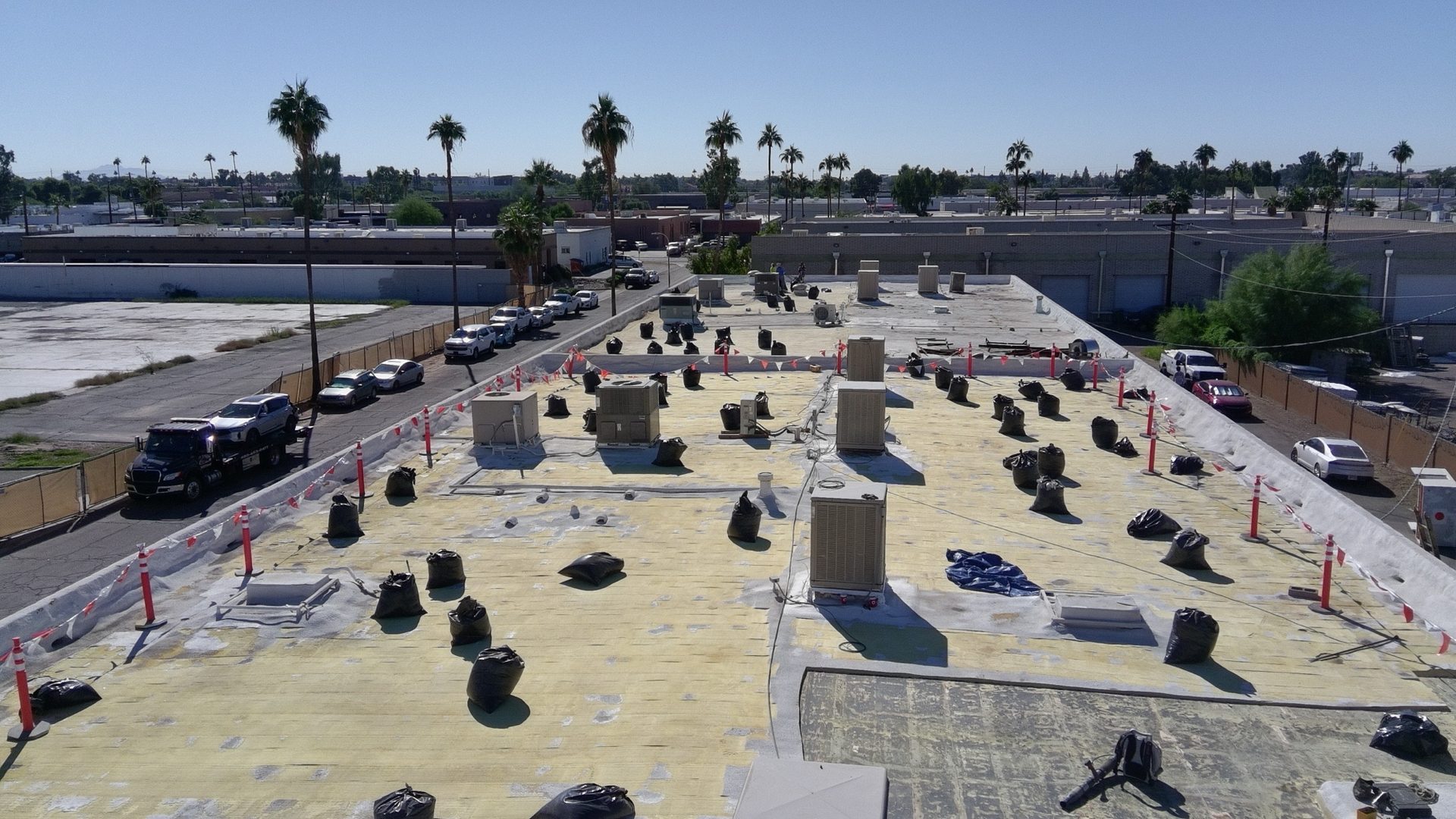
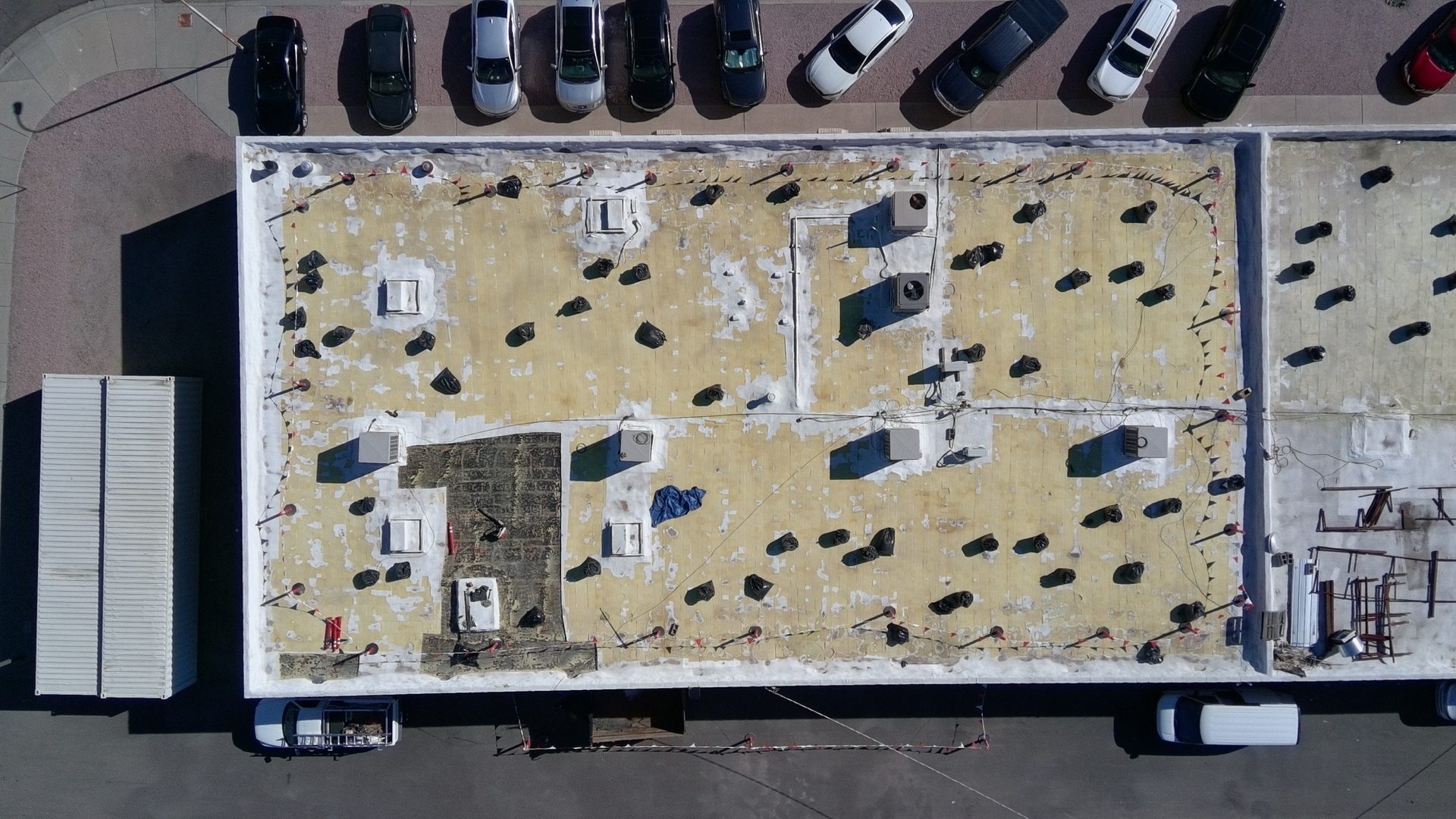
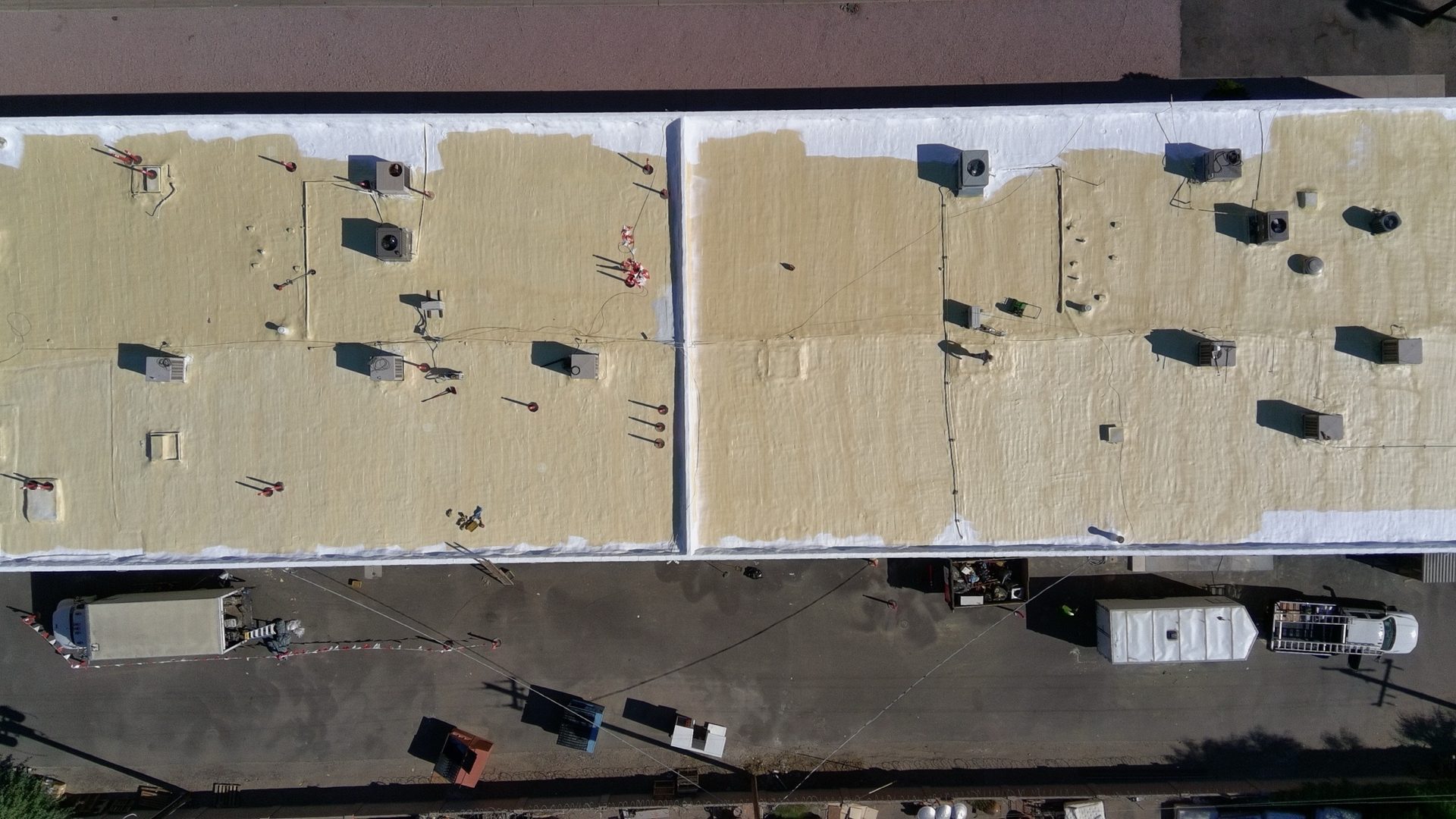
This is a working precision-manufacturing facility — chemical plating baths, sensitive electronics, and production runs that cannot be stopped for a roof project. Vanguard sequenced the work so that at every stage the tenant kept operating below. The scarify pass and the new foam application were tightly masked at every roof penetration so no debris or overspray entered the building envelope or the HVAC intakes. The full perimeter of the roof was fenced with construction cones, safety netting, and pennant lines throughout the project — visible in the drone photography — so no dropped material or worker access could create risk in the parking lot below. Weight bags anchored every corner and cone and secured the tarps and staging materials against Arizona monsoon-season wind gusts. The parking lots on both sides of the building stayed clear for tenant and delivery access every day.
Vanguard's 9-step scope for the 116 S Industrial Dr new foam roof
- Scarify existing foam roof down to sound foam — mechanical grinding of the weathered top layer and any delaminated foam back to solid closed-cell substrate that can bond to a new foam layer.
- Clean roof surface of dirt and debris — full clean of every square foot of scarified substrate before the new foam went down.
- Mask as needed — parapet walls, HVAC curbs, plumbing vents, gas lines, block wall coping, and roof-edge details all masked with polyethylene sheeting and tape.
- Apply 2 layers of polyurethane roofing foam to the entire roof surface — two passes of fresh closed-cell SPF across all 16,600 sq ft to full spec thickness, monolithic with no seams.
- Seal all scuppers and drains with ArmorPutty and reinforcing membrane — the highest-risk detail on any low-slope roof, monolithically re-sealed and reinforced into the new foam substrate.
- Seal all vent pipes and vents with ArmorPutty — every HVAC curb, plumbing vent, gas line, and roof penetration wrapped and sealed.
- Apply first coat of ARMORCOAT AC100 premium white elastomeric roof coating — base coat applied at spec across all 16,600 sq ft.
- Apply second coat of ARMORCOAT AC100 premium white elastomeric roof coating — finish coat applied at spec in cross-hatched direction to the first coat.
- Clean up all job-related debris — dumpsters staged out of the tenant traffic lanes, parking lots swept clean at end of every workday, no drums or materials left overnight.
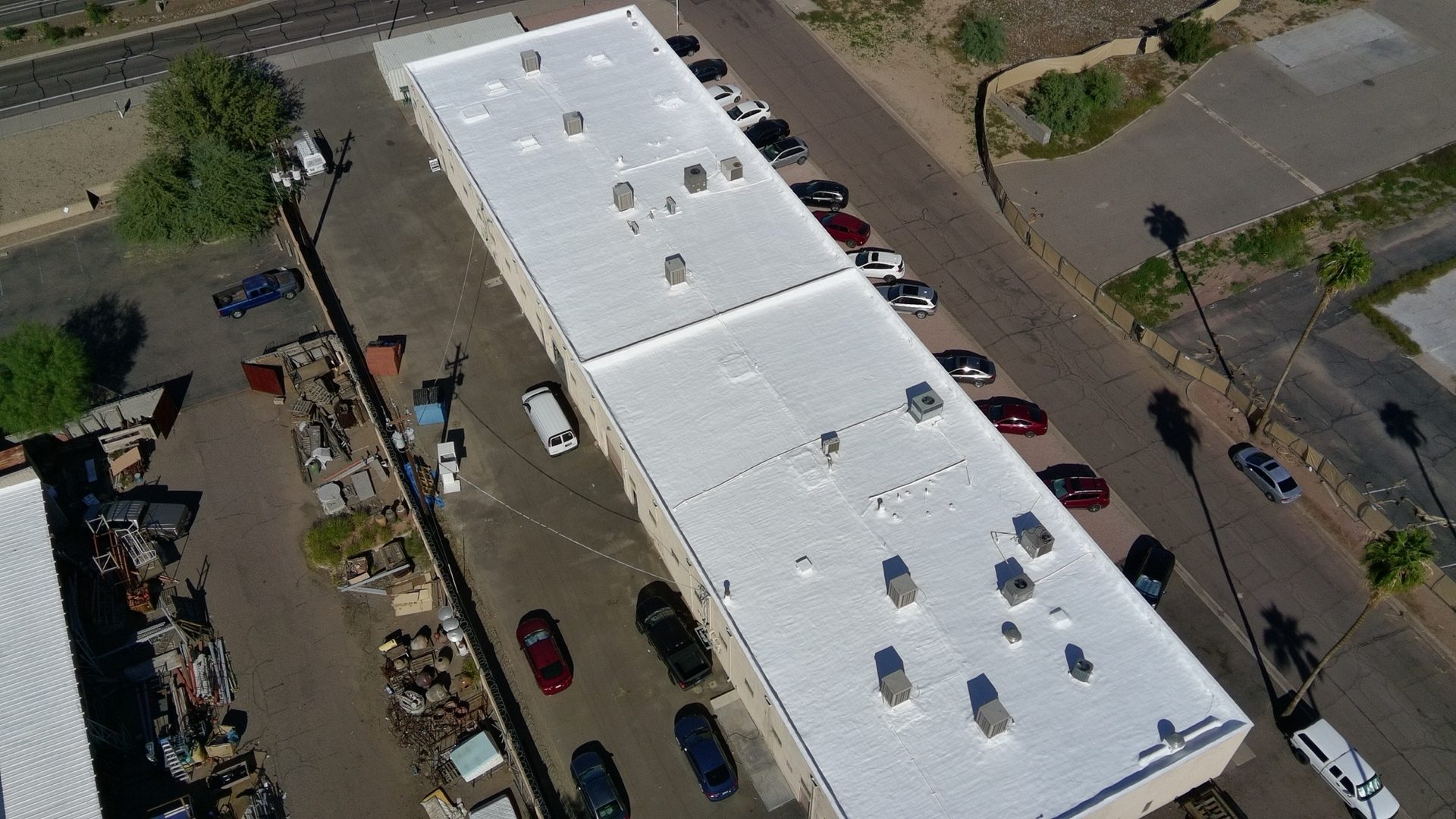
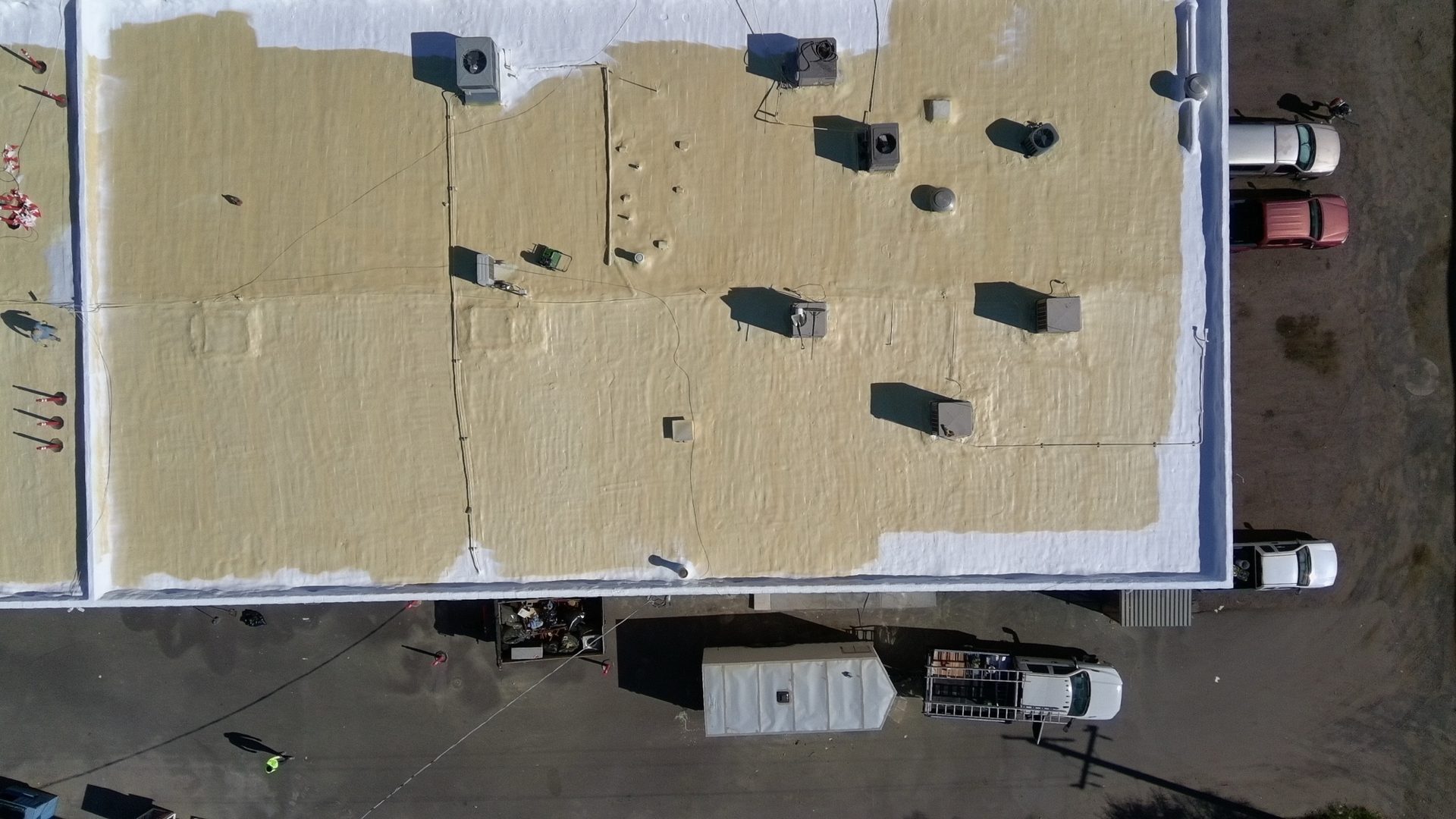
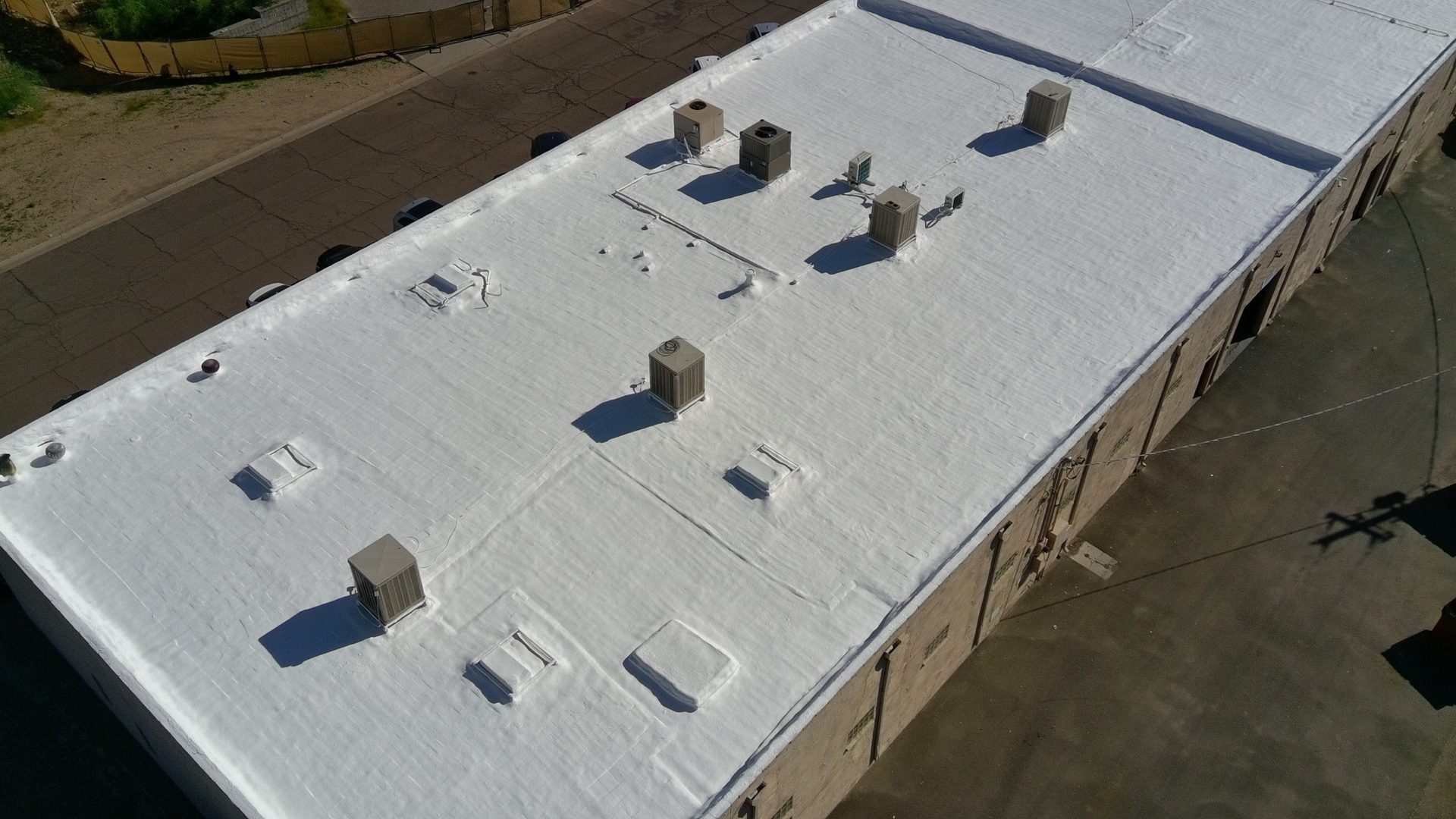
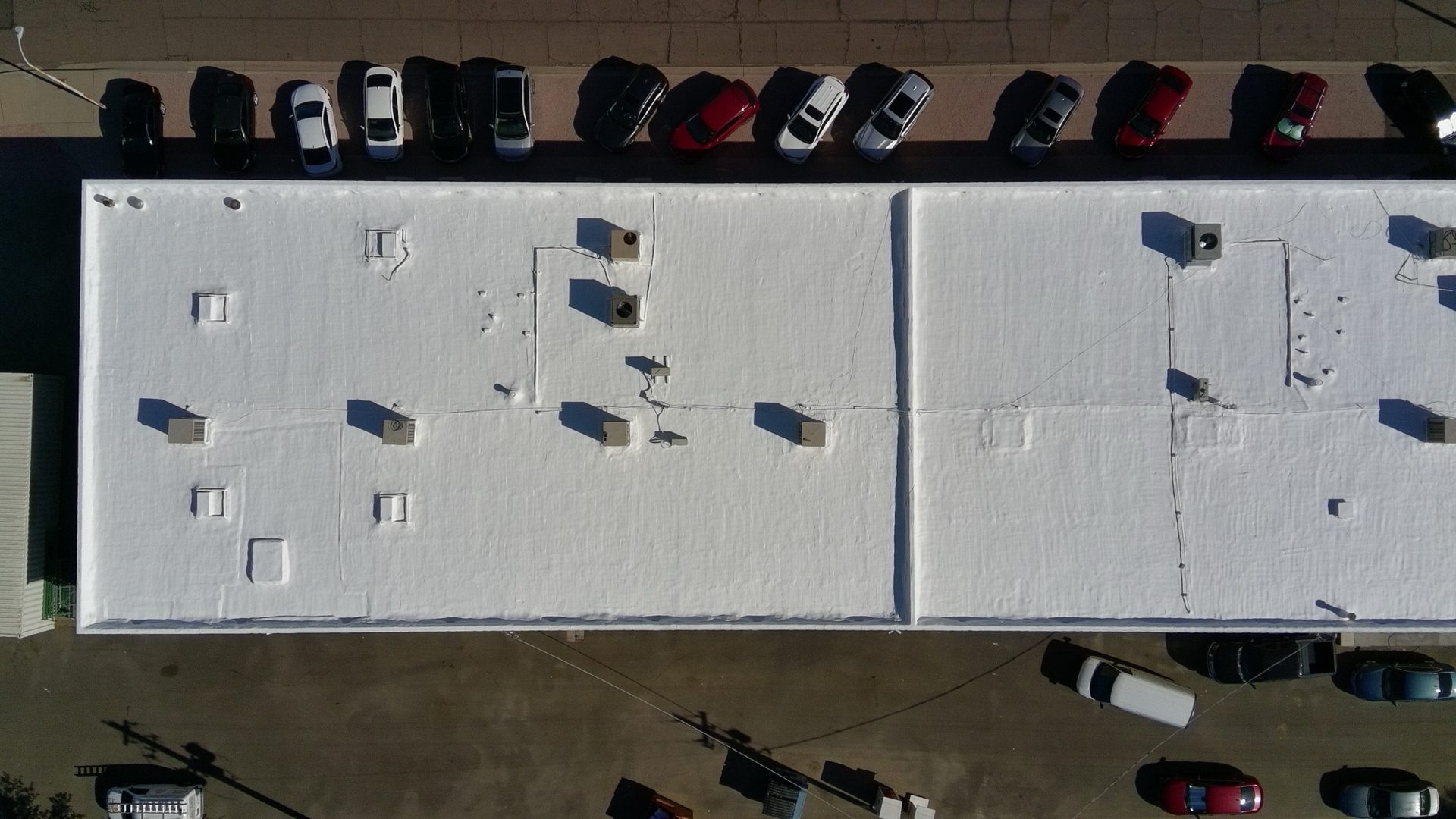
The finished drone photography shows the outcome: a monolithic bright white roof running the full length of the building, sharp parapet edges, every HVAC unit and roof penetration cleanly detailed, and the whole 16,600 sq ft reading as a single continuous piece from every angle. The video reel captured the arc of the project — from the scarified and staged prep condition (yellow, weighted, safety-fenced) through the freshly-sprayed new foam layer (uniform closed-cell surface) to the final two-coat AC100 finish (bright reflective white ready for another 10-plus years).
The DetailThe detail: why a new SPF roof is the right call over a scarified substrate
There's a decision tree on any aging foam roof. If the substrate is fundamentally sound and only the coating and details need to be refreshed, the right move is a repair-and-recoat — cut and re-fill bubbles, re-detail penetrations, put two fresh coats down. If the substrate is failing at the deck — wet insulation, ponding damage under the foam, structural issues — the right move is a full tear-off down to the deck. But there's a middle case, which is exactly what 116 S Industrial Dr looked like: the deck was fine and the underlying closed-cell foam was still solid, but the top surface of the foam had degraded past what a recoat could fix. Scarifying to sound foam and then spraying two fresh layers of new SPF on top gives you a monolithic new roof at a fraction of a tear-off cost — and without disturbing the deck or interrupting the tenant.
The new-foam-over-scarified-foam approach preserves the R-value and structure of the existing insulation, adds a full new closed-cell layer on top, and gives you a fresh substrate for a fresh two-coat elastomeric system with a full-length warranty. On a precision-manufacturing tenant like Gold Tech Industries, it also means no tear-off dust, no exposed deck during monsoon season, and no production shutdown while the roof gets rebuilt. The 10-year no-leak warranty reflects the confidence in the system: new foam, at-spec mil thickness, ArmorPutty at every detail, and two full coats of AC100 across the entire field.
The Warranty10-year no-leak warranty backed by an Arizona commercial roofer since 1957
The 116 S Industrial Dr new foam roof is covered by a 10-year no-leak material and labor warranty. If any covered part of the 16,600 sq ft roof surface leaks in the next 10 years — coating failure, ArmorPutty detail failure at a scupper, drain or vent, foam substrate failure, or workmanship defect — Vanguard returns to make it right at no cost to the property owner. Vanguard Roofing AZ is a division of MSW Contracting LLC, a Chandler-based Arizona commercial roofer on Valley roofs since 1957. AZ ROC CR-42 #289663 and R-62 #283025. GAF, Versico, ARMORCOAT, and MuleHide certified. A+ BBB rating.
The ResultsThe results — a monolithic new 16,600 sq ft foam roof, a bright cool-roof surface, and 10 years of no-leak coverage
The drone photography and video reel tell the whole story: a 16,600 sq ft precision-manufacturing roof scarified, re-foamed with two fresh layers of SPF, and finished under two full coats of bright white ARMORCOAT AC100 elastomeric — all without a single production shutdown below. The building owner gets a written 10-year no-leak warranty, a new closed-cell foam substrate with full R-value on top of the existing insulation, and a cool-roof reflective surface that lowers the load on the rooftop HVAC that cools the plating floor through Arizona's peak summer months.
Photo GalleryProject photos
Drone FlyoverSee the finished roof
FAQCommon questions
What was the scope on the 116 S Industrial Dr new foam roof?
Vanguard installed a new 16,600 sq ft spray polyurethane foam roof over the scarified existing foam substrate at 116 S Industrial Dr in Tempe. The 9-step scope was: scarify the existing foam down to sound foam substrate; clean the roof surface of dirt and debris; mask all perimeters and penetrations; apply two layers of new polyurethane roofing foam edge-to-edge across the entire 16,600 sq ft; seal every scupper and drain with ArmorPutty and reinforcing membrane; seal every vent pipe and roof vent with ArmorPutty; apply the first coat of ARMORCOAT AC100 white elastomeric at spec; apply the second coat of ARMORCOAT AC100 in a cross-hatched direction; complete debris cleanup; and back the whole roof with a 10-year no-leak warranty on materials and labor.
Why scarify and re-foam instead of repair-and-recoat or full tear-off?
There's a decision tree on any aging spray-polyurethane-foam roof. A repair-and-recoat is the right move when the foam substrate is fundamentally sound and only the topcoat and details need to be refreshed. A full tear-off is only the right move when the deck itself is failing — wet insulation, structural damage, or a substrate that can't be salvaged. In between is the case where the deck and underlying foam are sound but the top surface of the foam has degraded past what a recoat can fix. That's what 116 S Industrial Dr looked like. Scarifying back to sound foam and spraying two fresh layers of new SPF on top gives you a monolithic new roof at a fraction of a tear-off cost, preserves the R-value and structure of the existing insulation, and doesn't disturb the deck or interrupt the tenant below.
Was the manufacturing tenant able to keep operating during the project?
Yes. 116 S Industrial Dr is home to a precision-plating manufacturer with chemical plating baths, sensitive electronics, and production floors that can't be interrupted. Every stage of the work was masked and sequenced so the tenant kept operating below. Roof penetrations were tightly masked so no scarify dust or foam overspray entered the building envelope or HVAC intakes. The perimeter was fenced with cones, safety netting, and pennant lines throughout — visible in the drone photography — so no dropped material could create risk in the parking lot. The parking lots on both sides stayed clear for tenant and delivery access every day, and every workday ended with the lots swept clean.
Why is this a 10-year warranty instead of a 5-year?
Warranty length on a coating system depends on the scope, the age and condition of the substrate, and the mil thickness of the topcoat. On this project the entire system was rebuilt — the existing foam was scarified back to sound substrate, two fresh layers of new SPF were sprayed edge-to-edge, every detail was re-worked with ArmorPutty, and two full coats of ARMORCOAT AC100 went down at spec. That's essentially a new roof system on the existing deck. Because the substrate under the coating is new, Vanguard warrants the full assembly for 10 years no-leak on materials and labor. On projects where only the topcoat is being refreshed over an existing foam substrate, the standard warranty length is 5 years.
What is the reflectivity and cool-roof performance of ARMORCOAT AC100?
ARMORCOAT AC100 is a Phoenix-manufactured premium 100% acrylic white elastomeric roof coating developed specifically for use over spray polyurethane foam. Its initial solar reflectivity is 86% and its emissivity is 0.89 — high enough to meet Title-24 and ENERGY STAR cool-roof performance and to deliver measurable HVAC-load reduction through the Arizona summer. On a working manufacturing facility with rooftop HVAC serving production floors, that reflective white surface lowers the roof-deck temperature by 40-60°F on a peak-summer day, which lowers the load on the HVAC units cooling the plating floor below and extends the life of the rooftop equipment.
How long will this new foam roof last?
A properly-installed closed-cell spray polyurethane foam roof, protected by a maintained elastomeric topcoat, has essentially no fixed expiration date — it's a substrate on a maintenance cycle. In the Arizona climate, a foam roof needs to be inspected and its topcoat refreshed roughly every 8-12 years. Do that on schedule and you can own a foam roof for 30 or 40 years without ever needing a tear-off. The 116 S Industrial Dr roof was just rebuilt with new foam, new details, and a fresh two-coat AC100 topcoat — which resets the maintenance cycle to zero. On top of that, the owner has a written 10-year no-leak warranty from Vanguard. When the next maintenance window comes around in the mid-2030s, the roof will need a topcoat refresh, not a new foam installation.