
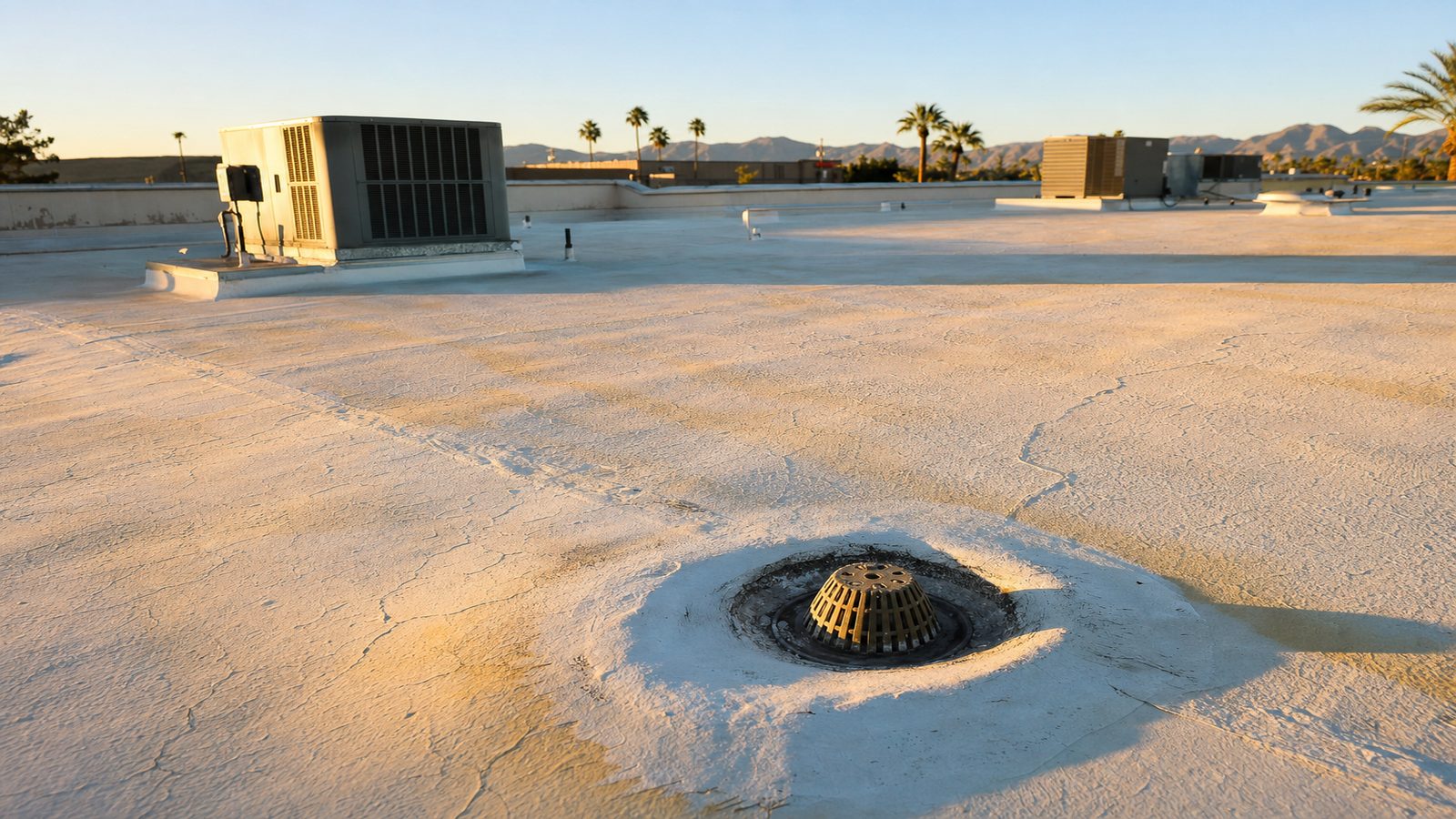
Spray polyurethane foam (SPF) is one of the best commercial roof systems ever developed for the Arizona desert. Seamless, self-flashing, R-6.5 per inch of insulation, and light enough that most existing structures can carry a full recover. When a foam roof is installed right and maintained right, it earns its reputation. When it isn't, it fails in ways that surprise property owners who trusted the sales pitch.
The honest answer: A well-maintained foam roof in Phoenix will last 25 to 30 years. But that only happens with a recoat every 10 to 15 years. Skip the recoat and you're looking at full replacement at year 15 to 18. The manufacturer's 30-to-50-year number assumes maintenance that most Arizona commercial owners never do.
What actually determines foam roof lifespan in Phoenix
The foam itself is remarkably stable. Closed-cell SPF at 3 lb density is essentially inert once cured — it doesn't rot, doesn't degrade with age, and holds its R-value indefinitely. The U.S. Department of Energy confirms that SPF insulation performs at spec for decades when protected from UV.
The problem is that "protected from UV" part. Foam has to be covered by a topcoat — usually acrylic, silicone, or occasionally polyurethane — and the topcoat is what actually takes the beating in Phoenix. Three local conditions eat through topcoats faster here than almost anywhere in the country:
- UV load about 30% higher than the U.S. average, per NOAA UV monitoring data. Acrylic topcoats chalk and thin in that intensity.
- Surface temperatures of 160–180°F on unshaded foam during summer. That thermal cycling — 60°F swing between night and day — cracks aged topcoats.
- Monsoon hail impact. Even pea-sized hail can dent a thin topcoat and expose foam underneath, which then absorbs moisture and delaminates.
Real Phoenix foam roof lifespan by scenario
Every foam roof in the metro falls into one of four categories. This is what I actually see out there:
*Using 2026 Phoenix metro pricing. Foam install $8–$14/sq ft; silicone recoat $2–$5/sq ft; acrylic recoat $1.50–$3/sq ft. Numbers exclude interior damage from leaks.
Look at that bottom row. Recoating on schedule is by far the cheapest way to own a commercial foam roof in Phoenix. Skipping maintenance costs more than doing it, even before you factor in tenant damage from leaks. The National Roofing Contractors Association has been publishing this math for decades and property owners still keep learning it the hard way.
The visual signs your foam roof is asking for a recoat
You do not need a moisture survey to know a foam roof needs attention. Walk up there once a year and look for these five things:
- Chalking — a powdery white residue that comes off on your hand when you rub the surface. Chalking means the topcoat is oxidizing and thinning.
- Yellowing or exposed brown foam — anywhere you can see through the topcoat to raw foam, the clock is ticking. More than 10% of the surface exposed usually means it's already past recoat and into replacement territory.
- Hairline cracks in the topcoat, especially around drains, HVAC curbs, and parapet transitions. Water gets in through these and undermines the foam from below.
- Blistering — soft spots where the foam has separated from the substrate or the topcoat has separated from the foam. These almost always mean moisture has already gotten in.
- Ponding water that no longer dries within 48 hours. If low spots are staying wet for days after a monsoon storm, the topcoat has lost its water resistance.
What a recoat actually costs in Phoenix (2026): Silicone recoat runs $2 to $5 per square foot installed. Acrylic recoat runs $1.50 to $3 per square foot but has a shorter service life in our UV. A silicone recoat on a 20,000 sq ft commercial building typically lands between $40,000 and $100,000 — versus $160,000 to $280,000 for a full foam replacement on the same footprint. Recoating is the single highest-ROI move a commercial property owner in Arizona can make on a foam roof.
Frequently asked questions
How long does a foam roof last in Phoenix?
A properly installed and maintained foam roof in Phoenix realistically lasts 25 to 30 years — but only with a recoat every 10 to 15 years. Without recoating, the foam is exposed to UV and starts breaking down at 12 to 15 years. Manufacturer literature quoting "30 to 50 years" assumes maintenance most Arizona commercial owners never do.
Why do foam roofs fail faster in Phoenix?
UV exposure is roughly 30% higher than the U.S. average, surface temperatures hit 160–180°F on unshaded foam, and monsoon hail can puncture the topcoat. The foam itself is stable — the acrylic or silicone topcoat protecting it is what wears out first. When the topcoat thins below about 8 mils, the foam yellows, chalks, and starts absorbing moisture.
When should I recoat my foam roof?
Plan on recoating every 10 to 15 years. Signs it's time: visible yellowing, chalking, hairline cracks in the topcoat, or exposed brown foam. Silicone recoat runs $2 to $5 per square foot — a fraction of full foam replacement at $8 to $14 per square foot.
Can a foam roof last 30 years without recoating?
No. Anyone saying that in Phoenix is uninformed or selling something. The foam might physically last that long, but exposed foam absorbs UV, chalks, cracks, and eventually loses R-value and leaks. We've seen 20-year foam roofs need full replacement because the owner skipped maintenance — and 30-year foam roofs still watertight because the owner recoated on schedule.
How do I know if my foam roof is nearing end of life?
Look for significant yellowing or exposed brown foam on more than 10% of the surface, blistering or delamination, deep cracks penetrating to foam, ponding water not drying within 48 hours, or an infrared moisture scan showing wet insulation. Any two of these together usually means full replacement rather than a recoat.
Related reading
- 7 Warning Signs Your Commercial Foam Roof Needs Replacement — how to tell when a recoat is no longer enough
- Silicone Roof Coating: How It Extends Your Commercial Roof 10–20 Years — the recoat option and 2026 Phoenix pricing
- TPO vs Foam Roofing for Phoenix Commercial Buildings — how foam stacks up against single-ply for your building
- The True Cost of Commercial Roof Replacement in Arizona (2026) — honest per-square-foot ranges by roof system