
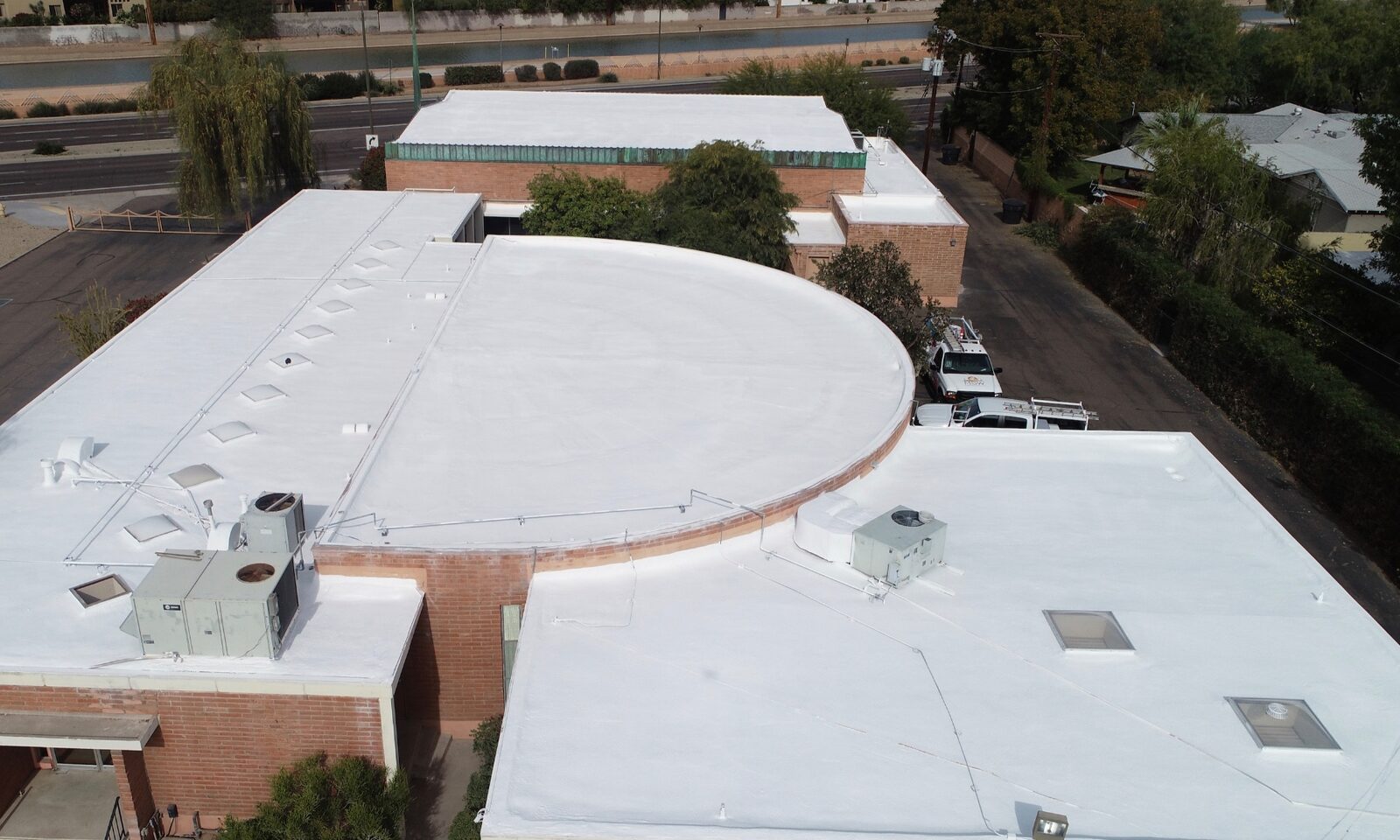
Case Study: Historic Church Roof Restoration — First Church of Christ, Scientist, Scottsdale AZ (1962 Landmark)
A 1962 modernist landmark on the Scottsdale Historic Register, a signature barrel-vault domed sanctuary, and an aging spray foam roof that had reached the end of its coating life. Rather than a costly and invasive tear-off, we restored the roof the way historic buildings deserve — cleaning the existing foam, cutting out bubbles and delaminating sections, rebuilding low areas with Armor Shield 2500 polyurethane foam, and coating the entire system with a two-coat AC100 elastomeric topcoat. Five days on site, the original 1962 substrate untouched, and a 5-year no-leak warranty.
Project SnapshotThe First Church of Christ, Scientist restoration at a glance
First Church of Christ, Scientist is a 1962 modernist landmark in Scottsdale, listed on the Scottsdale Historic Register. The church board engaged Vanguard Roofing AZ directly — no general contractor — to restore its aging spray foam roof while preserving the historic structure below. Here are the project facts at a glance.
First Church of Christ, Scientist — Scottsdale, AZ
| Property | First Church of Christ, Scientist (1962) |
| Location | 6427 E Indian School Rd, Scottsdale, AZ 85251 |
| Historic Status | Scottsdale Historic Register (added 2013) |
| Architect | T.S. Montgomery, 1962 |
| Building Type | Church / place of worship |
| Scope | Spray foam repair + AC100 elastomeric topcoat |
| Foam Product | Armor Shield 2500 polyurethane roofing foam |
| Coating Product | AC100 elastomeric roof coating |
| Timeline | 5 days |
| Project Cost | $20,000 (flat) |
| Warranty | 5-Year No-Leak |
| Contracting | Hired directly by the church |
| Completed | July 2026 |
The LandmarkA 1962 modernist landmark on the Scottsdale Historic Register
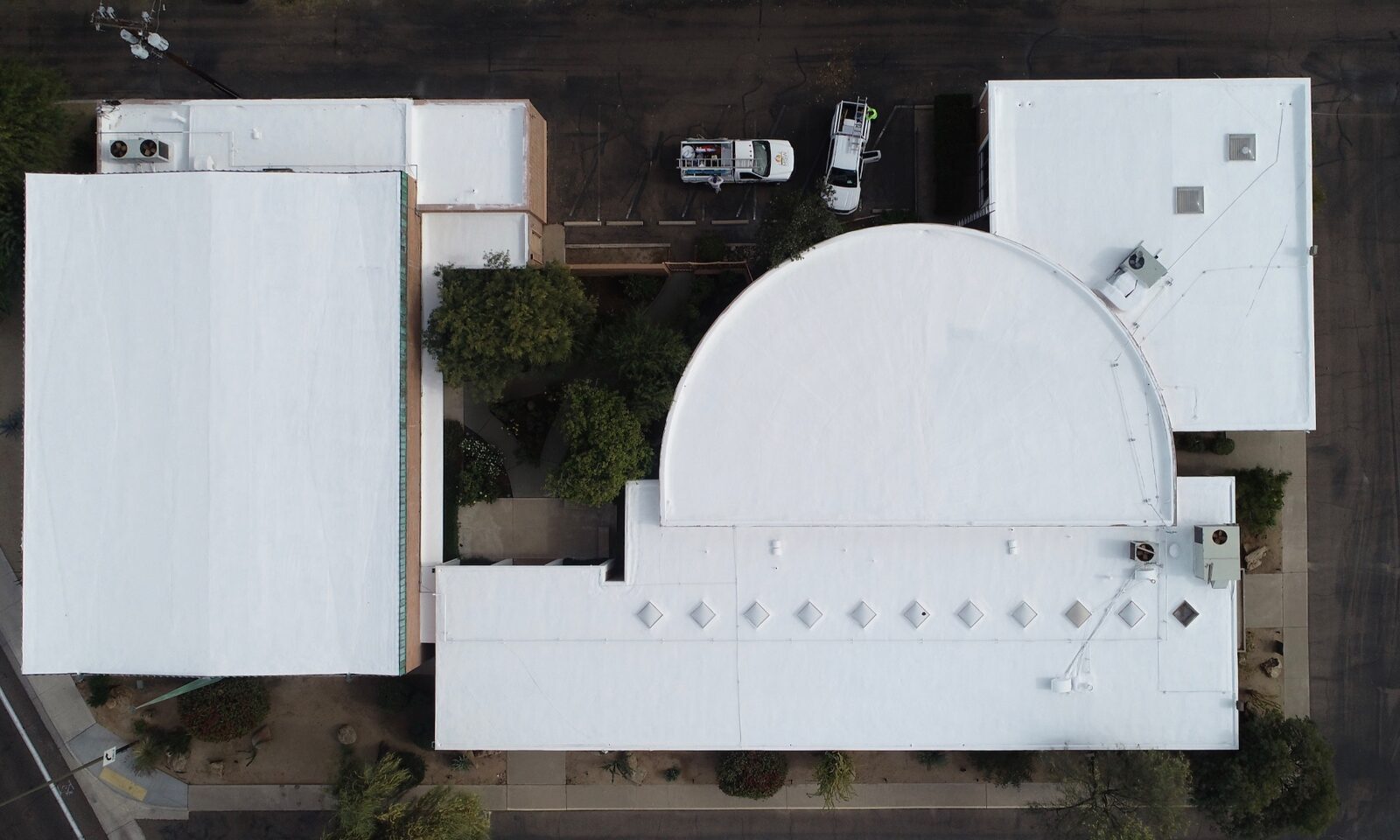
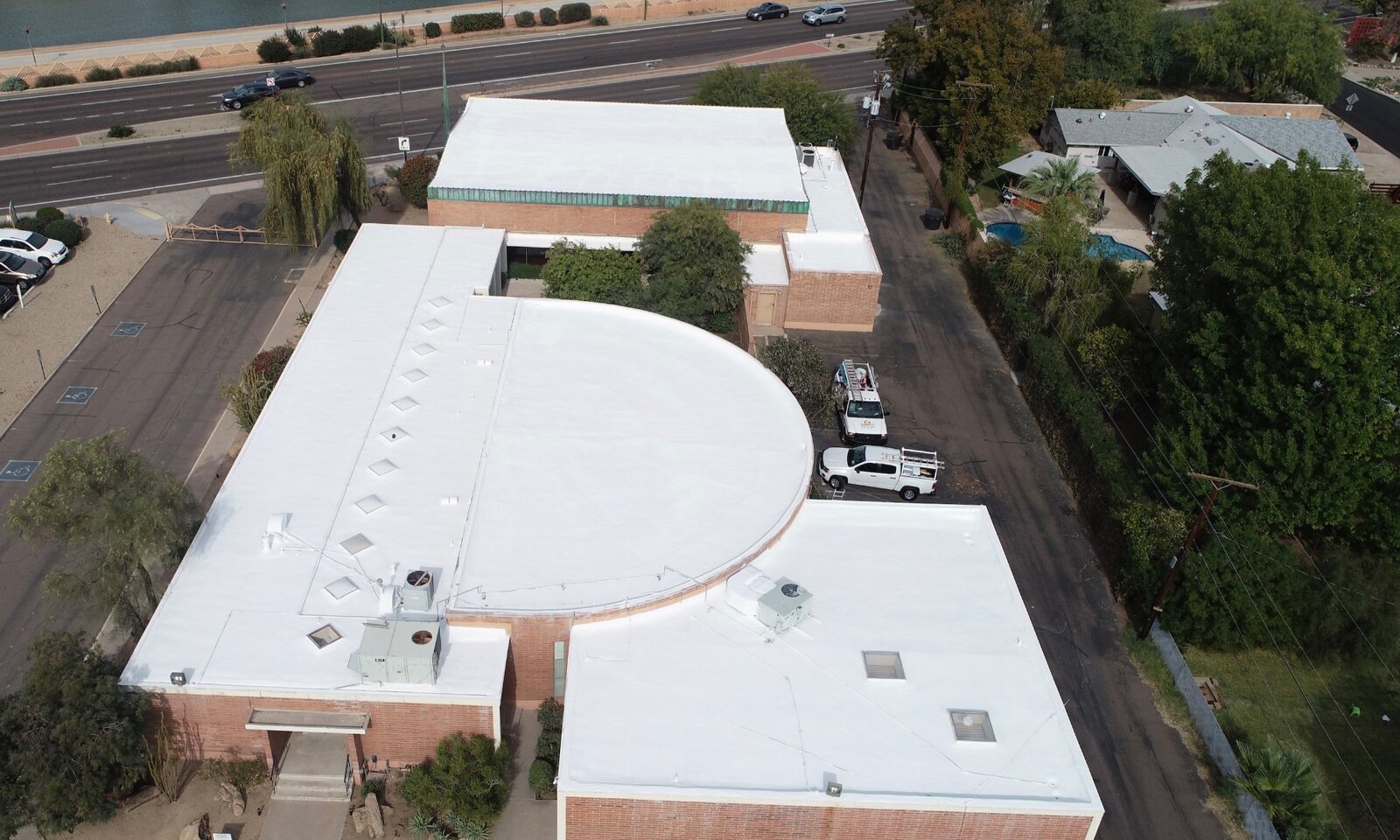
First Church of Christ, Scientist was designed in 1962 by architect T.S. Montgomery, and it remains one of Scottsdale's most distinctive pieces of mid-century modernist architecture. The building is composed of precast rectangular concrete blocks and burnt adobe blocks, trimmed in copper along the top and crowned by a sculpted copper spire — a quiet, dignified expression of the era's design language. Its most recognizable feature is the barrel-vault domed sanctuary, a sweeping curved form that gives the building its silhouette and presents a genuinely unusual roofing challenge.
The building is listed on the Scottsdale Historic Register and was one of three churches the City of Scottsdale added to its historic buildings list in 2013, recognized through the work of the city's Historic Preservation program. That designation carries a responsibility: work on the building must respect and preserve the original 1962 fabric. For the congregation, whose own history is documented on the church's website, the roof over the domed sanctuary is both a functional shelter and part of a protected architectural legacy. Restoring it required a roofing approach chosen specifically to honor that.
The ChallengeAn aging foam roof at the end of its coating life
The building's existing polyurethane spray foam (SPF) roof had reached the end of its coating life. Decades of Arizona sun had taken the familiar toll on an aging foam system: dirt and debris had accumulated across the surface, UV exposure had raised bubbles in the foam, and low areas showed delamination where the foam had begun to separate. Left alone, those are the conditions that eventually lead to water intrusion — a serious risk over an occupied, historic sanctuary.
The church board faced a familiar decision, but with higher stakes than most. A full tear-off and replacement would have been financially prohibitive for a congregation working from a fixed budget — and, just as important, it would have meant stripping the roof down and risking damage to the historic structure below. Spray foam restoration was the clearly superior path: it preserves the original substrate, extends the roof's life by ten years or more, and typically costs 60 to 70 percent less than replacement. The only question was whether the existing foam was sound enough to restore rather than replace — and a careful inspection confirmed that it was.
The ApproachWhy spray foam restoration preserves historic roofs
Spray foam restoration is the gold-standard preservation approach for a simple reason: it adds material rather than removing it. Where a tear-off exposes the decking, generates waste, and disturbs the assembly it sits on, a foam restoration builds back up from the existing surface — cleaning, spot-repairing, and recoating without ever peeling the roof off the building.
For a historic property, that distinction is everything. There's no decking exposure, no tear-off waste, and no risk to the underlying 1962 assembly that the historic register exists to protect. The original substrate stays exactly where it is, sheltered under a renewed and reinforced foam-and-coating system. It's the least invasive way to give a landmark roof another decade or more of watertight service — which is precisely why it was the right call here. For more on how these systems work, see our spray foam roofing and roof coating service pages.
Our ApproachThe 5-day historic restoration, day by day
Working on a place of worship means working with care — for the building, for the congregation's schedule, and for the historic fabric underneath. Here's how the five days ran, from first inspection to final sign-off with the church board.
Project sequence — 5 days on site
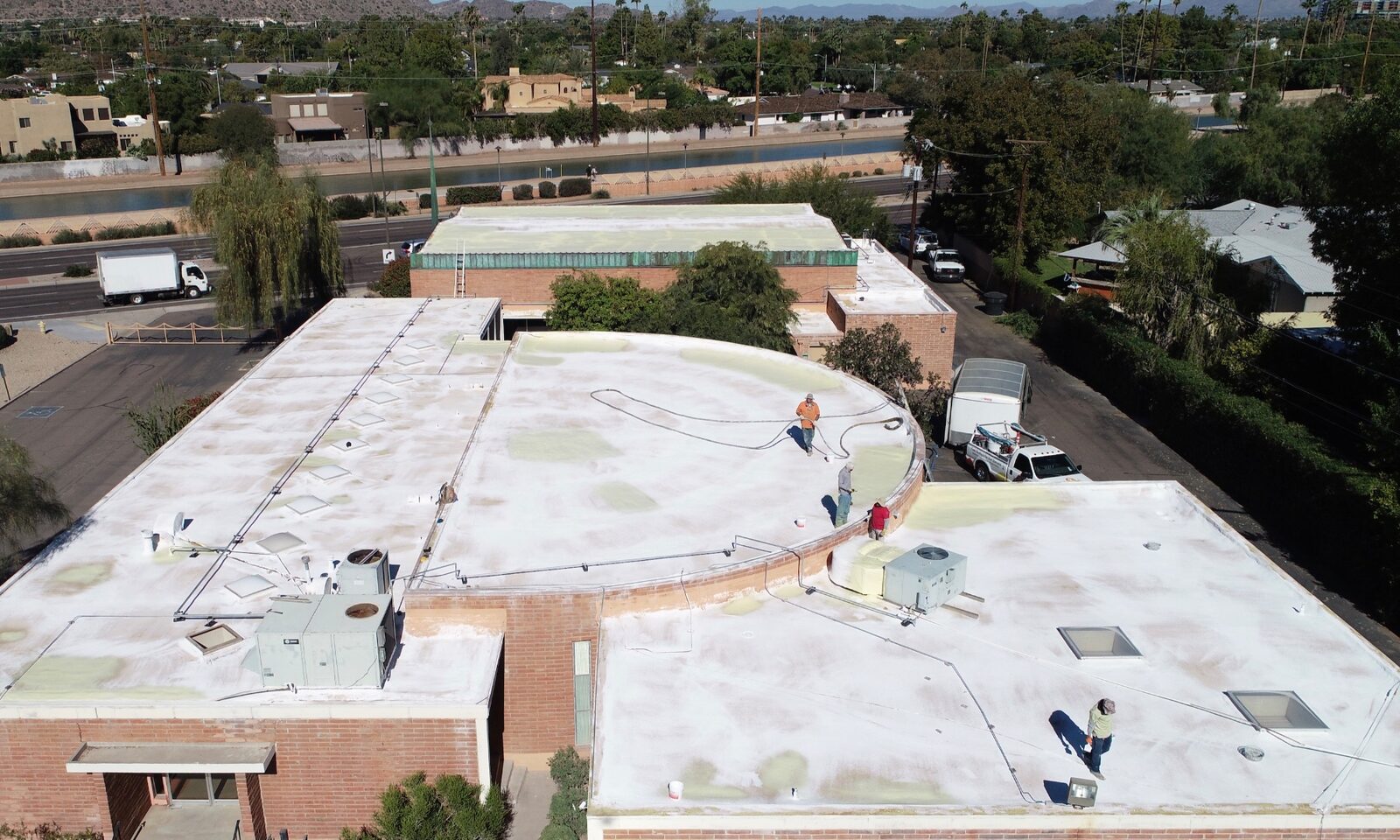
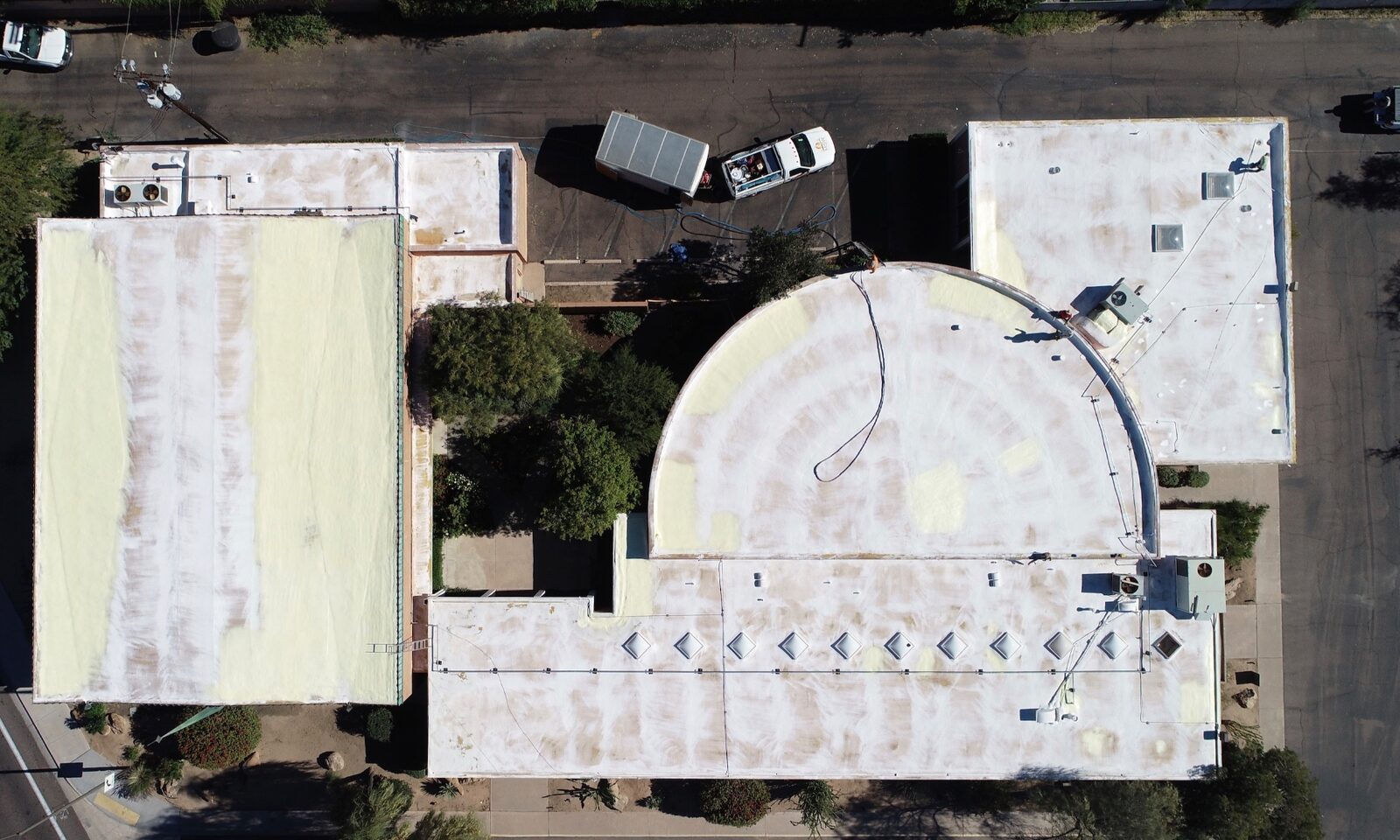
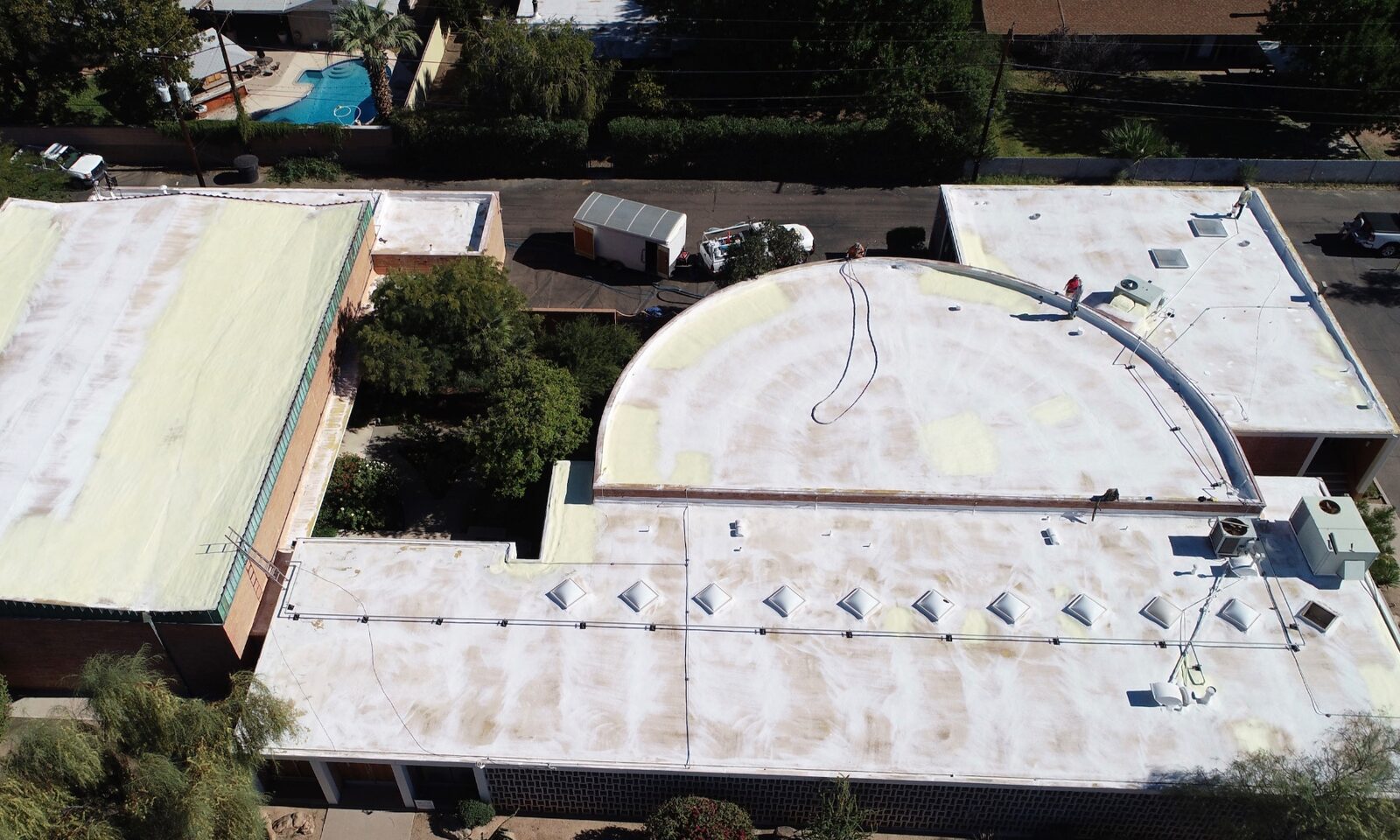
- Day 1 — Inspect and power wash. A full roof inspection followed by a complete power wash to remove dirt, debris, algae, and loose granules. We identified and paint-marked every bubble, delamination, and low area across the domed sanctuary and flat wing roofs.
- Day 2 — Surgical foam removal. We cut out the bubbles and delaminating foam — only the compromised material, nothing sound — and prepped the exposed substrate for new foam.
- Day 3 — Rebuild with Armor Shield 2500. Sprayed Armor Shield 2500 polyurethane roofing foam into all the cutouts and built up the low areas to positive drainage, feathering the edges to blend seamlessly with the existing foam.
- Day 4 — First AC100 coat. Applied the first full-surface pass of AC100 elastomeric roof coating — a proven elastomeric that flexes with the substrate and reflects solar radiation.
- Day 5 — Second coat and sign-off. A second cross-direction AC100 coat for full mil thickness, followed by a final walk-through with the church board, mil-thickness verification, and the punch list.
Because the church hired Vanguard directly — with no general contractor in between — every detail of scheduling, communication, and board reporting ran through one accountable team. That mattered on a building where weekend services and quiet hours had to be respected throughout the work.
The ProductsArmor Shield 2500 foam and AC100 elastomeric coating
The right products are what turn a restoration into a roof that lasts. On First Church of Christ, Scientist we relied on two proven systems, both suited to restoration over an aged SPF roof:
- Armor Shield 2500 — a closed-cell polyurethane roofing foam engineered for commercial roof repair and low-slope buildup applications. Its densities match SPF industry standards, so the new foam integrates cleanly with the original — ideal for filling cutouts and rebuilding low areas to positive drainage.
- AC100 elastomeric roof coating — an acrylic elastomeric coating designed for spray foam and single-ply substrates. It's UV-resistant, flexible enough to move with the roof through Arizona's temperature swings, and highly reflective. Because it's approved for restoration over aged SPF, it's the right topcoat for a foam-roof recoat like this one.
Together, these give the roof a renewed protective shell: fresh foam where the old had failed, and a reflective, flexible elastomeric membrane over the whole system to shield it from the UV that ends most foam roofs' lives. If you're comparing coating systems for a low-slope commercial or institutional roof, our guide to roof coating options in Phoenix and our silicone coating page walk through the trade-offs.
The RelationshipWhy coordinating with a church board takes different skills
Restoring a church roof is not the same as roofing a warehouse, and the difference has little to do with the roof itself. A church board approves every dollar and answers to a congregation, so the contractor has to be able to present scope, cost, and warranty in terms a volunteer board can review and stand behind. Weekend services can't be disrupted, quiet hours have to be honored, and the safety of parishioners moving in and out of the building is paramount throughout the work.
Vanguard was hired directly by the church board — not through a general contractor — which meant we handled every part of the project ourselves: scheduling around services, communicating with the board, and reporting progress in plain language. That's the same set of skills that property managers and HOA boards look for when they choose a roofing contractor, and it's a large part of what we do. Our work with community associations is a close parallel; see our writing on foam roof warning signs and our Scottsdale commercial roofing services for how we approach institutional and board-led projects across the area.
The ResultsA landmark preserved, watertight, and reflective
The restoration achieved what the church board needed — a renewed roof that respects the building's history:
The finished roof carries a bright, reflective AC100 finish that reduces the cooling load on the sanctuary below — a meaningful benefit in Scottsdale's climate — while leaving the 1962 structure completely intact. The barrel-vault dome and flat wing roofs drain properly again, the historic property is protected for another decade-plus, and the congregation has a watertight roof backed by a 5-year no-leak warranty. That's what a respectful, well-executed historic restoration looks like.
Photo GalleryFrom foam repair to finished AC100 dome
During restoration
Completed
FAQHistoric foam roof restoration — common questions
Can spray foam roofs be repaired instead of replaced?
In most cases, yes — and it's usually the better choice. A polyurethane spray foam (SPF) roof is a restorable system by design. As long as the foam is largely sound, the compromised areas — bubbles, delamination, low spots — can be cut out and re-sprayed, and the whole roof recoated with a fresh elastomeric topcoat. That's exactly what we did at First Church of Christ, Scientist in Scottsdale. Restoration preserves the original substrate, extends roof life ten years or more, and typically costs 60 to 70 percent less than a full tear-off and replacement.
What is AC100 roof coating?
AC100 is an acrylic elastomeric roof coating engineered for spray foam and single-ply substrates. It's UV-resistant, flexible enough to move with the substrate through Arizona's daily temperature swings, and highly reflective, which reduces the cooling load on the building below. Because it's approved for restoration over aged SPF, it's the ideal topcoat for a foam-roof recoat like the one at First Church of Christ, Scientist, where we applied two cross-direction coats for full mil thickness.
How much does a spray foam roof recoating cost?
Cost depends on roof size, the amount of foam repair required, and the number of coating passes, but a foam restoration typically runs 60 to 70 percent less than a full tear-off and replacement. The First Church of Christ, Scientist project in Scottsdale was completed for a flat $20,000, including cleaning, targeted foam repair with Armor Shield 2500, and a two-coat AC100 elastomeric topcoat. A free inspection is the honest way to determine whether a recoat or a replacement is the right call for a given roof.
Does Vanguard work on historic buildings in Arizona?
Yes. First Church of Christ, Scientist is a 1962 modernist landmark on the Scottsdale Historic Register, and Vanguard Roofing AZ was hired directly by the church to restore its roof. Spray foam restoration is particularly well suited to historic properties because it adds material rather than removing it — there's no tear-off, no exposure of the original decking, and no risk to the underlying 1962 assembly. As a family-owned Arizona contractor operating since 1957 and licensed under AZ ROC CR-42 #289663 and R-62 #283025, we approach historic work with the care these buildings deserve.
How often should a spray foam roof be recoated?
A spray foam roof should generally be recoated every ten to fifteen years, depending on the coating used, the mil thickness applied, and how much sun and weather the roof takes. The topcoat is the sacrificial layer that protects the foam from UV; when it thins, it's time to clean, spot-repair, and recoat — not replace. Staying on that maintenance cycle is what allows a foam roof, like the one at First Church of Christ, Scientist, to last for decades on the same original substrate.