
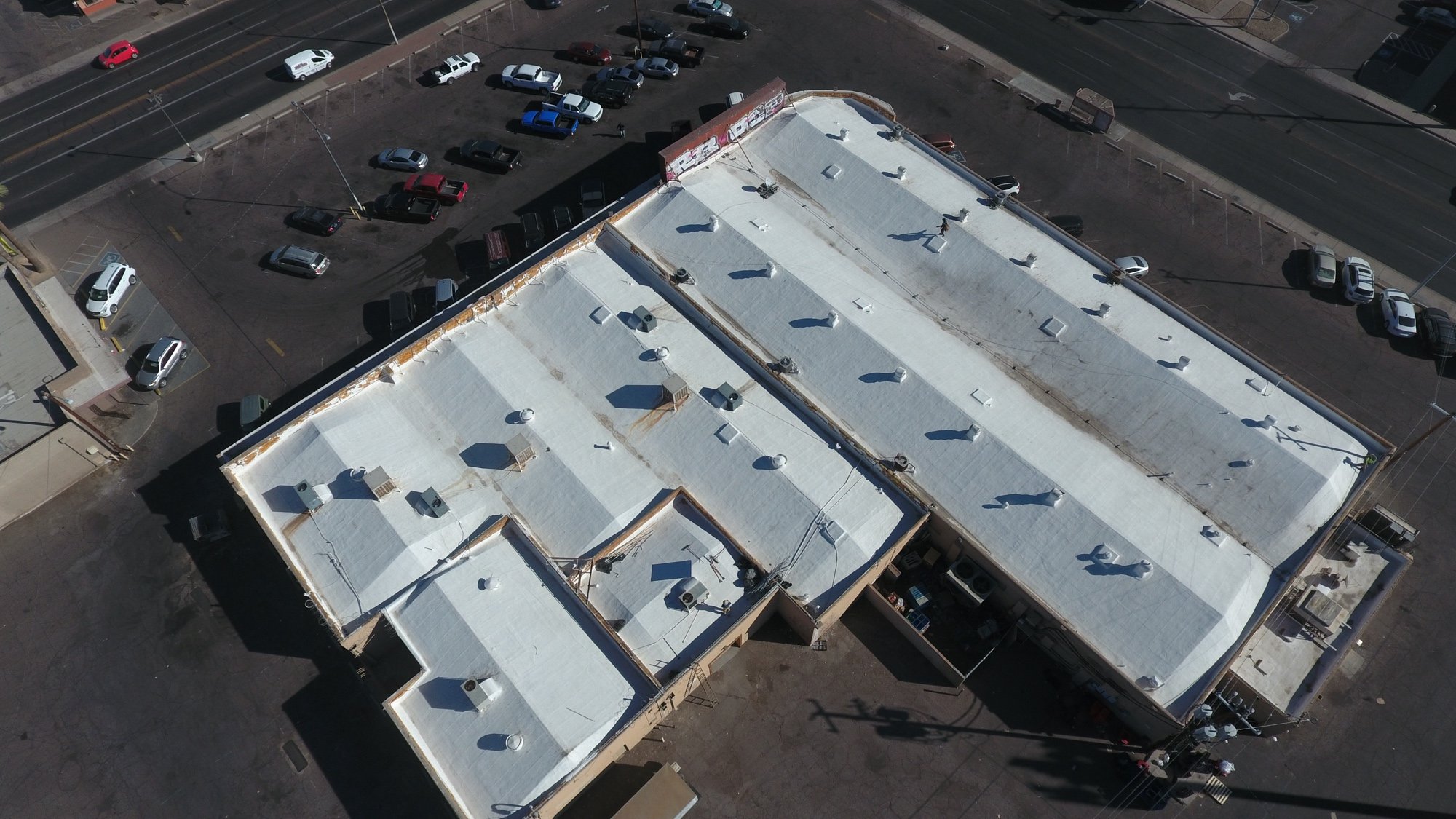
Case Study: 32,000 SF Grocery Roof Recoat with Parapet Refoam — Food City, W Van Buren St, Phoenix
The Food City grocery store at 2709 W Van Buren St in west Phoenix is the kind of hard-working, community-anchored retail roof that most Phoenix contractors would recoat and move on. What made this 32,000 square-foot job different — and what a property management team hired us for — was the parapet walls. After a decade of west-facing Arizona sun, the majority of the parapet foam was sun-damaged, chalked, and thinning far ahead of the field. We refoamed every failing parapet, raised low areas, and locked the whole roof under two coats of ARMORCOAT AC100 with a 10-year no-leak warranty, all with the grocery store open for business the entire time.
Project SnapshotFood City — 2709 W Van Buren St, Phoenix AZ 85009
West Van Buren Street is one of Phoenix's original commercial arteries — a decades-old retail corridor stretching west from downtown that anchors dozens of grocery, restaurant, and service businesses. The Food City at 2709 W Van Buren St has been a fixture of that corridor for years, feeding the surrounding neighborhoods on a floor plan that sits under 32,000 square feet of polyurethane foam roofing. When the property management team called us, the field of the foam roof was in reasonable shape for its age — but the parapet walls on the west and south elevations had taken a decade of unfiltered late-afternoon Arizona sun and were visibly failing.
Food City Van Buren — 32,000 SF Parapet Refoam + AC100 Recoat, Phoenix
| Property | Food City Grocery Store — Van Buren location |
| Address | 2709 W Van Buren St, Phoenix, AZ 85009 |
| Roof Size | 32,000 sq ft |
| Existing System | Aged polyurethane foam roof + sun-damaged parapets |
| Scope | Clean + refoam failing parapets + raise low areas + 2 coats AC100 |
| Coating System | ARMORCOAT AC100 White Elastomeric — 2 coats |
| Client Engagement | Property management referral |
| Warranty | 10-Year No-Leak |
| Completed | 2024 |
| Contractor | Vanguard Roofing AZ — since 1957 |
The ProjectThe building, the client, and what we were solving for
West Van Buren Street is one of Phoenix's original commercial arteries — a decades-old retail corridor stretching west from downtown that anchors dozens of grocery, restaurant, and service businesses. The Food City at 2709 W Van Buren St has been a fixture of that corridor for years, feeding the surrounding neighborhoods on a floor plan that sits under 32,000 square feet of polyurethane foam roofing. When the property management team called us, the field of the foam roof was in reasonable shape for its age — but the parapet walls on the west and south elevations had taken a decade of unfiltered late-afternoon Arizona sun and were visibly failing.
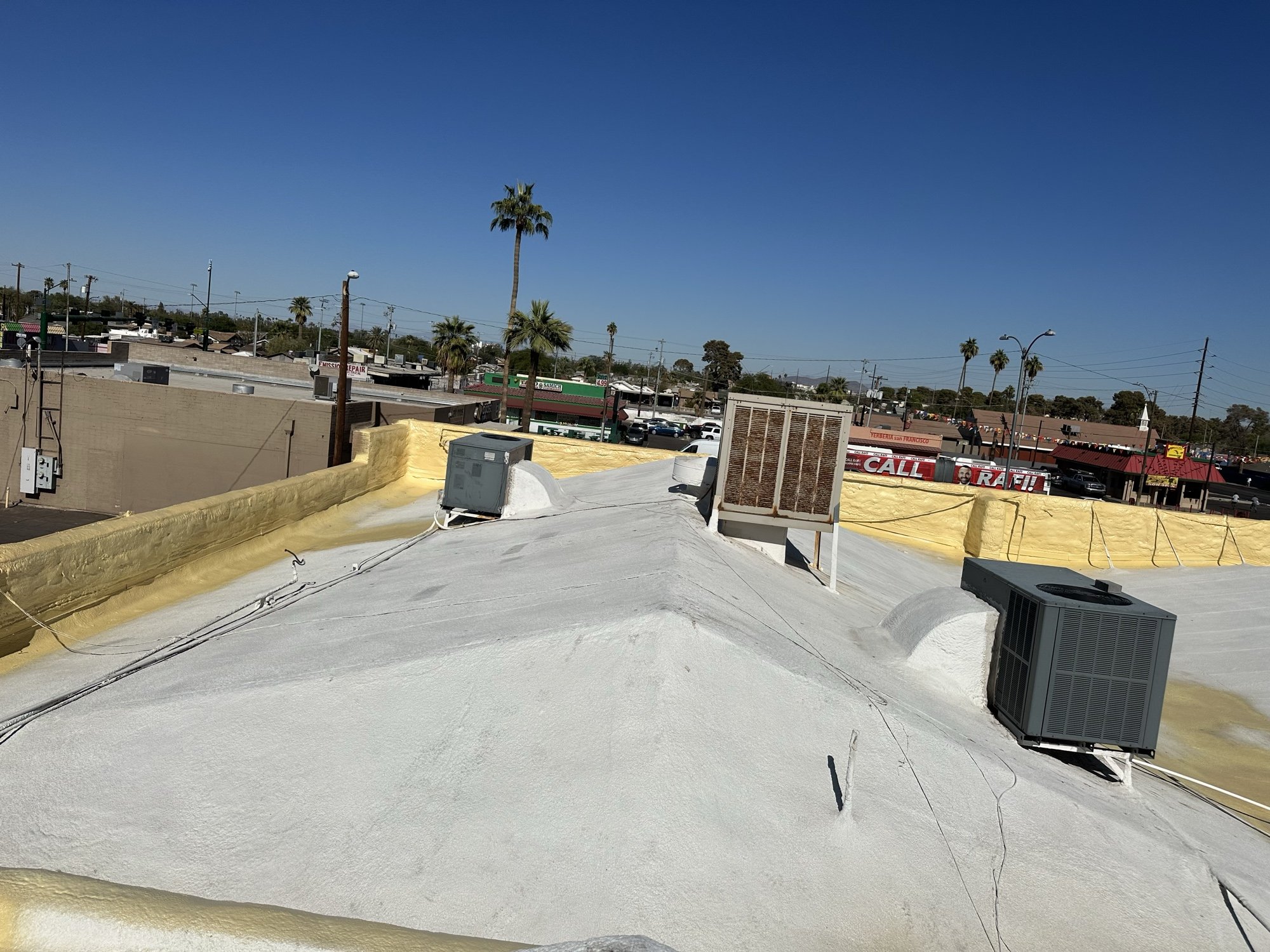
Parapet walls are the vertical extensions above the roof line that ring the perimeter of a commercial building. On foam roofs, the parapet is sprayed with the same polyurethane foam and coated with the same acrylic elastomeric as the field — which means the parapet gets exposed to the same UV as the field, but often at a steeper angle to the afternoon sun. In west Phoenix, west-facing parapets take the hardest hit. On this Food City the parapet foam had chalked, thinned, and in places delaminated to the point that a straight field recoat would have failed at the perimeter within a few years. See our Phoenix commercial roofing service page for more.
The SystemWhy refoaming parapets is the retail-recoat detail most contractors skip
On any foam roof recoat, the field of the roof gets most of the attention — because that's where the square footage is and that's what the bid is priced on. But the parapets are where the coating typically fails first, and they're the detail that a lot of Phoenix roofers hand-wave through with a spray-only recoat. On this Food City the parapets needed real foam, not just coating.
- Cut out failing parapet foam. Where the parapet foam had delaminated, chalked through, or lost thickness, we removed the failing material back to sound substrate.
- Spray new polyurethane foam on every failing parapet. Reapplied fresh polyurethane foam on the parapets that needed it — a real substrate correction, not a coating cover-up.
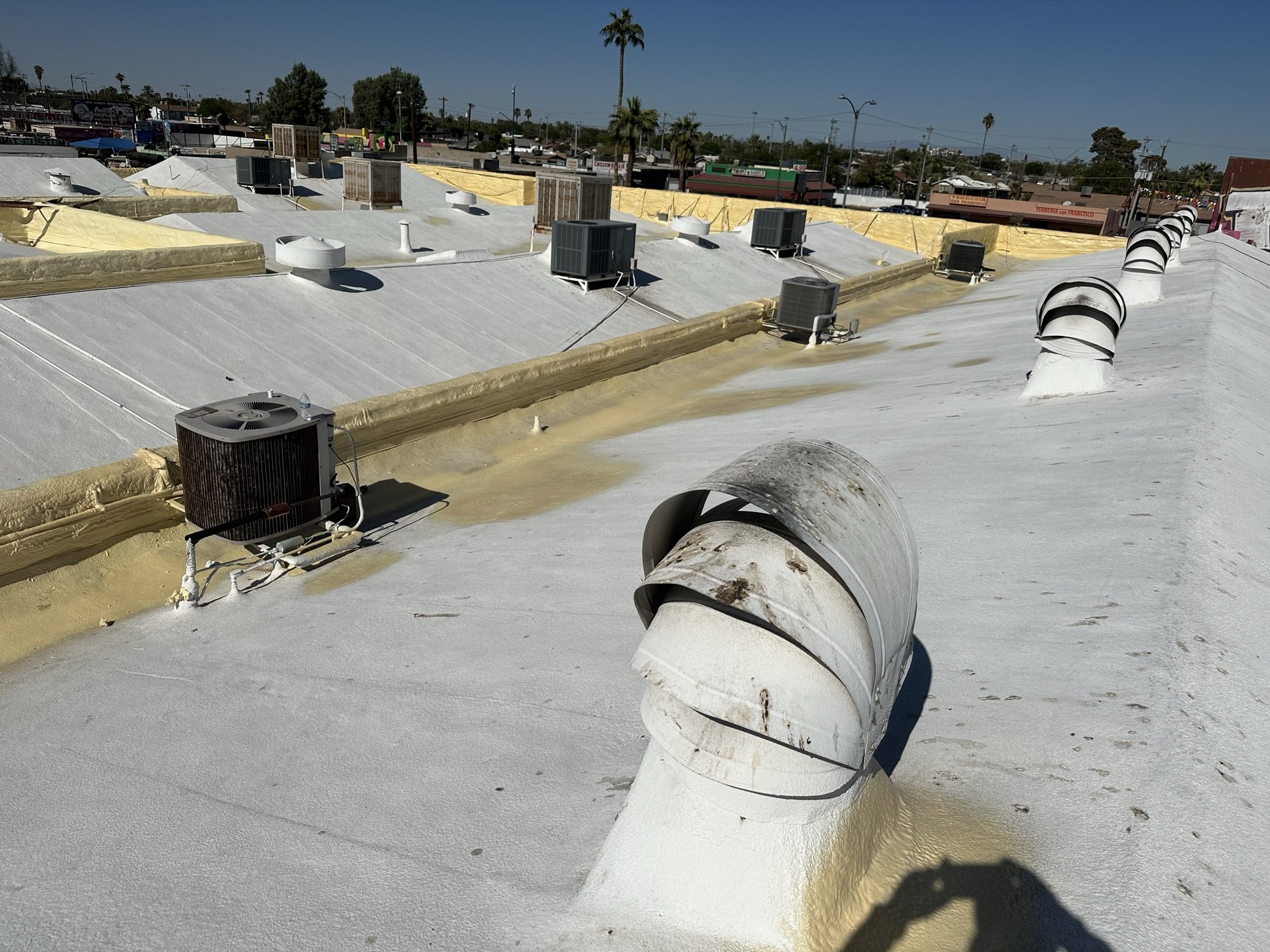
- Raise low areas in the field. Walked the roof, identified ponding low spots, and refoamed those areas back to positive drainage before the coating went down.
- Two coats of ARMORCOAT AC100. Locked the whole assembly — field and refoamed parapets — under two directional-crossed coats of AC100 white elastomeric with the 10-year no-leak warranty. See our roof coating services for the AC100 system spec.
Our ApproachHow we sequenced a grocery-store recoat with retail open
A grocery-anchored recoat has one non-negotiable constraint: the store cannot close. Customers, deliveries, refrigeration lines, and rooftop HVAC on constant duty for freezer racks all had to keep operating throughout. Here's how we sequenced the job:
Scope of work — the parapet-forward recoat sequence
- Full roof and parapet survey. Walked every foot of the 32,000 sq ft field and every linear foot of parapet to inventory which foam was sound and which was failing — the survey drove the scope.
- Power-wash clean. Removed a decade of west Phoenix dust, chalk from the aged coating, and debris around every HVAC curb and drain — coatings do not bond to dirty foam.
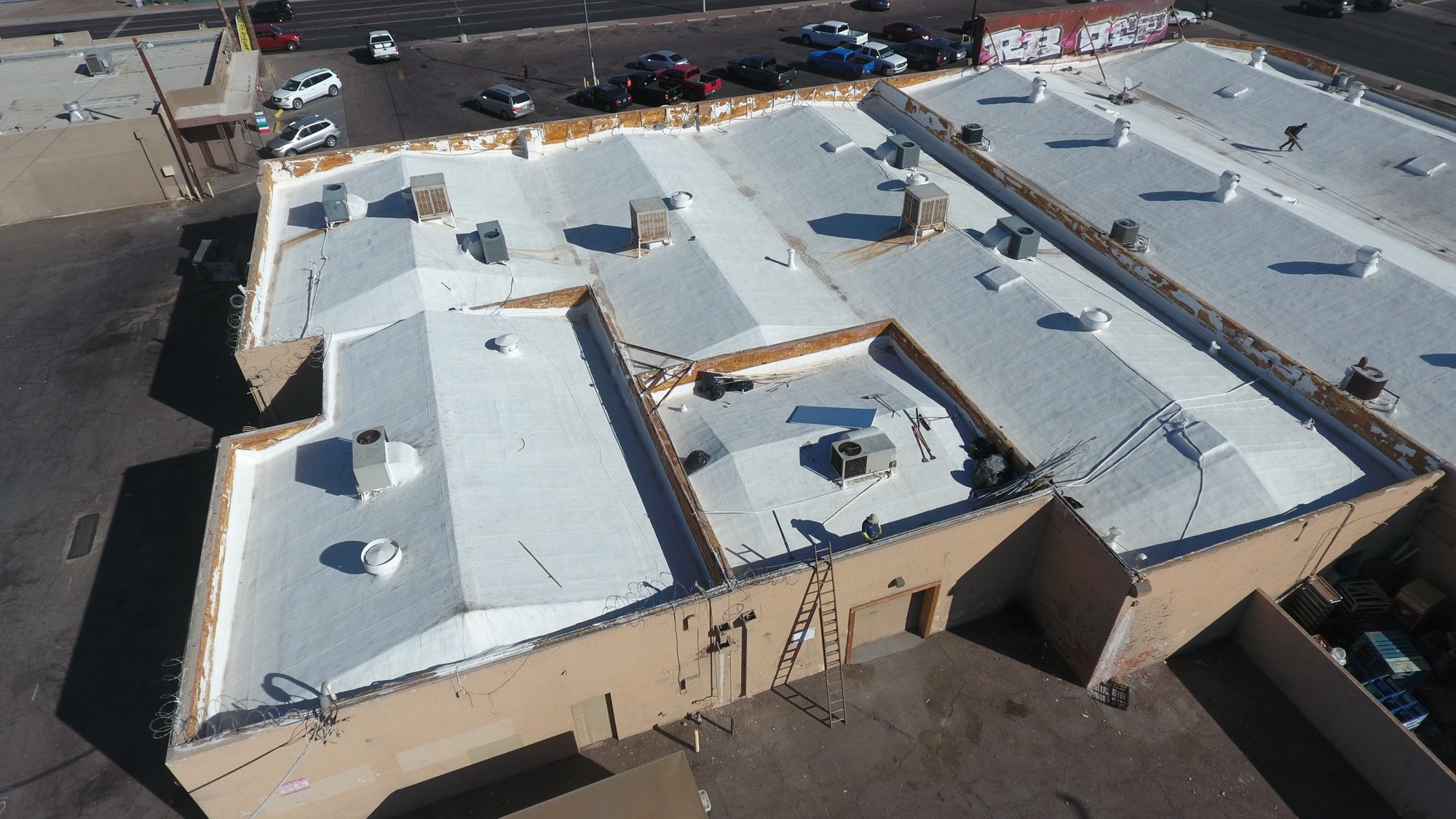
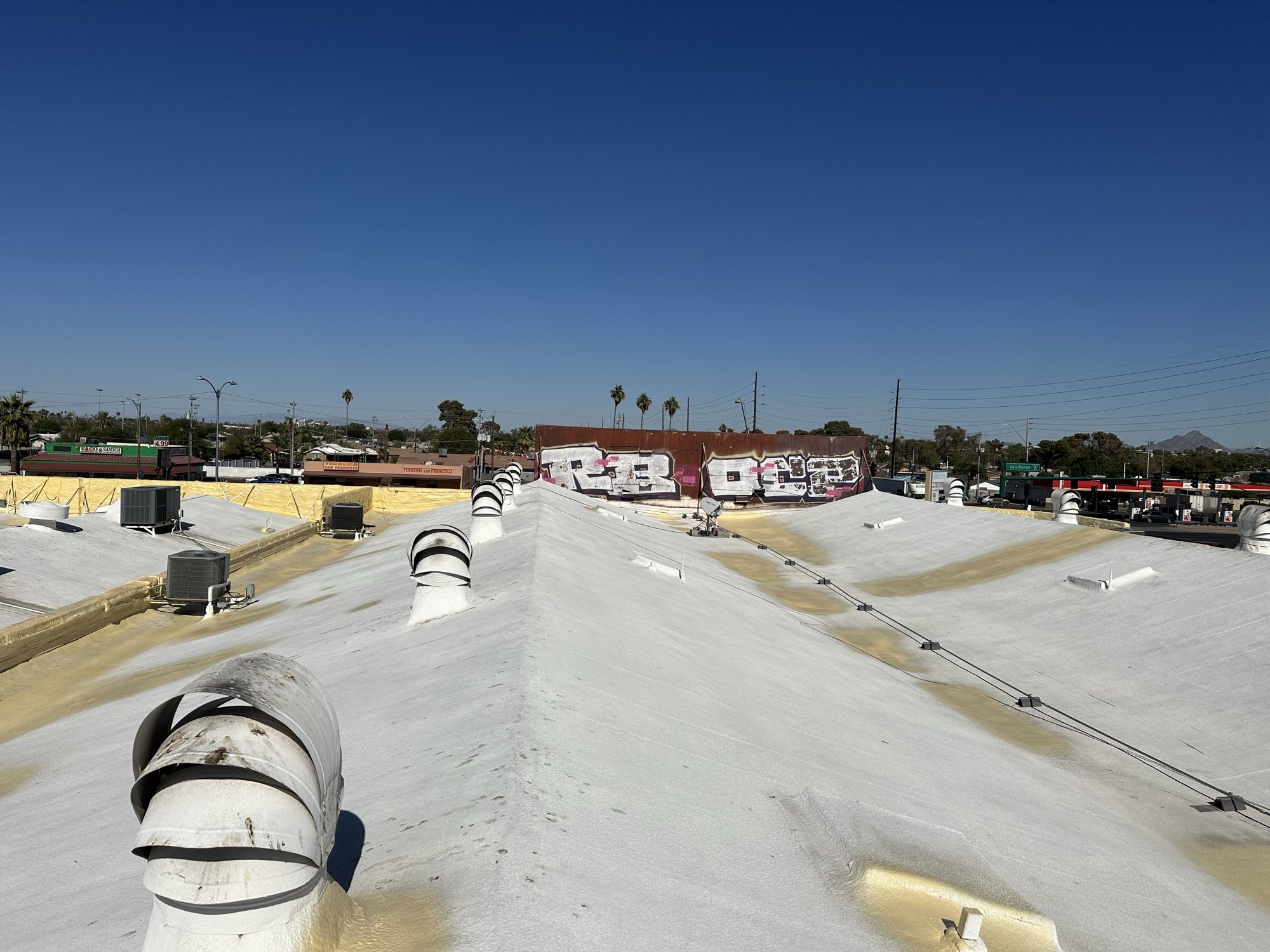
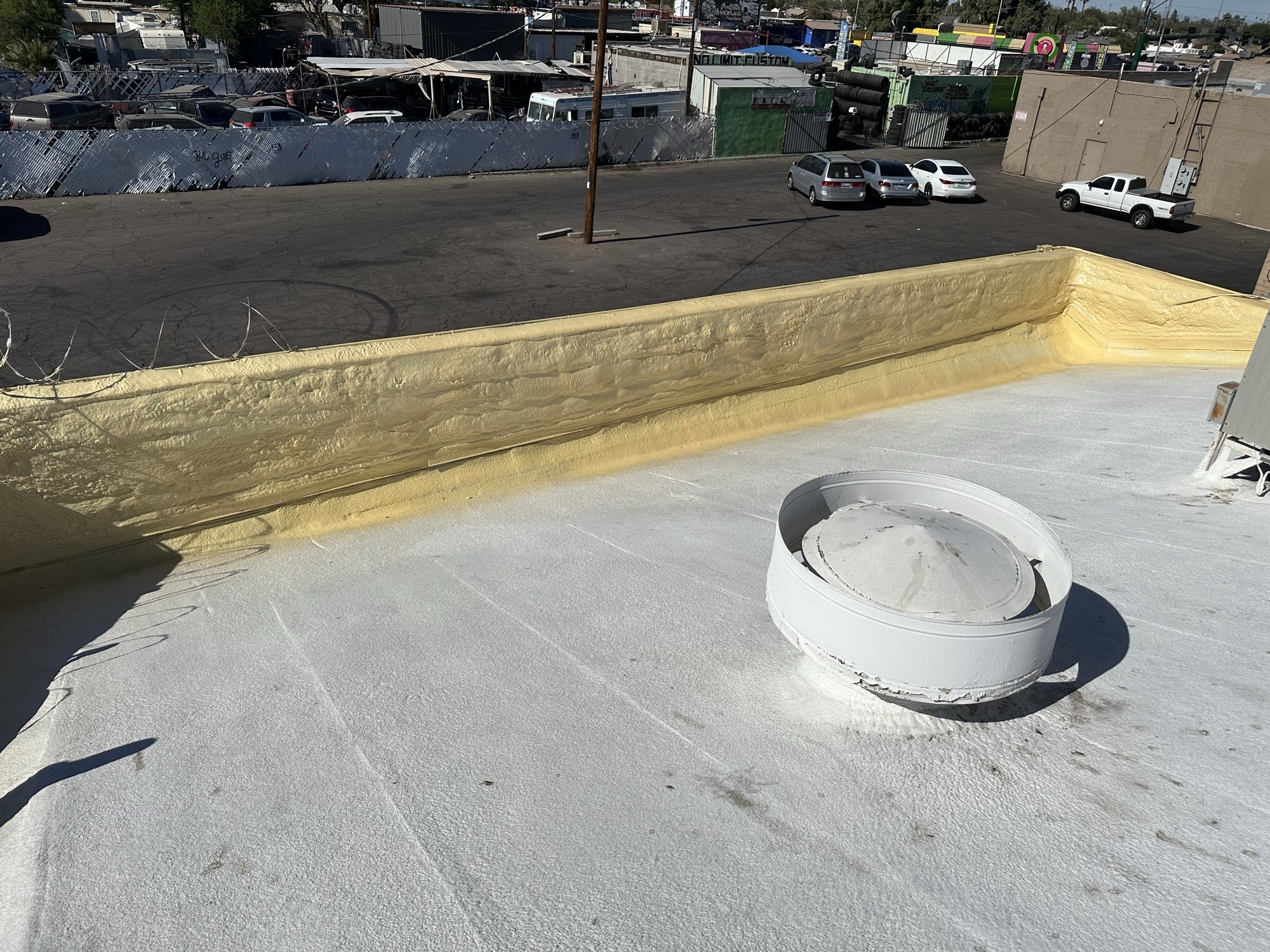
- Refoam every failing parapet. Cut out the failing polyurethane foam on the sun-damaged parapets and sprayed fresh foam back in place — the visual detail is clearly shown in our photos where the yellow refoamed sections sit next to the still-white existing coating before final recoat.
- Raise low areas. Refoamed the low spots in the field to restore positive drainage before the coating went down.
- First coat of AC100. Directional first-coat spray across the full 32,000 sq ft field and every parapet — refoamed and existing — sealing the substrate under a uniform elastomeric film.
- Second coat cross-directional. Second AC100 pass at 90 degrees to the first, delivering the full-mil thickness required for the 10-year no-leak warranty and ensuring pinhole-free coverage.
The property management team stayed the single point of contact throughout — no store-manager coordination, no franchisee approvals, one property manager approving the phased work as it moved across the roof. That's the coordination model retail recoats need.
The DetailSun-damaged parapets — the failure mode most owners underestimate
When a property owner or manager walks their commercial roof, most of them look at the field — that's the biggest surface, and it's where they've been told coating failures start. What we see on jobs like the Food City Van Buren location is that the parapets fail first, and they fail worse. The parapet catches direct sun for hours a day at a steeper angle than the field, it's less well-drained, and it's often the last section coated on the original install — sometimes at reduced mil thickness. Ten years in, the parapet is chalking to substrate while the field still has coating on it.
The right recoat on a roof like this doesn't treat the parapet as a coating problem. It treats it as a foam substrate problem — and it fixes the substrate before the coating goes down. That's a bigger scope than a straight recoat, and it's usually the difference between a warranty-grade recoat and a job that starts failing at the perimeter in year four. For more on the warning signs of a failing foam roof, see our blog on foam roof replacement warning signs.
The WarrantyThe 10-year no-leak warranty on the finished system
The finished Food City roof carries our 10-year no-leak warranty on the ARMORCOAT AC100 coating system, backed by the parapet foam refoam and low-area corrections done underneath. The warranty is credible on this roof because the substrate is credible — we didn't coat over failing foam and hope. Fix the substrate, then coat, and the warranty terms hold up.
The Results32,000 sq ft roof brought back to warranty grade — grocery open the whole time
The Food City at 2709 W Van Buren St operates today under a fully-recoated 32,000 sq ft foam roof with refoamed parapets, corrected drainage, and a 10-year no-leak warranty. Refrigeration ran without interruption, customers shopped without knowing the roof was being recoated overhead, and the property management team's next big-ticket capital line item just moved out a decade.
Photo GalleryProject photos
FAQCommon questions
Why do parapet walls fail before the field on a foam roof?
Parapets take direct sun at a steeper angle than the field for more hours per day, they're often coated at reduced mil thickness compared to the field on the original install, and their vertical orientation drains coating solids downward during application — leaving the top edge thinner than the base. All of that adds up to parapet foam and coating that ages faster than the field. On a Phoenix roof after a decade of Arizona UV, it's normal for the parapets to be visibly worse than the field.
Do you have to refoam every parapet, or just the failed sections?
Just the failed sections. On the Food City Van Buren job we surveyed every parapet, cut out the foam that was delaminated or chalked through, and refoamed those areas. Sound parapet foam was left in place and coated over — refoaming intact substrate would be wasted material. The scope is dictated by the actual condition of each linear foot, not a blanket approach.
Can you recoat a grocery store without shutting down refrigeration?
Yes. Rooftop HVAC and refrigeration units stay operational throughout the recoat — we work around them, mask their intake and exhaust as needed for the coating pass, and coordinate any brief shutdowns with the store management if a specific unit needs to be de-energized for direct work. On this Food City the refrigeration racks ran continuously.
How much does a 32,000 sq ft foam recoat cost in Phoenix?
Costs vary with substrate condition and how much refoaming is required at parapets and low areas, but a properly specified two-coat AC100 recoat on an intact foam roof is a fraction of a full tear-off and replacement — usually 20 to 30 percent of a replacement number. See our blog on the true cost of commercial roof replacement in Arizona for a fuller comparison.
How long will this Food City roof last after the recoat?
The two-coat AC100 system carries a 10-year no-leak warranty and typically delivers 10 to 15 years of service life in Arizona's climate before the coating layer needs to be refreshed. If the underlying foam and refoamed parapets stay sound — which they should, because we corrected the substrate before coating — the roof can be recoated again at that point for another decade, extending the useful life of the assembly indefinitely on a maintenance-friendly cycle.