
Case Study: Reshaping a Chronically Ponding Roof — Goodwill Bethany Home, Phoenix
A well-known retail store on Bethany Home Road in central Phoenix had a roof problem that a normal recoat could not fix: the deck itself had gone flat over the years, and water was standing in a 40-foot by 190-foot area every time a monsoon rolled through. So we did what most Phoenix roofers won't quote — we rebuilt the drainage. Site-built tapered wood crickets, fresh polyurethane foam over the whole assembly, and two coats of ARMORCOAT AC100 to lock the new geometry in. We didn't just recoat the roof; we reshaped it.
Project SnapshotGoodwill Bethany Home — Central Phoenix, AZ
Central Phoenix has some of the oldest commercial building stock in the Valley — and that means some of the oldest commercial roof decks. Buildings framed decades ago were designed with the roof pitches of their era, and after fifty-plus years of Arizona sun, settlement, HVAC additions, and re-roof layers, a lot of those decks have essentially gone flat. That was the story at this Goodwill retail store on Bethany Home Rd: the roof wasn't leaking through the foam itself, but a 40-foot by 190-foot section of the deck had settled to the point that every monsoon storm left several inches of standing water for days at a time.
Goodwill Bethany Home — 40'×190' Tapered Cricket Drainage Rebuild + Foam Recoat
| Property | Goodwill Retail Store — Bethany Home Rd |
| Location | Bethany Home Rd corridor, Central Phoenix AZ |
| Roof Type | Low-slope commercial retail |
| Existing Problem | Chronic ponding across a 40'×190' low area |
| Scope | Site-built tapered wood crickets + full foam + 2 coats AC100 |
| Coating System | ARMORCOAT AC100 White Elastomeric |
| Client Engagement | Direct property owner hire |
| Warranty | 10-Year No-Leak |
| Completed | Recent (2024–2026) |
| Contractor | Vanguard Roofing AZ — since 1957 |
The ProjectThe building, the client, and what we were solving for
Central Phoenix has some of the oldest commercial building stock in the Valley — and that means some of the oldest commercial roof decks. Buildings framed decades ago were designed with the roof pitches of their era, and after fifty-plus years of Arizona sun, settlement, HVAC additions, and re-roof layers, a lot of those decks have essentially gone flat. That was the story at this Goodwill retail store on Bethany Home Rd: the roof wasn't leaking through the foam itself, but a 40-foot by 190-foot section of the deck had settled to the point that every monsoon storm left several inches of standing water for days at a time.
Ponding water is the number one enemy of any flat commercial roof in Arizona. It accelerates coating degradation, breeds algae, invites insect infestation, and — most seriously — telegraphs failures through any pinhole in the coating layer. The property owner had lived with the problem for years, patching individual failures as they showed up. When they engaged us directly, they asked the question every honest commercial owner eventually asks: what would it take to actually fix this, not just patch it? Our answer was the one most contractors avoid quoting: we needed to reshape the roof. See our Phoenix commercial roofing service area for more.
The SystemTapered crickets — the drainage rebuild most Phoenix roofers won't quote
A cricket is a small tapered structure built on top of a roof deck to divert water toward drains. On most roofs they're built at the uphill side of curb-mounted HVAC units — small, four-foot triangles. What we built at the Goodwill Bethany Home site was 40 feet wide and 190 feet long — essentially a new roof slope on top of an old one, engineered to move the standing water out of that entire section and into the existing drain path.
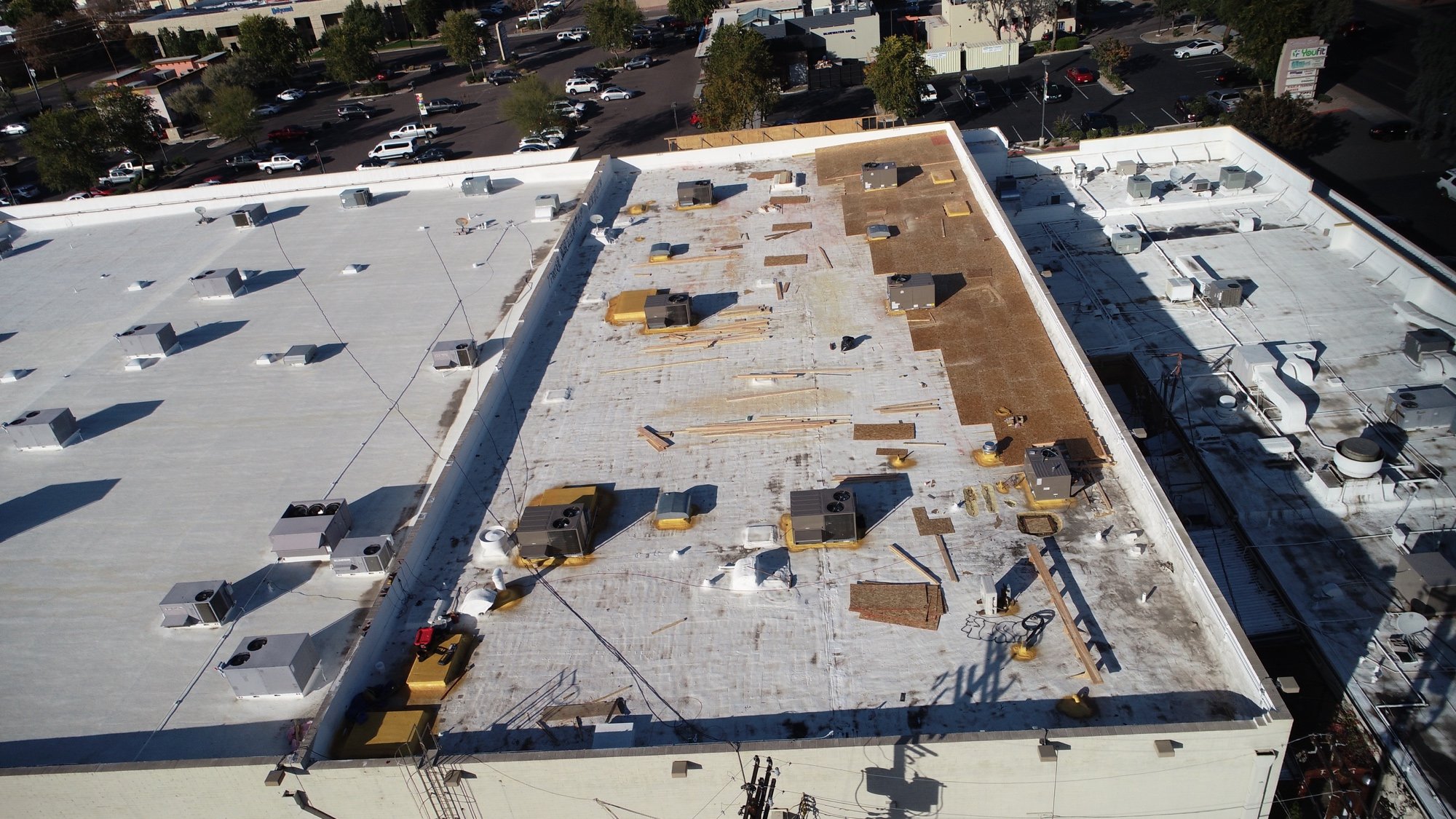
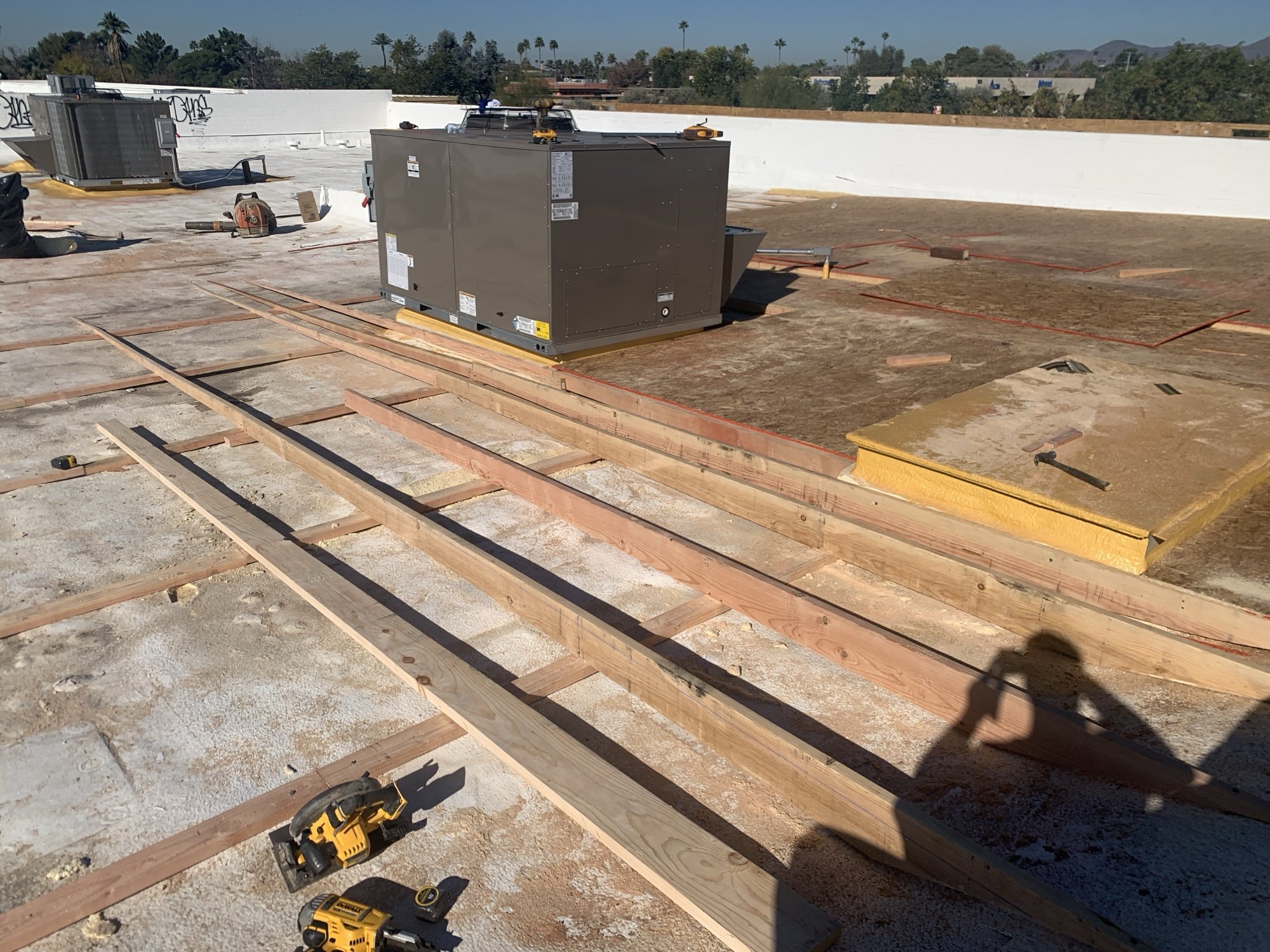
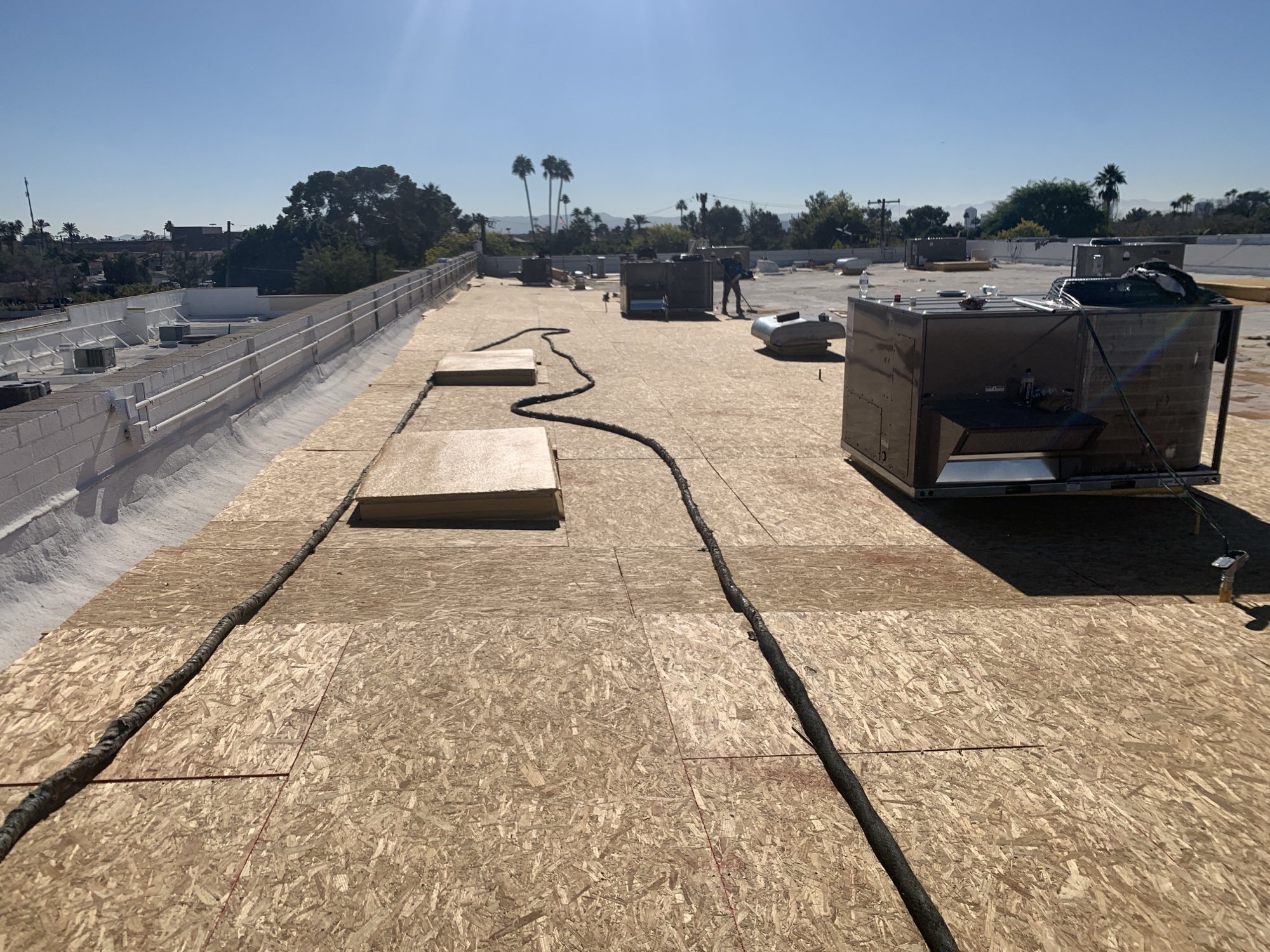
- Site-built tapered wood framing. Our crews framed the crickets on the roof using dimensional lumber, sistered into the existing structure and sheathed with new OSB — a permanent structural addition, not a stopgap.
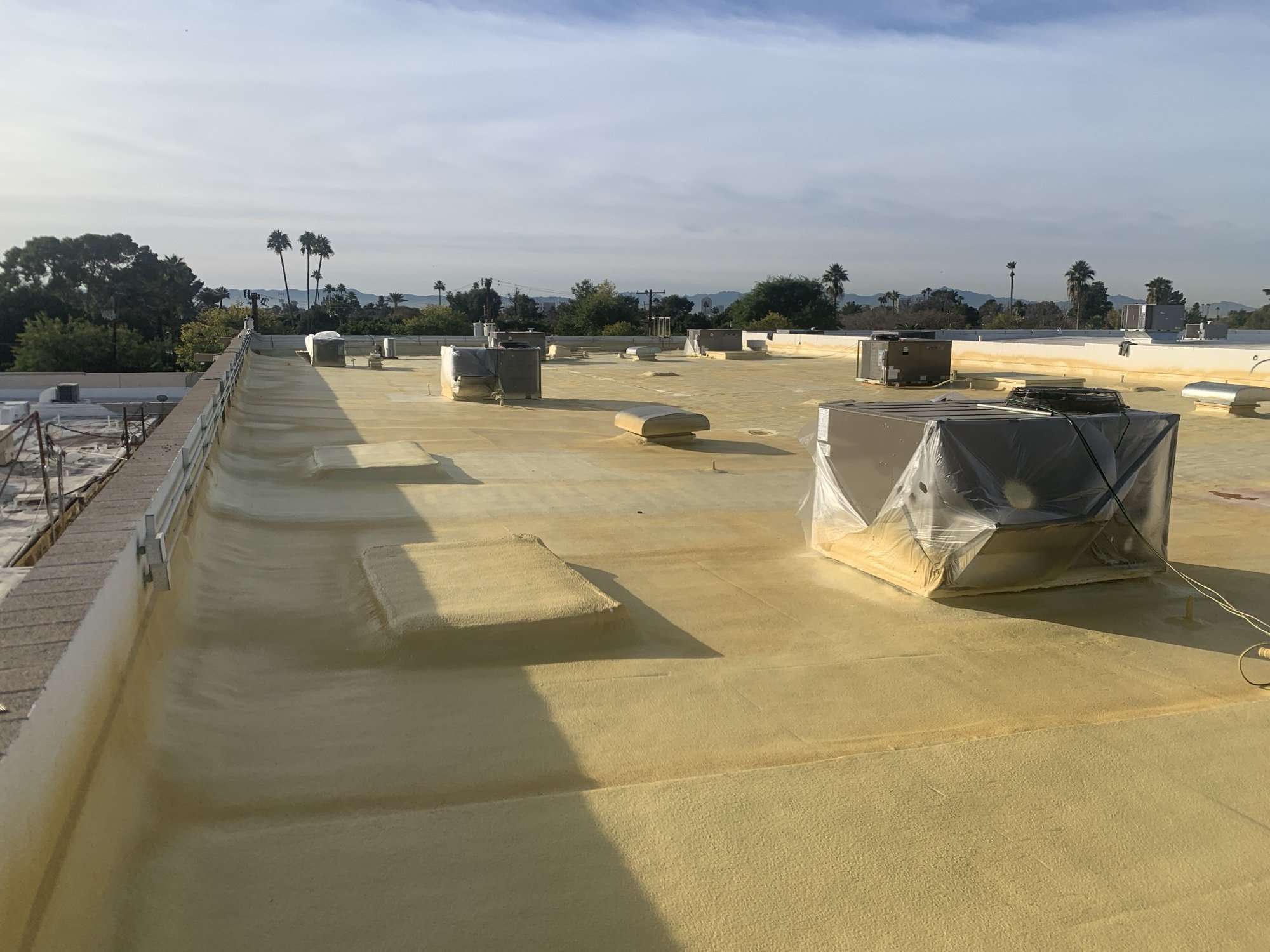
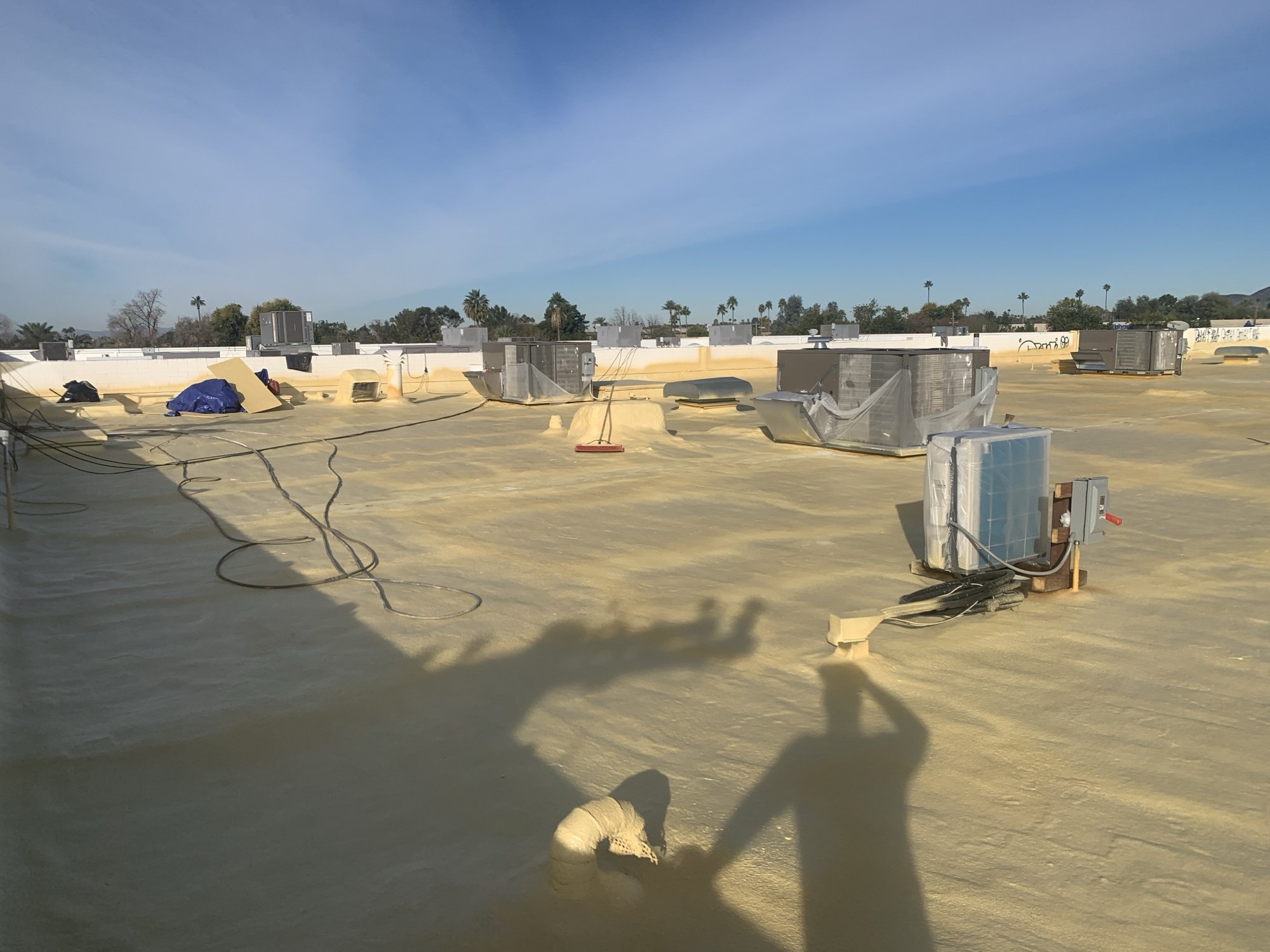
- Fresh polyurethane foam over the whole assembly. Once the new geometry was in place, we spray-applied polyurethane foam across the entire roof — over the new crickets and over the existing substrate — creating a continuous, seamless, thermally-insulating membrane with no seams, no laps, and no cold bridges.
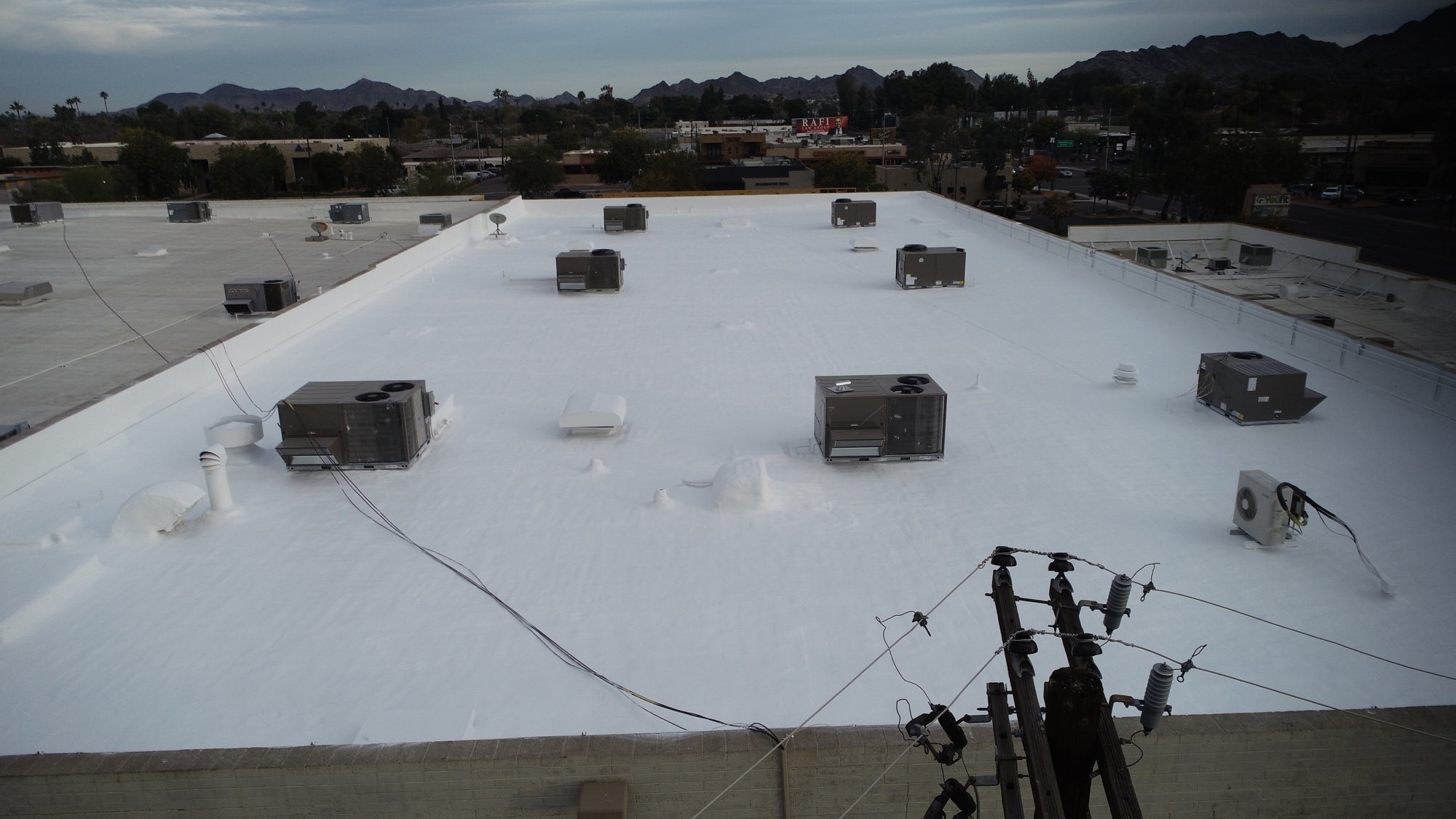
- Two coats of ARMORCOAT AC100. Locked the whole thing under a highly reflective, warranty-grade elastomeric — see our roof coating services page for how the AC100 system is applied to spec.
- Standing water eliminated. After the rebuild, that 40-by-190 area drains cleanly to the roof drains within hours of every storm — no ponding, no algae, no premature coating failure.
Our ApproachHow we sequenced a drainage rebuild on an occupied retail store
A drainage rebuild on an operating retail store is more complex than a straight recoat. The store had to stay open, the parking lot had to stay accessible, and the crickets had to be framed and sheathed before any coating went down. Here's how we sequenced it:
Scope of work — the drainage rebuild sequence
- Survey the ponding pattern. Walked the roof after a rain event, drone-mapped the exact footprint of the ponding, and designed the cricket geometry to move that water to the existing drain locations without altering the parapet lines.
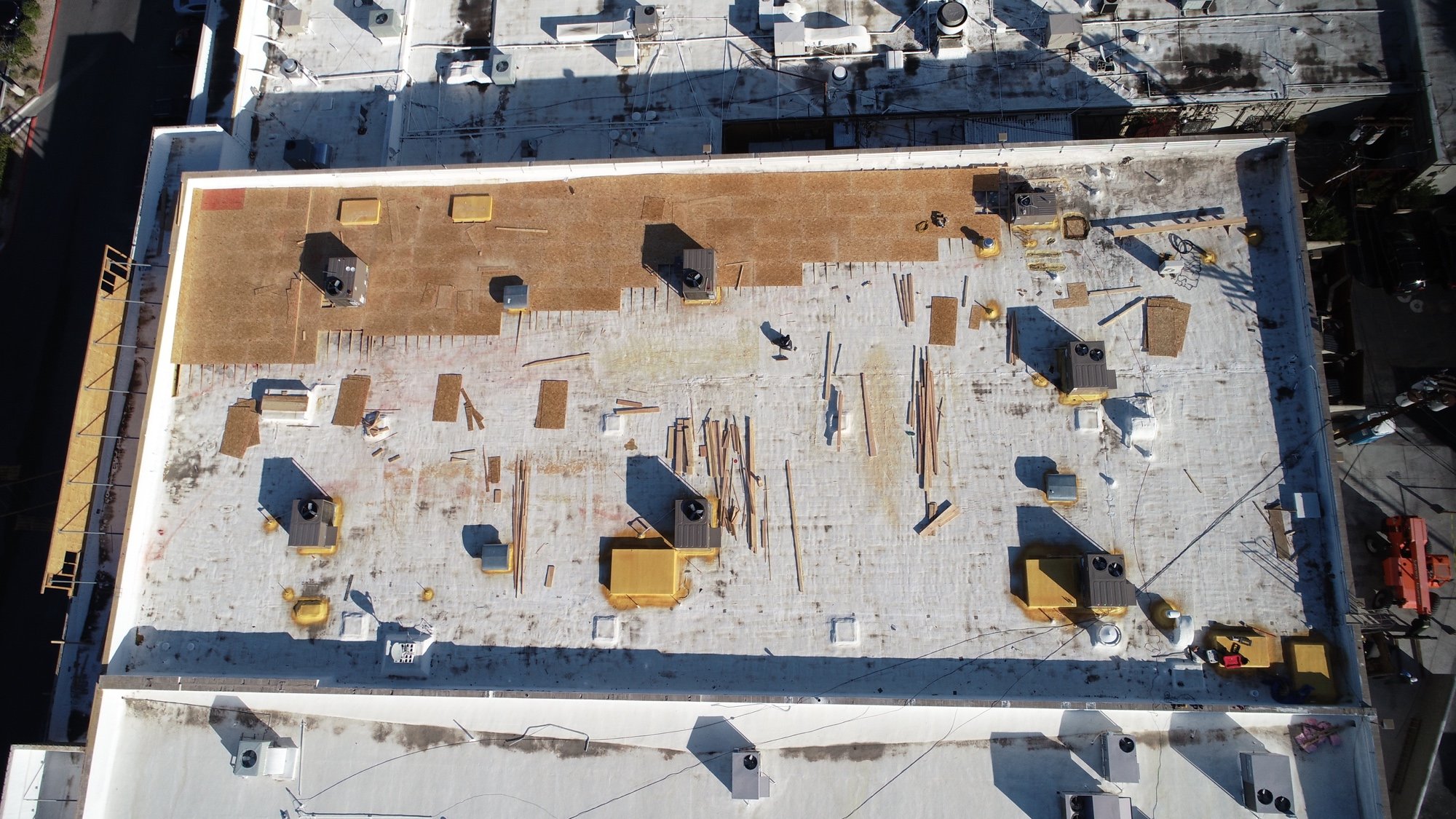
- Frame the tapered crickets. Cut dimensional lumber to the taper spec, sistered into the existing roof structure where needed, and stood the framing over the entire 40 by 190 foot ponding footprint — a full carpentry scope on top of a roofing scope.
- Sheath with fresh OSB. Installed new OSB decking over the cricket framing, screwed into the structure, ready for spray foam application.
- Spray-apply polyurethane foam. Once the new substrate was tight, we sprayed continuous polyurethane foam across the entire roof — over the new crickets and the existing surface — to create one seamless thermal membrane.
- Two coats of ARMORCOAT AC100. First coat directional, second coat cross-directional at 90 degrees to guarantee full mil thickness and warranty compliance.
- Verify drainage on a live test. Water-tested the finished roof by flooding the reworked area with a hose to confirm that runoff was reaching the drains cleanly before final walk-off.
Because the property owner engaged us directly, we owned the whole scope — carpentry, foam, and coating — under one contract, one crew, and one warranty. No coordinating three trades and hoping the schedule holds.
The DetailWhy 'we reshaped the roof' is not a marketing line
Most Phoenix commercial roofers, when confronted with a chronic ponding area, will quote a recoat and hope the owner doesn't notice the water is still standing after year one. It's easier, it's cheaper to bid, and it keeps the scope inside the coating trade. The problem is that recoating a ponding area is throwing warranty-grade product into a failure mode — the water will find any weakness in the coating and it will breed algae until it does.
The right answer for a chronically ponding roof is to fix the geometry first and coat second. That means carpenters on the roof, structural attachment, and a new tapered surface built before any spray foam or coating hits the deck. On the Goodwill Bethany Home job that's exactly what we did — 40 feet by 190 feet of new tapered structure, permanent, engineered, and warrantied under the coating on top. For more on the warning signs of a failing foam roof, see our foam roof replacement warning signs article.
The WarrantyThe 10-year no-leak warranty on the finished system
The finished roof at the Goodwill Bethany Home store carries our 10-year no-leak warranty on the ARMORCOAT AC100 coating system, backed by the drainage geometry we rebuilt underneath. The reason we can stand behind that warranty on this roof — where a straight recoat would have failed early — is that the water is no longer standing on the coating. Fix the drainage, then coat, and the roof lasts. Coat over a ponding area, and the warranty is a piece of paper.
The ResultsA chronically failing roof turned into a warrantied 10-year system
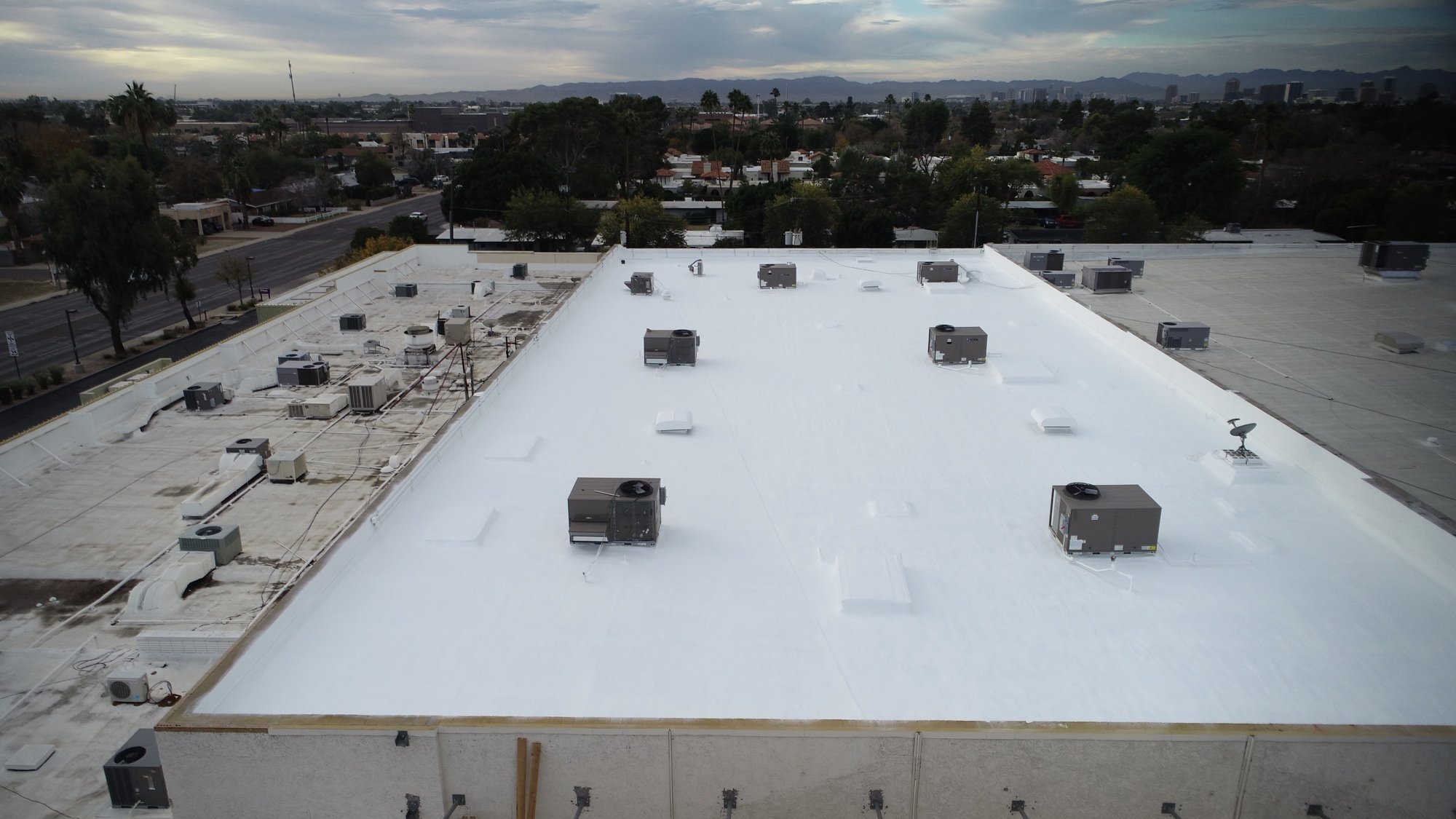
The retail store operates today under a roof that no longer collects standing water, no longer stains ceiling tiles, and no longer forces the maintenance team into reactive patch cycles after every storm. The photos from the finished job show the downtown Phoenix skyline visible past a bright white, uniformly-draining, warrantied foam roof — the exact opposite of the roof we walked onto.
Photo GalleryProject photos
FAQCommon questions
Why not just recoat over a ponding area?
Because coatings applied over standing water fail early. A ponding area holds moisture against the coating film, breeds algae that degrades the elastomeric, and telegraphs any pinhole into a leak. Every warranty on the market — including ours — specifically excludes coating failure caused by ponding water. The only real fix on a chronically ponding roof is to change the geometry first, then coat.
What is a roof cricket and why 40 feet by 190 feet?
A cricket is a tapered structure built on a roof to divert water toward drains. Small four-foot crickets are common uphill of HVAC curbs. What we built at Goodwill Bethany Home was much larger — 40 feet wide by 190 feet long — because the ponding footprint was that large. The size of the cricket is dictated by the size of the low spot; on old Phoenix building stock, decks can settle over large areas and require correspondingly large drainage rebuilds.
Can you do a drainage rebuild without closing the store?
Yes. The entire drainage rebuild at Goodwill Bethany Home was executed with the retail store open for business. Because all the carpentry and coating work happens above the finished ceiling, there was no interior impact — the crew accessed the roof from a service point, staged materials in a coned-off section of the parking lot, and the store operated normal hours throughout.
How does this compare to a full roof tear-off?
A full tear-off replaces the entire roof assembly down to the deck. On a roof with a good structural deck but a bad drainage profile, that's the wrong tool — you'd be spending replacement money to solve a geometry problem. The right move is to keep the sound roof, add the missing drainage geometry with tapered crickets, and lock the whole thing under a warrantied coating. For more on when replacement is actually the right call, see our blog on the true cost of commercial roof replacement in Arizona.
Does the drainage rebuild come with the same 10-year warranty as a straight recoat?
Yes — with an important nuance. The 10-year no-leak warranty covers the finished AC100 coating system in exactly the same way it covers a straight recoat. The reason we can stand behind that warranty on a rebuilt roof is that the drainage rebuild eliminated the specific condition (ponding) that would have voided a warranty on a straight recoat. Fix the geometry first, then coat, and the warranty terms are the same.