
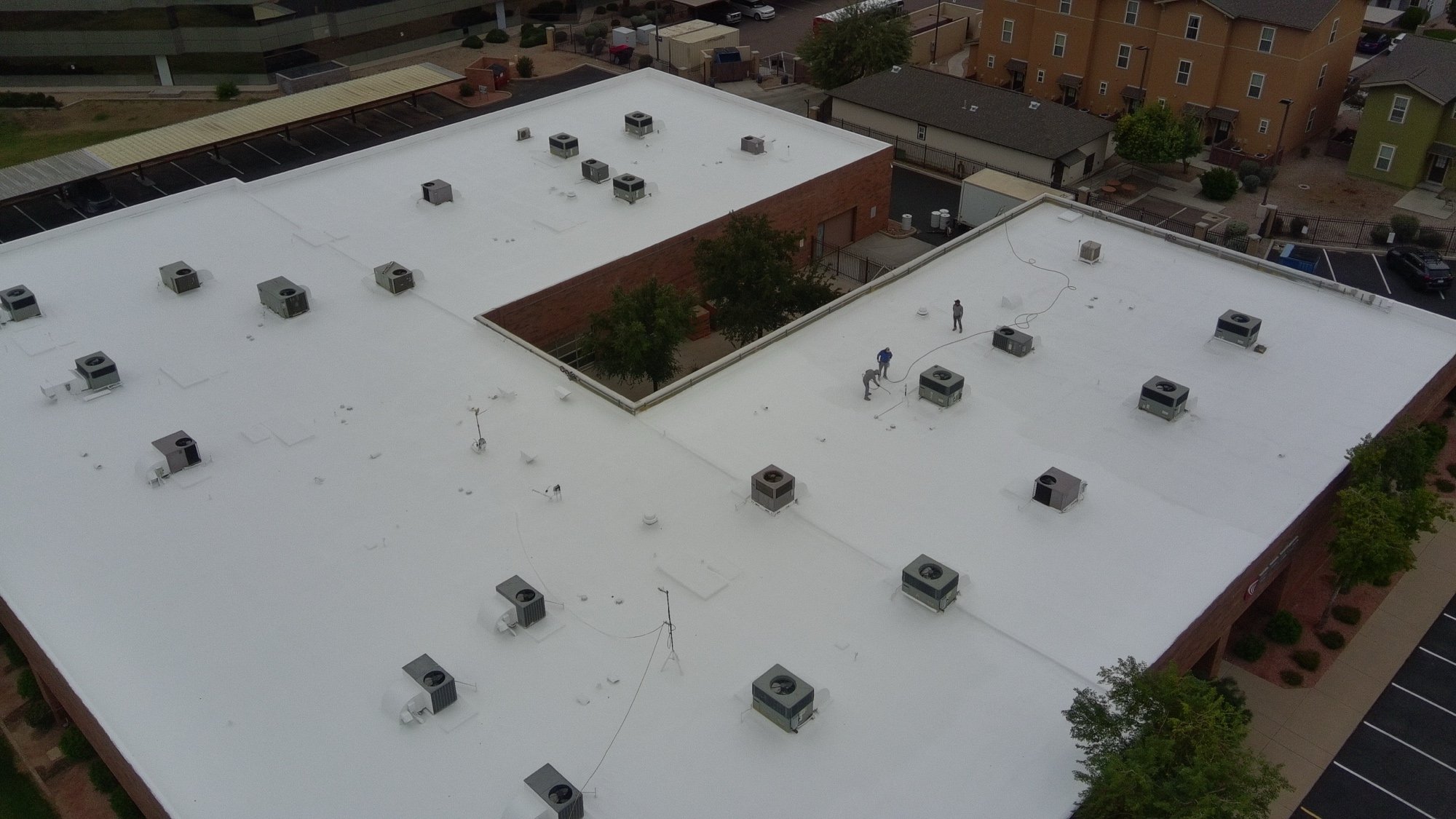
Case Study: 523-Panel Solar Removal + 29,500 SF Foam Restoration — 1860 W University Dr, Tempe
Some commercial roofs bring problems that eliminate half of the Phoenix contractor market from the bid list. A 29,500 square-foot foam roof at 1860 W University Dr in Tempe — the ASU corridor — had one of those problems: 523 rooftop solar panels sitting on ballasted racking, an aging foam substrate underneath, and an ownership group who needed the roof restored to new-install spec without abandoning the solar array. Vanguard tested and disconnected the panels, removed and stored 523 modules, scarified the existing foam, replaced scuppers and skylights and rotten decking as needed, sprayed a new inch of polyurethane foam, coated in a white acrylic elastomeric, and reinstalled every panel — this is the only case study on our site to date in the city of Tempe, and the story of what a full-scope solar-and-foam restoration actually takes.
Project Snapshot1860 W University Dr — Tempe, AZ 85281
The 1860 W University Dr property sits inside the ASU corridor in Tempe — the stretch of commercial real estate that runs through the university's northwest edge, feeding student housing, tech offices, and campus-adjacent services. Commercial buildings in this corridor tend to run heavier than average on rooftop solar because of the campus sustainability optics and because the tenants often value renewable-energy branding. The 29,500 sq ft building we restored carried a substantial rooftop solar array: 523 modules on ballasted racking spread across the roof plane, generating power for the property below.
523 Solar Panels + Foam Restoration — 29,500 SF Tempe
| Property | University Pointe — commercial building |
| Address | 1860 W University Dr, Tempe, AZ 85281 |
| Roof Size | 29,500 sq ft |
| Solar Array | 523 rooftop panels on ballasted racking |
| Scope | Solar remove/reinstall + scarify + repair + 1" new foam + white acrylic |
| Foam System | Polyurethane spray foam — 1 inch new lift |
| Coating System | White acrylic elastomeric topcoat |
| Client Engagement | Direct property owner hire |
| Warranty | 10-Year No-Leak |
| Contractor | Vanguard Roofing AZ — since 1957 |
The ProjectThe building, the client, and what we were solving for
The 1860 W University Dr property sits inside the ASU corridor in Tempe — the stretch of commercial real estate that runs through the university's northwest edge, feeding student housing, tech offices, and campus-adjacent services. Commercial buildings in this corridor tend to run heavier than average on rooftop solar because of the campus sustainability optics and because the tenants often value renewable-energy branding. The 29,500 sq ft building we restored carried a substantial rooftop solar array: 523 modules on ballasted racking spread across the roof plane, generating power for the property below.
When the ownership group came to us, the foam substrate under those panels was aging, ballast blocks had settled into low spots, coating layer had chalked and thinned, and roof-plane details like scuppers and skylights needed replacement. But the array was still generating well and pulling it permanently was not on the table. The scope had to include full solar removal, full substrate restoration, and full solar reinstallation on the same footprint — end-to-end, one contractor. This is the kind of scope most Phoenix roofers subcontract or refuse. It's also our first published case study in the city of Tempe. See our Tempe commercial roofing service area for more.
The SystemWhy removing and reinstalling 523 panels beats coating around them
There is a shortcut some contractors will quote on a solar-loaded foam roof: coat around the panels. It's cheaper to bid because it eliminates the electrical and logistical scope of the array. It's also functionally useless — because the substrate under and around ballasted panels is where the coating has failed first, where debris has collected, where ponding has ponded, and where any real restoration has to reach. On this Tempe project we quoted the honest scope: test the array, disconnect it, remove every panel and store it, restore the substrate, and reinstall the array on top of the finished roof.
- Test and disconnect the array. Full electrical isolation and safe disconnect of the solar array before any panel or racking hardware was touched.
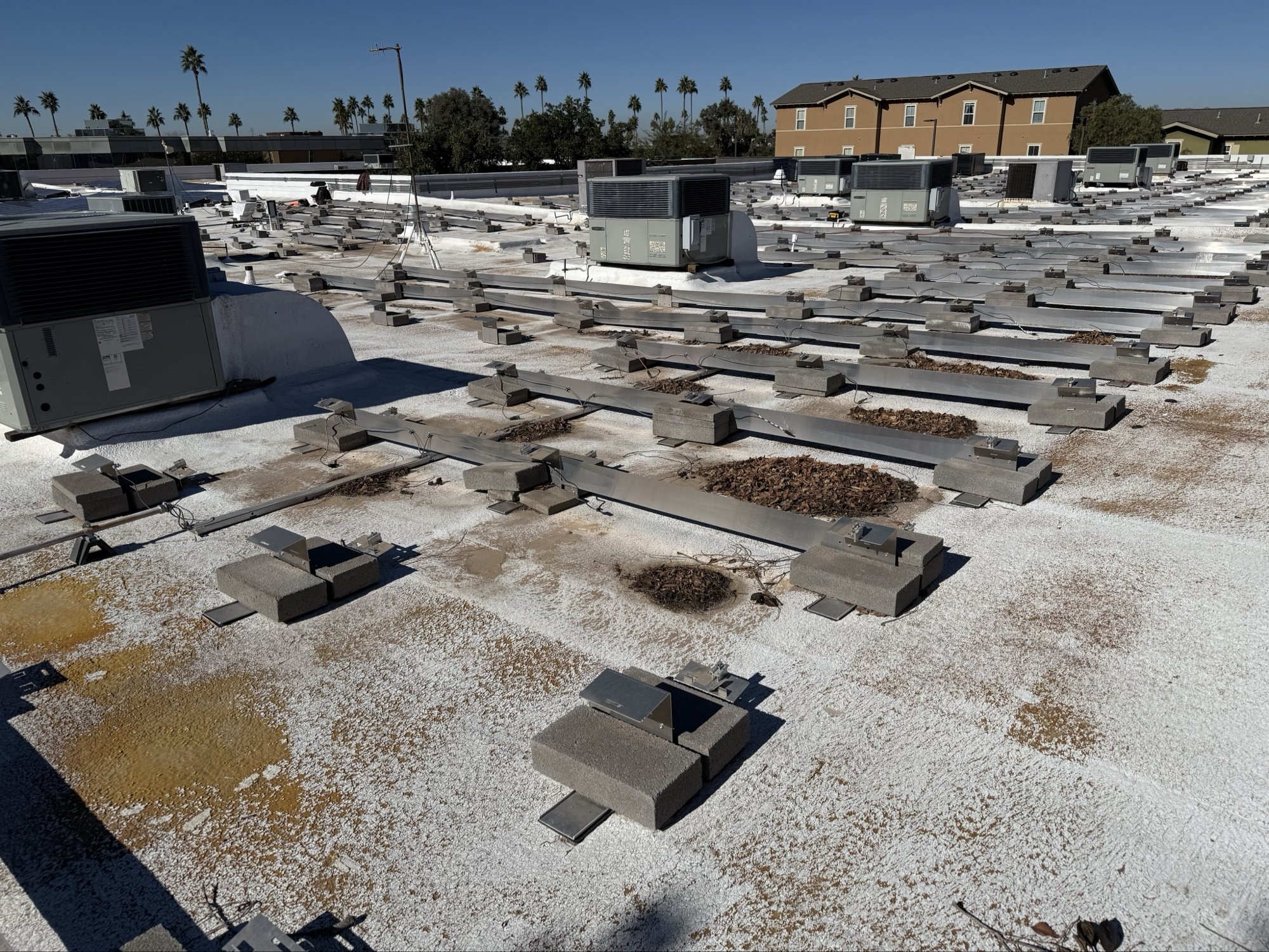
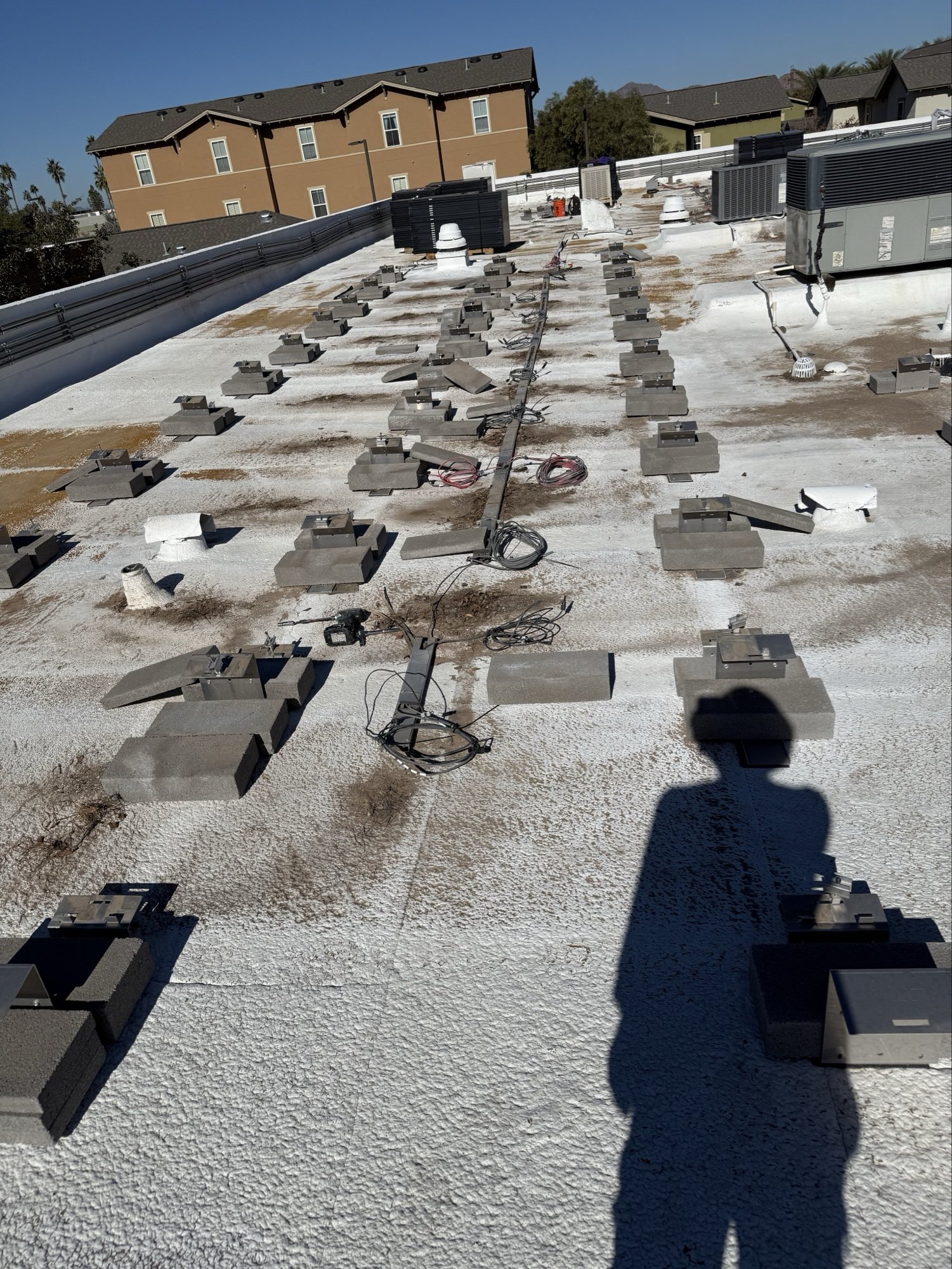
- Remove and store 523 panels + all racking. Every panel and every piece of ballast racking removed from the roof and staged for reinstallation — the roof came clean to substrate.
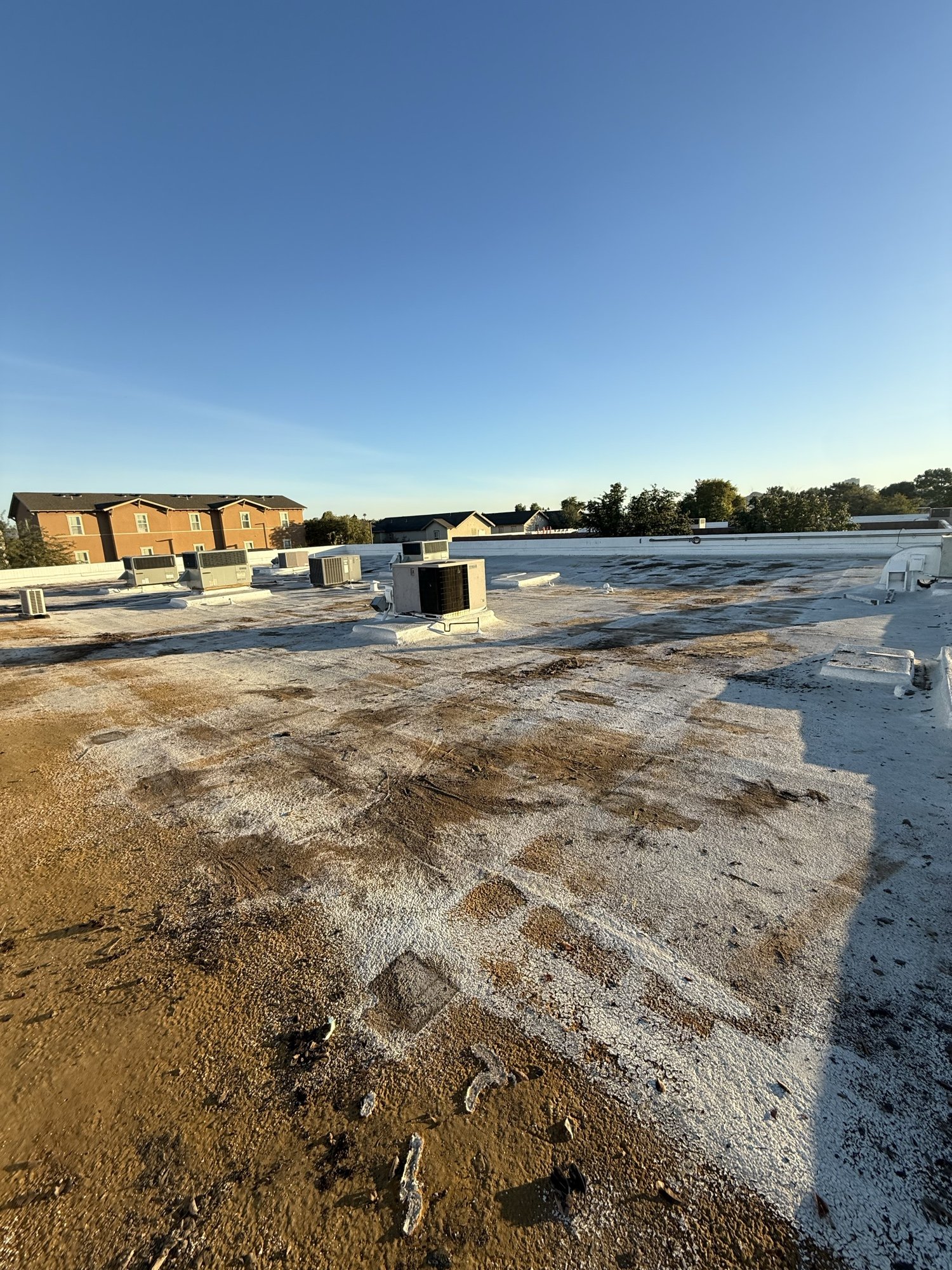
- Scarify existing foam and cut out high-moisture areas. Removed the top layer of the aging foam substrate to a sound layer, cut out any high-moisture pockets in the foam that could not be recovered, and replaced scuppers, skylights, and decking as needed to bring the substrate to new-install-quality condition.
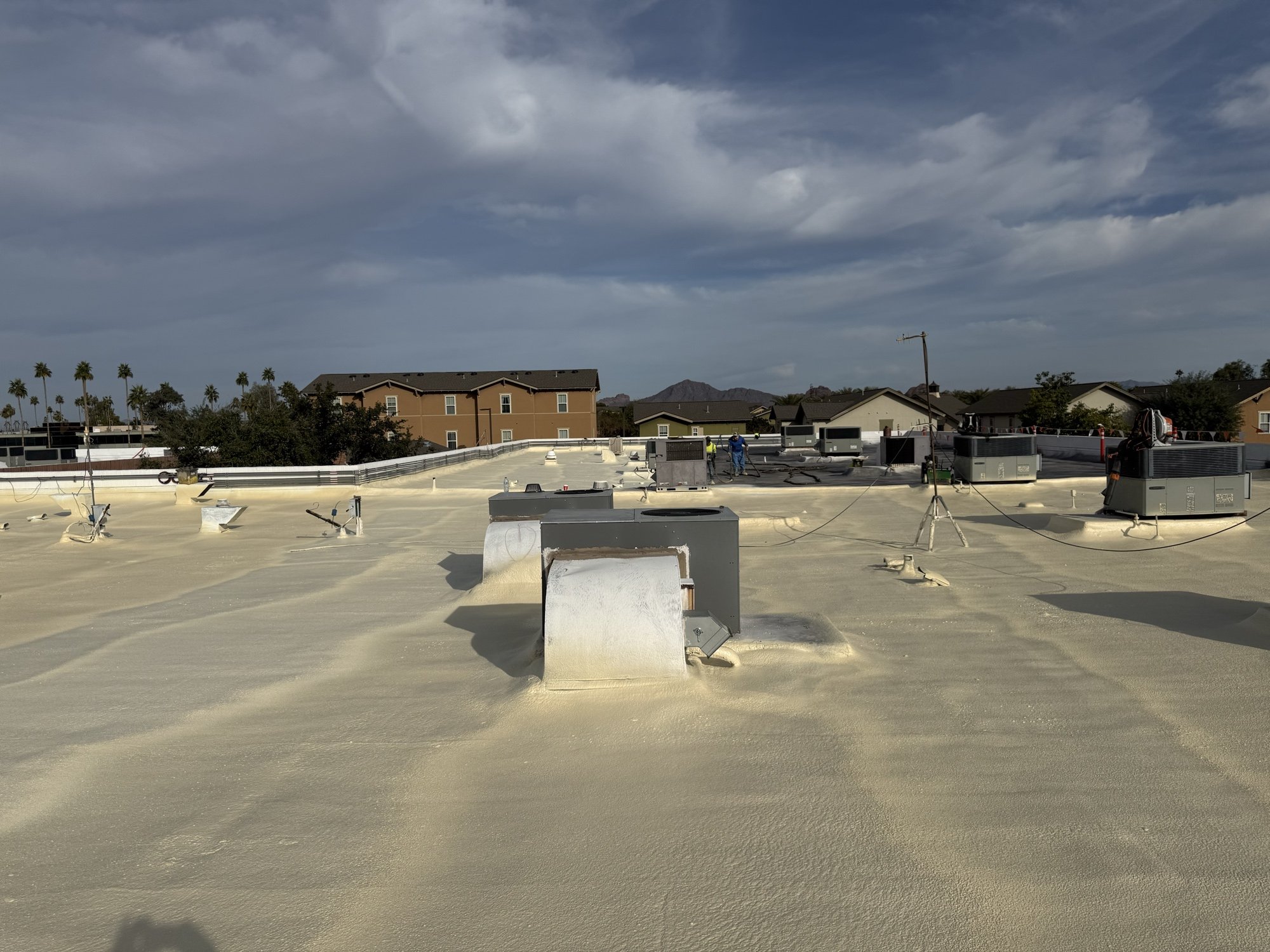
- Spray 1 inch of new polyurethane foam. Fresh full-thickness polyurethane foam over the restored substrate — a new continuous seamless membrane.
- Apply white acrylic elastomeric topcoat. Coated the fresh foam with a high-reflectivity white acrylic elastomeric — the same category of coating as the ARMORCOAT AC100 spec used elsewhere in our portfolio.
- Reinstall all 523 solar panels + racking. Every module and every piece of racking reinstalled on the finished roof — the array back to full generation on a substrate that will outlast it.
Our ApproachHow we sequenced solar removal, substrate restoration, and solar reinstall
The 1860 W University project is a schedule and safety exercise as much as a roofing exercise. 523 panels have to come off in the correct sequence, get stored where they won't be damaged, and go back on in the correct sequence. The foam and coating work has to happen inside the window while the array is off the roof. And the electrical work — disconnect, isolation, reconnect — has to be coordinated with the coating cure schedule. Here's how the sequence ran:
Scope of work — solar + foam restoration sequence
- Solar test and disconnect. Verified array function, then coordinated electrical isolation and safe disconnect before any hardware was touched.
- Systematic panel and ballast removal. Removed all 523 solar panels and all ballast racking hardware from the roof plane in a documented sequence, staged for reinstall.
- Substrate scarify and high-moisture cut-out. Removed the top layer of aged foam to a sound layer across the whole 29,500 sq ft, cut out any pockets with unrecoverable moisture, and prepared the substrate for fresh foam.
- Scupper, skylight, and decking replacement. Replaced scuppers, skylights, and rotten decking as identified during substrate prep — every roof-plane detail brought to new-install-quality condition before the new foam went down.
- 1-inch new polyurethane foam. Sprayed full-thickness fresh polyurethane foam across the restored substrate — a continuous seamless new membrane.
- White acrylic elastomeric topcoat. Applied a high-reflectivity white acrylic topcoat across the entire finished foam — locking the new roof under a warranty-grade coating.
- Complete solar reinstall. Reinstalled all 523 panels and ballast racking on the finished roof, coordinated the electrical reconnect, and returned the array to full generation.
End-to-end scope like this can only be delivered by a contractor who owns the roofing scope and coordinates the electrical work — not by a roofer who bids the coating and leaves the array as someone else's problem. That's the point of hiring Vanguard on a solar-loaded roof.
The DetailThe ASU corridor and the solar-on-foam roof reality
Rooftop solar on commercial buildings sold hard in the 2010s across Arizona, and a lot of those arrays are now approaching their first substrate crisis: the roof under the panels needs restoration and the array is complicating the scope. Some of those buildings will be forced into unnecessary premature-replacement decisions because the owner cannot find a roofing contractor willing to own the solar remove-and-reinstall alongside the foam scope. That's a mistake avoidable with the right contractor.
Vanguard's willingness to own solar remove-and-reinstall on foam restoration jobs — as we did on the 1860 W University project — is not accidental. It reflects the fact that we've been doing commercial roofing in Arizona since 1957, and we've been doing it long enough to know when a solar-loaded roof needs a real restoration and when it needs a coating shortcut that's going to fail early. For more context on foam substrate failures, see our blog on foam roof replacement warning signs.
The Warranty10-year no-leak warranty on the finished restored roof
The finished 1860 W University Dr roof carries our 10-year no-leak warranty on the restored polyurethane foam and white acrylic elastomeric coating system. Because the substrate was rebuilt to new-install-quality condition (scarified, high-moisture areas removed, scuppers and skylights and decking replaced as needed) before the fresh foam and coating went down, the warranty terms are the same as we would offer on a new-install foam roof. That's what a real restoration delivers — the warranty stands up because the substrate stands up.
The Results29,500 sq ft restored, 523 panels back on, roof under warranty
The 1860 W University Dr property in Tempe operates today under a fully-restored polyurethane foam roof, a fresh white acrylic elastomeric coating, and a rooftop solar array running at full generation on top of a substrate designed to outlast it. This is our first published case study in the city of Tempe and the reference project for anyone asking whether solar-loaded commercial foam roofs can be truly restored rather than replaced.
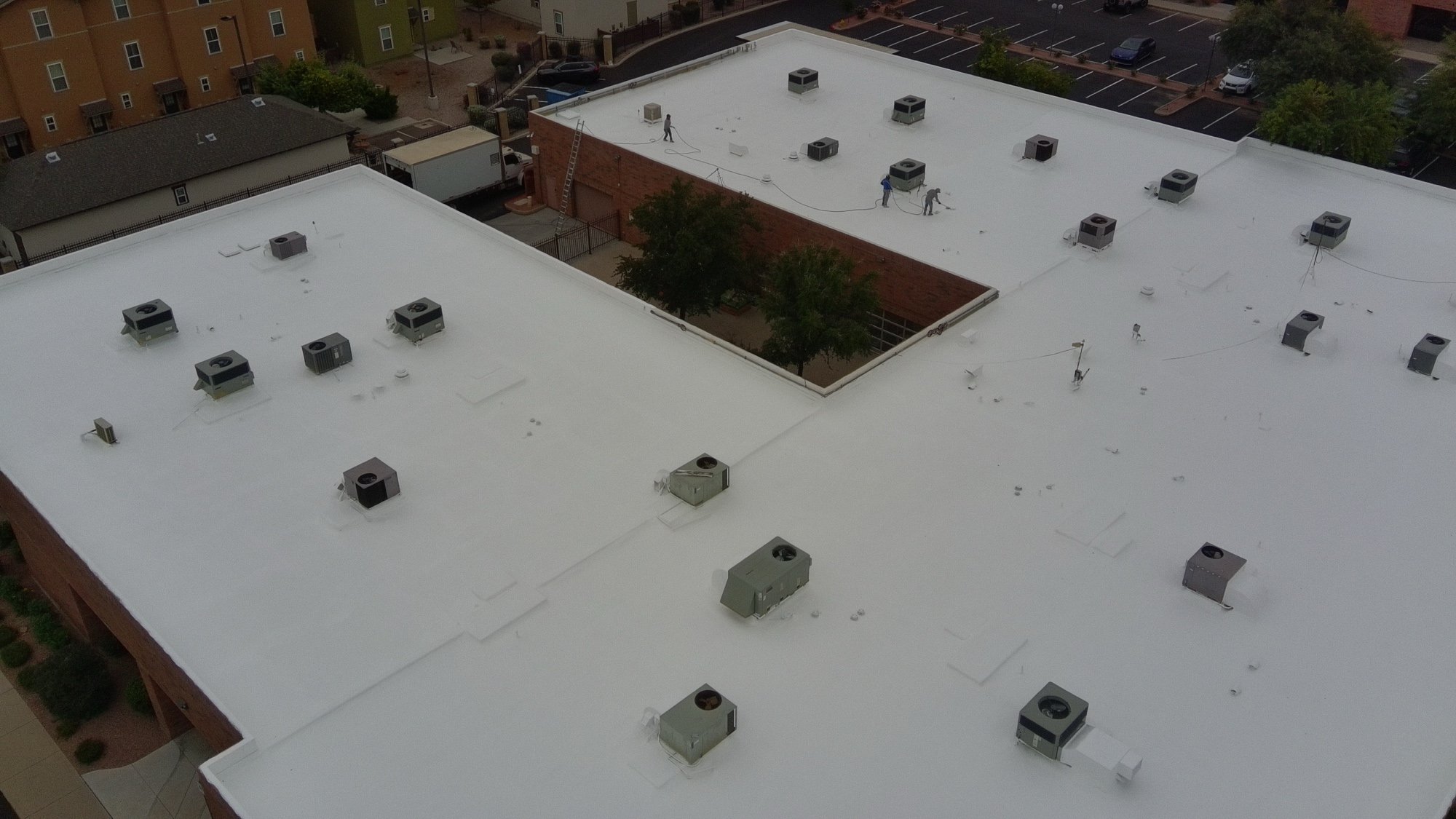
Photo GalleryProject photos
FAQCommon questions
Can you really remove and reinstall 523 solar panels for a roof restoration?
Yes — on the 1860 W University Dr project in Tempe we tested and disconnected the array, removed all 523 panels and ballast racking to storage, restored the foam substrate underneath, and reinstalled every panel on the finished roof. This is a scope most Phoenix roofers subcontract or decline. Vanguard owns the whole sequence end-to-end on solar-loaded jobs like this one.
Can you just coat around the solar panels instead of removing them?
Some contractors will quote it that way. The problem is that the substrate under and around ballasted solar panels is exactly where the coating has failed first — that's where debris collects, water ponds, and coating chalks fastest. Coating around the array is functionally a cosmetic pass on the exposed field with no real substrate work where it matters. It's a shortcut that fails early.
How long does the solar array stay off the roof during the restoration?
The array is offline for the duration of the restoration window on that section of roof — typically the length of time it takes to remove panels, scarify and rebuild substrate, spray new foam, apply the topcoat and cure, then reinstall. On the 1860 W University project the sequence was tightly scheduled to minimize solar downtime and coordinated with the ownership group's generation expectations.
What about the electrical scope — disconnect and reconnect?
The electrical disconnect and reconnect on a solar array like this is coordinated with licensed electricians and the property owner's solar service partner. Vanguard owns the roofing scope end-to-end and coordinates the electrical scope so the ownership group has a single point of contact for the whole restoration rather than juggling three trades on a solar-loaded roof.
Does this restoration extend the roof life the same way a new foam install would?
Yes. Because the substrate was rebuilt to new-install-quality condition — scarified, high-moisture areas cut out, scuppers and skylights and decking replaced — before the fresh foam and coating went down, the finished system delivers the same performance and same warranty terms as a new-install foam roof. The 10-year no-leak warranty covers the finished coating system for the first decade and the roof can be recoated on cycle beyond that.