
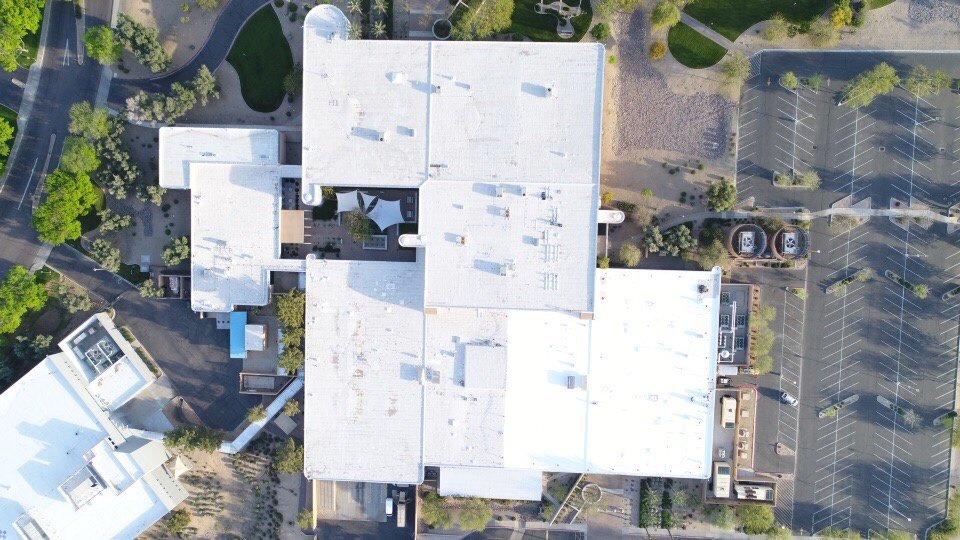
Case Study: 155,000 SF Corporate HQ Foam Roof Recoat — AAA Insurance Arizona, Glendale
One of the largest foam roofs in Glendale, a 155,000 square-foot corporate headquarters at 5353 W Bell Rd, and the same challenge every large flat-roof owner eventually faces: an aging foam roof that still had years of life in the substrate, but a topcoat that was chalking, thinning, and losing reflectivity. We cleaned, patched, raised the low spots, and locked the whole roof under two coats of ARMORCOAT AC100 white elastomeric — 10-year no-leak warranty, two weeks on site, no tenant disruption.
Project SnapshotAAA Insurance HQ — 5353 W Bell Rd, Glendale AZ
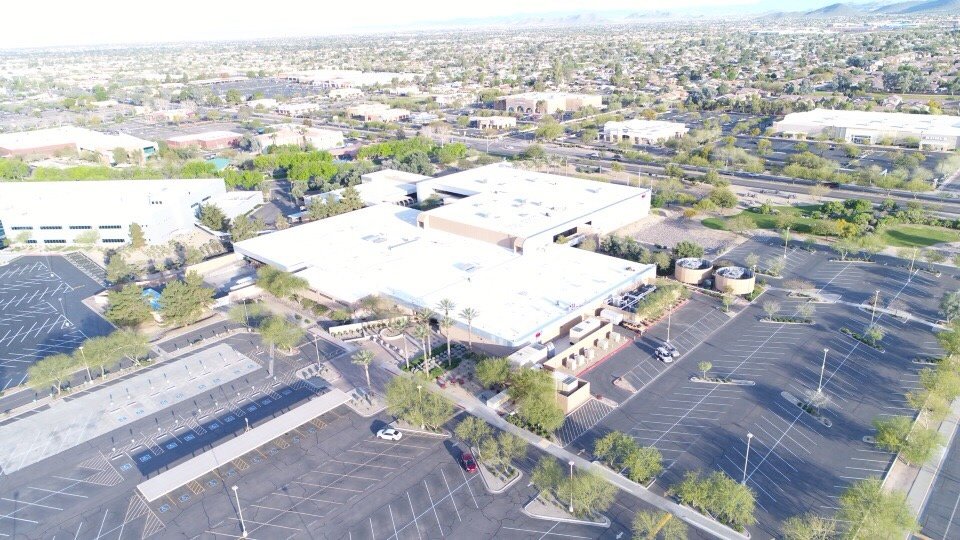
The AAA Insurance corporate headquarters at 5353 W Bell Rd sits at the intersection of Bell Road and the Loop 101 in northwest Glendale, one of the busiest commercial corridors in the entire Phoenix metro. It's the kind of building most drivers pass every week without ever thinking about the roof — a low-slope, tenant-occupied corporate campus with 155,000 square feet of foam decking above active offices, servers, and daily business operations. And that's exactly the point: a properly maintained foam roof is invisible from the parking lot, but the moment it fails, everything under it — every workstation, every server rack, every ceiling tile — is at risk.
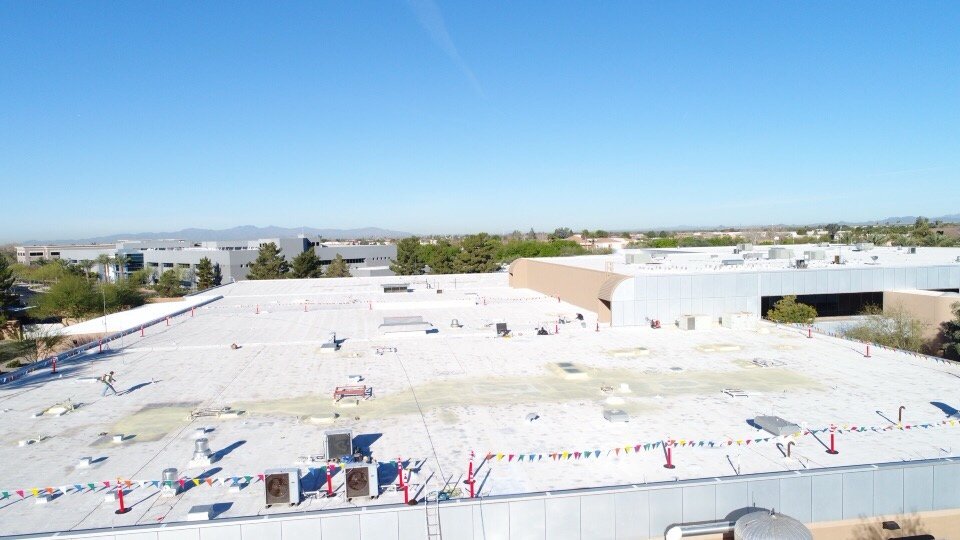
AAA Insurance HQ Foam Recoat — 155,000 SF ARMORCOAT AC100, Glendale AZ
| Property | AAA Arizona Corporate Headquarters |
| Location | 5353 W Bell Rd, Glendale, AZ 85308 |
| Roof Size | 155,000 sq ft |
| Existing System | Aged polyurethane foam roof |
| Scope | Clean + patch + level low areas + 2 coats AC100 |
| Coating System | ARMORCOAT AC100 White Elastomeric |
| Timeline | 2 weeks |
| Warranty | 10-Year No-Leak |
| Client Engagement | Property manager referral |
| Completed | Recent (2024–2026) |
The ProjectThe building, the client, and what we were solving for
The AAA Insurance corporate headquarters at 5353 W Bell Rd sits at the intersection of Bell Road and the Loop 101 in northwest Glendale, one of the busiest commercial corridors in the entire Phoenix metro. It's the kind of building most drivers pass every week without ever thinking about the roof — a low-slope, tenant-occupied corporate campus with 155,000 square feet of foam decking above active offices, servers, and daily business operations. And that's exactly the point: a properly maintained foam roof is invisible from the parking lot, but the moment it fails, everything under it — every workstation, every server rack, every ceiling tile — is at risk.
This roof was originally installed as a spray polyurethane foam system, one of the most durable flat-roof assemblies in Arizona's climate when it's coated on schedule. The problem AAA's property management team faced was the coating layer, not the foam. After roughly a decade of Arizona UV, the elastomeric topcoat had chalked, thinned, and lost most of its reflectivity — normal wear for a coating designed to sacrifice itself and be reapplied. The foam underneath was still doing its job. Our scope was to bring the whole roof back to its original performance without a costly tear-off, and to do it on a two-week schedule with the building fully occupied. For more on how we approach corporate work across the West Valley, see our Glendale commercial roofing page.
The SystemWhy ARMORCOAT AC100 for a 155,000 SF corporate recoat
When a foam roof this size needs to be restored, the coating spec is the single most consequential decision — and it's a decision made harder by how much bad advice exists in the marketplace. Cheap acrylics look identical to premium ones on day one. The difference shows up in year three, five, and seven, when the wrong product has chalked out and the owner is paying for the same job twice. We specified ARMORCOAT AC100 — the same elastomeric we use on almost every foam recoat because it's proven itself over more than a decade of Arizona projects. For a broader look at how coating systems work, see our roof coating services.
- Formulated for Arizona UV. AC100 is a high-solids acrylic elastomeric engineered specifically for hot desert climates — the same product line that anchors the ARMORCOAT warranty program Vanguard has installed for years.
- Two coats, not one. A single coat looks fine on day one and fails five years early. Two coats — applied cross-directionally so pinholes and thin spots in one pass are covered by the other — is the manufacturer spec and the only way to hit the 10-year warranty.
- Highly reflective white finish. A fresh two-coat AC100 finish returns the roof to ENERGY STAR-level reflectivity, cutting HVAC load on 155,000 square feet of tenant space by measurably reducing rooftop surface temperatures.
- Restoration cost, not replacement cost. On a 155,000 sq ft foam roof, tear-off and full replacement would run into seven figures. A properly executed recoat is a fraction of that number — often 20–30% of a replacement — and buys the building another decade of service life.
Our ApproachThe 2-week recoat sequence on a 155,000 SF occupied HQ
A recoat this size looks simple from the parking lot: spray the roof white, hand back the warranty. Getting there in two weeks on an occupied corporate building without disrupting tenants is where craft actually shows up. Here's how we sequenced the job:
Scope of work — the recoat sequence
- Full roof cleaning. Power-washed the entire 155,000 sq ft to remove years of accumulated Arizona dust, chalk from the old coating, and debris around every HVAC unit and roof drain. A clean substrate is non-negotiable — coatings do not bond to dirty foam.
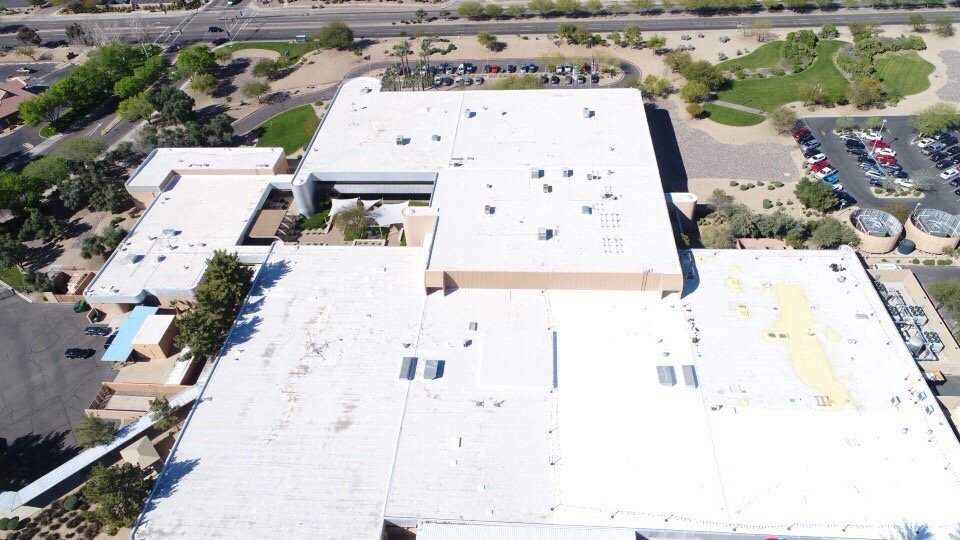
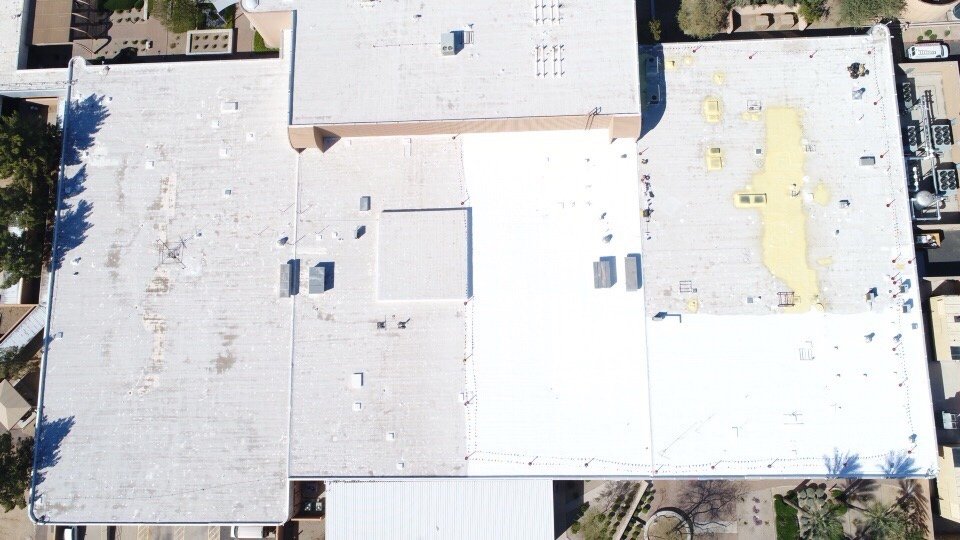
- Raise low areas. Walked every square foot to identify ponding-water low spots that had settled into the aging foam over time, and refoamed those areas to restore positive drainage before the topcoat went down.
- Patch all visible defects. Cut out any weathered or bird-damaged foam, patched with new polyurethane foam, and feathered the transitions so the topcoat would go on smooth.
- First coat — full 155,000 sq ft. Sprayed the first pass of ARMORCOAT AC100 across the entire roof — one directional pass to seal the substrate and provide the base film thickness.
- Second coat — cross-directional. Applied the second AC100 pass at 90 degrees to the first, guaranteeing complete coverage over any pinholes or thin spots in the initial coat. This is the pass most contractors skip on large-scale bids; it's what actually earns the 10-year warranty.
- Final punch and warranty registration. Walked the whole roof, verified mil-thickness readings against the AC100 spec, and submitted the warranty documentation to lock in the 10-year no-leak coverage.
Because AAA's property management team engaged us directly, the coordination stayed simple: one contractor accountable for the whole 155,000-square-foot scope, one crew running the sequence, one warranty at the end. No layered subs, no finger-pointing when weather compressed a day of the schedule.
The DetailThe scale problem — and why crew management is the hidden variable
A 155,000 square-foot single-ply recoat is not just a bigger version of a small job. The variables scale non-linearly. You need enough coating on site to complete the whole roof without an in-progress shortage that stops the job halfway through. You need crew depth so that every square foot gets the same quality of application from day one through day 14. You need staged material handling — a roof this size can hold days of coating inventory on it if it's not managed. And you need the drone and photo documentation to prove every foot got both coats to the specified mil thickness, because on a job this size, an owner can't inspect it visually the way they can on a 5,000 sq ft roof.
That kind of operational depth is what separates a family-owned commercial roofer that's been in Arizona since 1957 from a two-truck outfit that took a bid because it looked good on paper. Vanguard's crews handle projects this size on a regular basis — see our Verde at Cooley Station new construction case study and our Talis Industrial 41,550 sq ft install for other large-scale examples.
The WarrantyThe 10-year no-leak warranty on the finished system
The AC100 recoat at the AAA Insurance HQ carries a 10-year no-leak warranty from Vanguard Roofing AZ. That means for the next decade, if a covered defect in the coating system causes a leak, we come back and fix it — no fine print, no prorated cost recovery arguments. That warranty is only possible because the ARMORCOAT AC100 spec was executed to the letter: full clean, patched substrate, low areas raised, two directional passes, and photographed mil-thickness verification. On a corporate roof this size, the warranty isn't a marketing bullet — it's the primary reason the property management team chose to recoat rather than defer for another year.
The Results155,000 SF restored to spec in 2 weeks
The AAA Insurance corporate headquarters roof was handed back reflective, warrantied, and drainage-corrected, with no interruption to tenant business operations and no ceiling stains inside the offices during or after the work. On a roof this size that's the standard, not the exception — and it's what we mean when we say Vanguard handles large commercial recoats other Phoenix contractors quietly walk away from.
Photo GalleryProject photos
FAQCommon questions
How much does it cost to recoat a large commercial foam roof in Arizona?
Costs vary with size, substrate condition, and repair scope, but a properly specified two-coat AC100 recoat on an intact foam roof typically runs a fraction of a full tear-off and replacement — often 20–30% of the replacement cost. On a 155,000 sq ft roof like the AAA Insurance HQ, the savings compared to a replacement are substantial and the 10-year no-leak warranty extends the roof's service life by another decade or more. For a real comparison, see our blog on the true cost of commercial roof replacement in Arizona.
Can you really recoat 155,000 sq ft in 2 weeks without disrupting tenants?
Yes — with the right crew depth, material logistics, and sequencing. Because a foam recoat happens entirely on the roof surface with no interior work, tenants below never see the crew. There's no interior noise, no dust in the office space, and no ceiling penetrations. On the AAA HQ project we scheduled around AC exhaust venting and worked around the building's normal business rhythm; the tenants never lost a day.
How long does an ARMORCOAT AC100 recoat last in Phoenix?
A properly applied two-coat AC100 system on an intact foam substrate typically delivers 10 to 15 years of service life in Arizona's climate before the coating needs to be refreshed. The 10-year no-leak warranty covers the first decade explicitly. After that, if the underlying foam is still sound, the roof can be recoated again for another decade — extending the useful life of the original foam roof indefinitely as long as the recoating cycle is maintained on schedule.
Why not just do a single thicker coat instead of two coats?
The manufacturer spec calls for two coats applied cross-directionally, and there's a real technical reason: pinholes. Any single-pass spray application will leave microscopic pinholes and thin spots that light UV can degrade through. Applying the second coat at 90 degrees to the first guarantees full coverage — anywhere the first pass was thin, the second pass covers it. Contractors who skip this step to save a day of labor end up with premature failures 4–6 years in. The warranty explicitly requires two coats at the specified mil thickness.
What if the underlying foam has moisture damage?
Before the recoat we walk the entire roof and identify any areas where the foam has been damaged, saturated, or delaminated. Those areas get cut out and repaired with new polyurethane foam before the coating goes down — otherwise you're locking moisture into the roof under fresh coating, which is the fastest way to create a bigger problem. On the AAA HQ we found and refoamed the low areas that had settled over the years to eliminate ponding before the AC100 went down.